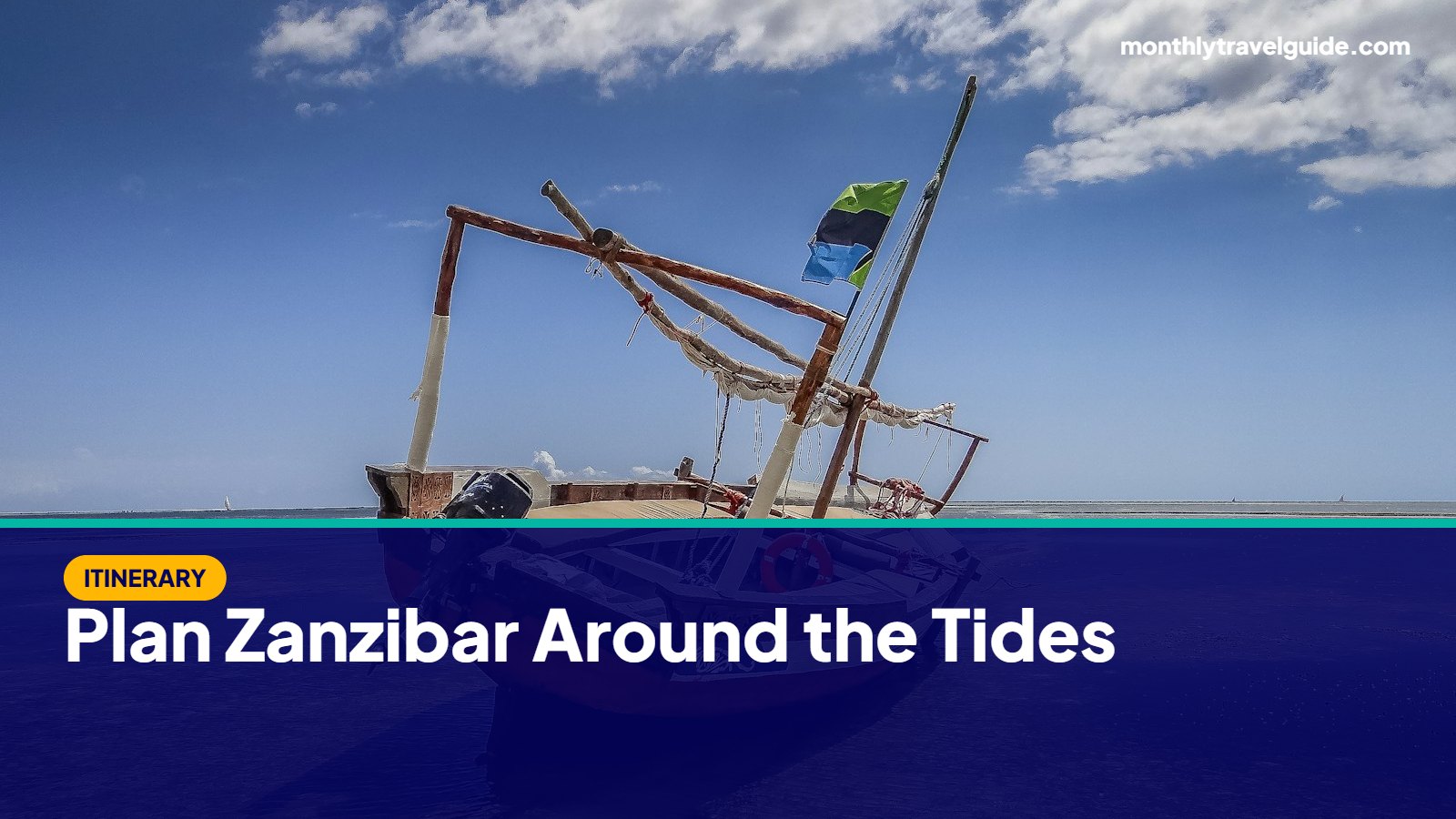
A good Zanzibar itinerary splits your days between Stone Town, the forests and farms of the interior, and one or two beach coasts, and it puts each beach day where the tide works for you. Five days covers the essentials, seven gives the island a proper rhythm, and ten lets you add the far north, a snorkel trip to Mnemba or a safari on the mainland. The best months are June to October, with January and February a hot second choice. April and May bring the long rains, so the season you pick shapes the route as much as the stops do.

Quick answer
How many days do you need in Zanzibar?
Five days covers Stone Town, a spice farm, Prison Island, Jozani Forest and one beach coast. Seven days is the sweet spot for most first visits, because it adds a second coast without long transfers. Ten days suits travellers who want Mnemba snorkelling, a quieter south-coast stay or a safari on the mainland before the island.
Key facts
- Is 7 days in Zanzibar too long? Not for most travellers. Seven days gives you two nights in Stone Town, three on the east coast and two in the north, with time to plan beach days around the tides.
- What is the best month to visit Zanzibar? July, August and September are the driest months, with about 50 mm of rain each and highs of about 29 to 30 °C.
- Is it better to stay in the north or the east of Zanzibar? Stay in the north if you want to swim at any time of day, because tides there are small, and for sunsets over the sea.
- Should I start a Zanzibar itinerary in Stone Town? Yes, for most trips. Flights and ferries arrive near Stone Town, and its sights, the spice farms and Prison Island are all close by.
Pick your length, then your months
Three ways to plan Zanzibar
5 days
Essentials
Stone Town, spice farm, Prison Island, Jozani, one east-coast base
Best: Jun to Oct7 days
The classic
Adds a second beach: the east coast for space, the north for all-tide swimming
Best: Jun to Oct, Jan to Feb10 days
Slow or wild
Adds Mnemba snorkelling, a quiet south-coast stretch or a mainland safari
Best: Jul to SepAvoid: April and May (long rains) · Watch: November and December (short rains)
Short answer
Spend two nights in Stone Town for the old town, a spice farm and Prison Island, then visit Jozani Forest on the way to the east coast. Add the north for a seven-day trip, and Mnemba or a safari for ten. Go between June and October, put sightseeing on low-tide days and keep beach mornings for high tide.
Key takeaways
July, August and September are the driest months, with about 50 mm of rain each in long-term averages.
April is the wettest month, with about 385 mm, and May still brings about 255 mm.
Zanzibar has two high and two low tides a day, and the times move later each day.
The east coast has the biggest tides; Kendwa in the north is swimmable for most of the day.
Stone Town to Nungwi takes about an hour by road; Nungwi to Paje takes 1.5 to 2 hours, because no road runs straight along the coast.
Jozani’s red colobus lives only on Zanzibar’s main island, Unguja.

How Tides Shape a Zanzibar Itinerary
This section explains the one thing most route plans forget. On much of Zanzibar’s coast, the sea doesn’t sit still: it pulls back across the reef flats and returns twice a day, and that decides when you swim, when you snorkel and when you’d be better off in Stone Town.
Zanzibar has two high and two low tides a day, about 12 hours 25 minutes apart, so each low tide arrives a little later than the day before. The biggest swings come around the new moon and the full moon, when the pull of the sun and moon combine (Altezza Travel). In practice, a beach that’s perfect at 10 am this week may be a wide, rocky flat at 10 am next week.
| Coast | Tide effect | Plan it as |
|---|---|---|
| East coast (Paje, Jambiani, Bwejuu, Michamvi) | Large; the water can pull far out across the reef flat | Swim near high tide; walk the flats, visit seaweed farms or take day trips at low tide |
| Chwaka Bay | The largest; low tide can expose up to about 1.5 to 2 km of seabed | A base for quiet, not for swimming on your own schedule |
| North (Kendwa, Nungwi) | Small; Kendwa is swimmable for most of the day, Nungwi’s tip pulls back more | All-tide beach days; sunset at the beach |
| South (Kizimkazi) | Moderate | Dolphin and reef trips by boat, timed with the operator |
| Stone Town | Less pronounced | Sightseeing; swim elsewhere |
🗓️ Free: the 12-Month Map for Tanzania & Zanzibar
Every month on one page: best weeks, shoulder weeks and the ones to skip. Print it or keep it on your phone.
Source: Altezza Travel, Zanzibar tides. The rule that follows is simple. Book the east coast for space and long beach walks, and the north if you want to swim whenever you like. On the east coast, put your sightseeing days on the dates when low tide falls in the middle of the day, and keep high-tide mornings or afternoons for the sea.
Tip
Snorkelling at Mnemba works best around high tide, so book the trip for a morning when the tide is rising. Morning trips also tend to have calmer water, because the wind builds through the day.
🧰 Try it while you read: a free tool for this trip
Free trip timing tool
Trip Length Calculator
Work out how many days you need for the regions you want to see.
Loading the tool…
7-Day Zanzibar Itinerary, Day by Day
This section gives the full one-week route, the version that suits most first visits. It runs from the history of Stone Town to the forest in the middle of the island, then out to the east coast and up to the north, so the transfers stay short and the last days are slow ones.
The order is deliberate. Stone Town comes first because the island’s flights and ferries arrive there, and two nights let you see the old town without rushing. The spice farm and Jozani share a day because both sit inland, on the way to the east coast, so they cost no extra driving. The north comes last because its beaches stay swimmable at most tides, which makes it the safest place to end a trip on fixed flight times.
Stone Town: days 1 and 2
Stone Town is a World Heritage site that UNESCO describes as an outstanding example of a Swahili trading town, with architecture that blends African, Arab, Indian and European influences. Key buildings include the Old Fort, the House of Wonders built by Sultan Barghash, the two cathedrals and houses of coral rock and mangrove timber with carved doors (UNESCO). Go early, before the heat builds, and hire a licensed local guide if you want the history behind each building.

The Smart Timing Bundle
Pick the month, book in the right order, pack once
Six printable timing tools for any trip: the Trip Timing Planner, When to Book, When NOT to Go, the Shoulder Season Playbook, the family timing guide and the Packing by Season System.
See the bundle · $37Six products, $100 separately · Digital download · All sales final
Prison Island, also called Changuu, is about 25 minutes by small boat from Stone Town. Its giant tortoises are Aldabra tortoises that first arrived as a gift from the Seychelles in the colonial era, and the island’s prison building was used as a quarantine station rather than a jail (Atlas Obscura). Plan two to three hours including the boat.

Spice farm and Jozani: day 3
A spice farm tour takes half a day inland from Stone Town. Guides show cloves, cinnamon from tree bark, vanilla from a climbing orchid, nutmeg with its red mace, ginger, cardamom and black pepper, and most tours end with fruit tasting. Cloves arrived under Omani rule in the 19th century and made the island one of the world’s main clove producers, a wealth built largely on enslaved labour (Expert Africa).
Jozani Forest lies about 35 to 40 km south-east of Stone Town, about an hour by car, inside Jozani Chwaka Bay National Park. Its star is the Zanzibar red colobus, also called Kirk’s red colobus, a monkey found only on Unguja, with an estimated 5,000 to 6,000 left. A visit usually ends on a wooden boardwalk through the mangroves. Keep at least 3 metres from the monkeys (Altezza Travel; Tanzania Tourism).

Note
Jozani is close to the east coast, around 40 to 45 minutes by car from Jambiani. That’s why it works best on the transfer day: see it in the late afternoon, when the monkeys are most active, and reach your beach base before dark.
5-Day Zanzibar Itinerary: The Essentials
This section is for a short trip, often added to the end of a safari. Five days is enough for Stone Town, the interior and one beach coast, but not two coasts without losing a day to the road.
| Day | Plan | Sleep |
|---|---|---|
| 1 | Arrive; evening walk in Stone Town | Stone Town |
| 2 | Old town morning; Prison Island afternoon | Stone Town |
| 3 | Spice farm; Jozani in the late afternoon; drive to the coast | East coast or north |
| 4 | Beach day timed to the tide | Same base |
| 5 | Morning swim; airport | Fly out |
Pick one coast only. If you’re coming straight from the bush and just want to swim, choose the north, where the tide matters least. If you want space, kitesurfing or long walks on the sand, choose the east coast and check the tide table before you book the trip, so your two beach days don’t fall on spring tides with the water out all morning.
10-Day Zanzibar Itinerary: Add the Reef or the Bush
This section shows how to use extra days. Ten days lets you slow down, add one more coast and fit in the trips that need good weather and calm seas.
Option A
Reef and beaches
Follow the seven-day route, then add two nights near Matemwe on the north-east coast for a morning boat to Mnemba Atoll, under 30 minutes away, plus a spare day for weather.
Option B
South coast and slow days
Add three nights on the quieter south and south-east coast. Kizimkazi is about 45 minutes from Stone Town, and the days here suit reading, village walks and boat trips.
Option C
Safari and beach
Start with three or four days on a mainland safari, then fly to the island for a compressed six or seven-day Zanzibar week.
Mnemba Island itself is private and you can’t land on it, but you can snorkel and dive the reefs around it, part of a marine conservation area with a visitor fee. The dry season from June to October has the calmest seas and clearest water, while the long rains often cancel trips (Nomado). For the bush half of option C, read our guides to the Great Migration river crossings and the Tanzania safari in September.
| Length | Best months | How to split the nights | Best for |
|---|---|---|---|
| 5 days | June to October | 2 Stone Town, 3 on one coast | After a safari; short breaks |
| 7 days | June to October; January and February | 2 Stone Town, 3 east coast, 2 north | First visits |
| 10 days | July to September | 2 Stone Town, 3 east, 2 north-east, 3 north or south | Snorkelling, families, honeymoons |
Best Months for Each Zanzibar Itinerary
This section covers timing month by month. Zanzibar is hot all year, so the deciding factors are rain, wind and sea conditions, and those change sharply between the dry, cooler middle of the year and the two rainy seasons.
Month verdicts for a Zanzibar itinerary
Average high °C · monthly rainfall
Jan
33° · 85 mm
Hot, mostly dry; kite wind
GoFeb
33° · 55 mm
Hot; Stone Town music festival
GoMar
33° · 150 mm
Humid; rains begin
Go with careApr
31° · 385 mm
Wettest month
SkipMay
30° · 255 mm
Long rains continue
SkipJun
29° · 70 mm
Dry season starts
GoJul
29° · 50 mm
Dry, breezy, busy
GoAug
30° · 50 mm
Dry; peak demand
GoSep
30° · 50 mm
Dry, calm seas
GoOct
31° · 95 mm
Mostly dry; quieter
GoNov
31° · 215 mm
Short rains
Go with careDec
32° · 185 mm
Showers; holiday rush
Go with careLong-term averages from Climates to Travel. Any single year can be wetter or drier.
According to Climates to Travel, rain drops to about 70 mm in June and about 50 mm a month from July to September, then climbs to about 215 mm in November and peaks at about 385 mm in April. Highs stay between about 29 °C and 33 °C all year. The sea is warmest, at about 29.5 °C, in March and April, and coolest, at about 25.5 °C, in August and September. The site rates July, August and September as the best months, with June close behind.

The complete kit
Every country guide, every timing tool
All 24 When to Go country guides, the six Smart Timing tools and every 12-Month Map, with a Start Here that tells you what to open first.
See the kit · $127The five bundles cost $225 separately · Digital download · All sales final
Wind matters on the east coast. The north-east kaskazi blows from about mid-December to March, mostly at 12 to 16 knots, and the stronger south-east kusi from June to October, mostly at 15 to 18 knots. Wind tends to drop in April and May and from late October to early December (Kitemana). That’s good news for kitesurfers in the dry season, and a reason to pick a sheltered beach if you just want flat water. For the full year in one place, see our guide to the best time to visit Zanzibar.
If you want: Calm seas for snorkelling
Go from June to October, and book Mnemba for a morning.
If you want: Kitesurfing
Go in January and February or from June to August, when the trade winds are steady.
If you want: Live music
Go in February, when the Sauti za Busara festival usually fills Stone Town (Busara Music).
If you want: Fewer visitors
Go in early June or in October, at the edges of the dry season.
If you want: A festive trip
December works, with showers; see Tanzania and Zanzibar in December.
When Not to Run This Itinerary
This section is the honest part. Zanzibar is open all year, but some weeks undo a plan built around boats, beaches and outdoor walks.
| Avoid | Why | Do this instead |
|---|---|---|
| April | About 385 mm of rain over about 18 days; heavy downpours and flooding | Go in late June or July |
| May | Long rains continue; boat trips are often cancelled | Go from mid-June |
| Spring tides on a short east-coast stay | Around new and full moon the water goes furthest out | Base yourself in the north or shift the dates |
| Late December | Short-rain showers plus holiday demand | Go in late January or February |
| Ramadan, if food is the focus | Many local cafes close by day; the date moves each year | Check the dates and plan hotel meals |
Rain figures from Climates to Travel. Run any dates through the free When Not to Go checker, and use the Best Month Finder to compare the dry months.
Getting Around and Planning the Days
This section covers the practical side: roads, transfers and how to fit the day trips around the tides.
The island is about 85 km long and 30 km wide. Stone Town to Nungwi takes about an hour, Stone Town to Paje or Jambiani 45 to 60 minutes, and Nungwi to Paje 1.5 to 2 hours, because there’s no direct coast road between the north and the south-east (Nomado). Local dala-dala minibuses are cheap but slow and leave when full, so most visitors use pre-booked transfers on moving days.
Book the day trips that depend on the sea first: Mnemba around high tide, dhow sunsets in the north, lagoon kite lessons on the east coast. Then fill the low-tide days with the dry-land trips, Stone Town, the spice farm and Jozani.

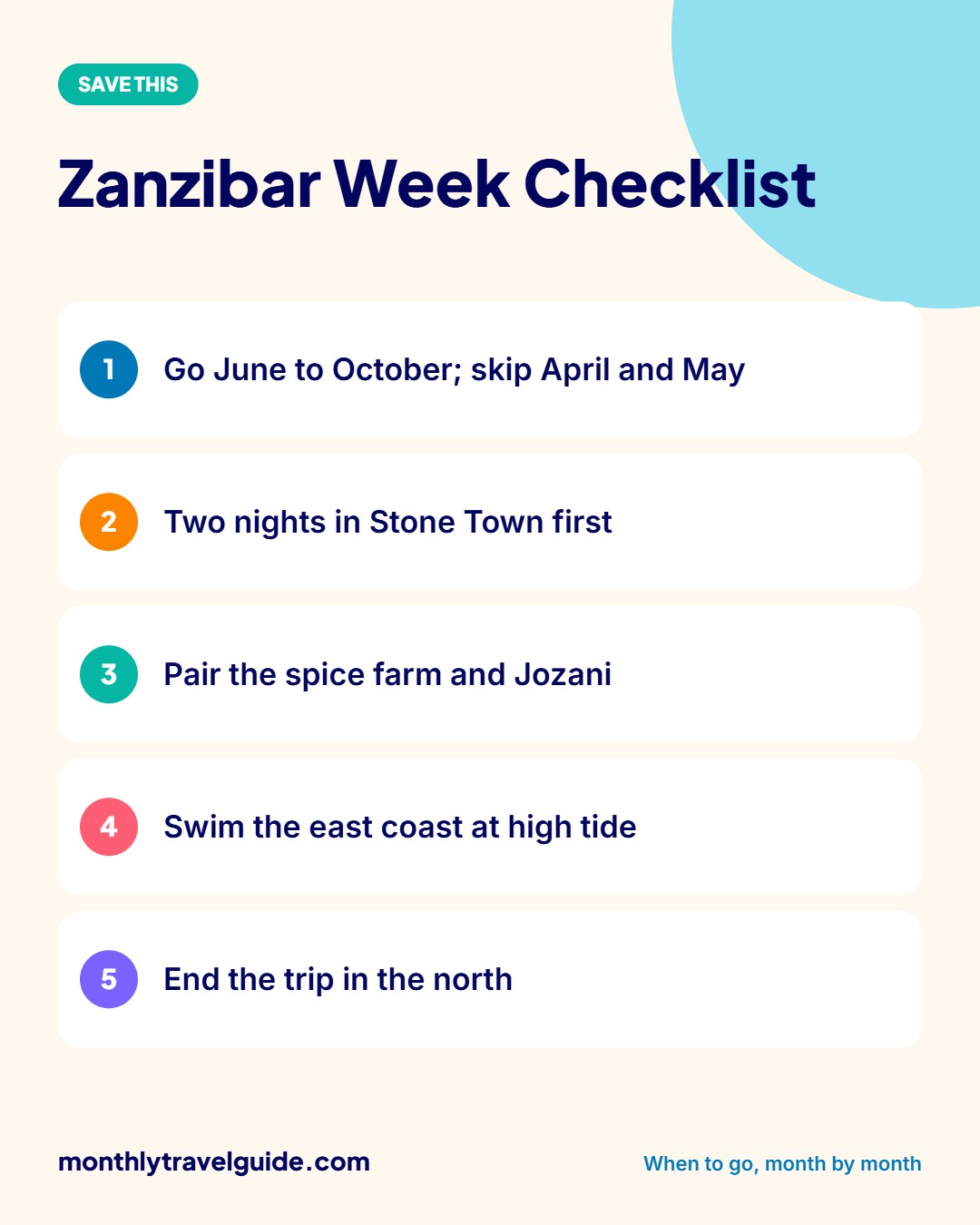
Save the card below for the week in one view.
Important
Pack reef shoes for the east coast. At low tide the flats hide sea urchins, sharp coral and seaweed farms, and you’ll walk a long way to reach water deep enough to swim. The free packing generator builds a list for the season you choose.
5 Common Mistakes on a Zanzibar Itinerary
1. Booking the east coast without checking the tides
The sea in Paje or Jambiani can sit far out for hours, but it comes back twice a day. Check the tide table before you book and plan beach time around high water.
2. Splitting the trip across too many bases
Every move between the north and the south-east costs up to two hours on the road. On five days, pick one coast. On seven, two bases is the most that still feels relaxed.
3. Visiting Jozani at midday
The red colobus is most active in the early morning and late afternoon. A midday visit in the heat often means sleepy monkeys high in the trees.
4. Coming in April without a backup plan
April is the wettest month, and boat trips can be cancelled for days. If those are your only dates, base yourself in Stone Town and keep the trips flexible.
5. Leaving the north for the first night
The north’s all-tide beaches make it the easiest place to finish a trip. Starting there and ending on a low-tide east-coast morning puts your last swim at risk.
Zanzibar Itinerary FAQ
How many days do you need in Zanzibar?
Five days covers Stone Town, a spice farm, Prison Island, Jozani Forest and one beach coast. Seven days is the sweet spot for most first visits, because it adds a second coast without long transfers. Ten days suits travellers who want Mnemba snorkelling, a quieter south-coast stay or a safari on the mainland before the island.
Is 7 days in Zanzibar too long?
Not for most travellers. Seven days gives you two nights in Stone Town, three on the east coast and two in the north, with time to plan beach days around the tides. If you only want a beach, five days is enough, but a week lets you see the history and the forest without rushing from place to place.
What is the best month to visit Zanzibar?
July, August and September are the driest months, with about 50 mm of rain each and highs of about 29 to 30 °C. June and October are also good and a little quieter. January and February are hot but mostly dry. April is the wettest month by far, with about 385 mm of rain on average.
Is it better to stay in the north or the east of Zanzibar?
Stay in the north if you want to swim at any time of day, because tides there are small, and for sunsets over the sea. Stay on the east coast for space, quiet villages and kitesurfing, but plan beach time around high tide. A seven-day trip can include both, ending in the north.
Should I start a Zanzibar itinerary in Stone Town?
Yes, for most trips. Flights and ferries arrive near Stone Town, and its sights, the spice farms and Prison Island are all close by. Seeing them first leaves the rest of the week for the beaches. The only exception is a trip straight from a safari, when you may want a few beach days before the town.
Can you visit Jozani Forest and a spice farm on the same day?
Yes. Both sit inland between Stone Town and the east coast, so a spice farm in the morning and Jozani in the late afternoon fits one day with time to spare. Plan it as the transfer day to the coast, and you’ll arrive at your beach base by the evening without an extra drive.
The Bottom Line
The best Zanzibar itinerary starts in Stone Town, uses the transfer day for the spice farm and Jozani, then moves to the beaches with the tide table in hand. Go between June and October, avoid April and May, and keep the north for the end of the trip. For more island guides, read visiting Zanzibar or browse our Zanzibar travel guides.
Rains, winds, herds and crowds
Time the island and the safari before you book
When to Go: Tanzania & Zanzibar sets out the best and worst weeks for every part of the trip. Combining Zanzibar with Morocco, Egypt or South Africa? The Sun, Souks & Safari Bundle covers those countries too.
Free download
The 12-Month Map, free
The whole year for one country on four printable pages, so you can see the right months before you read anything else.
- Good, shoulder and avoid months at a glance
- Region by region, not one average for the whole country
- Prints cleanly on US Letter
Your download page opens as soon as you sign up. 24 countries available.