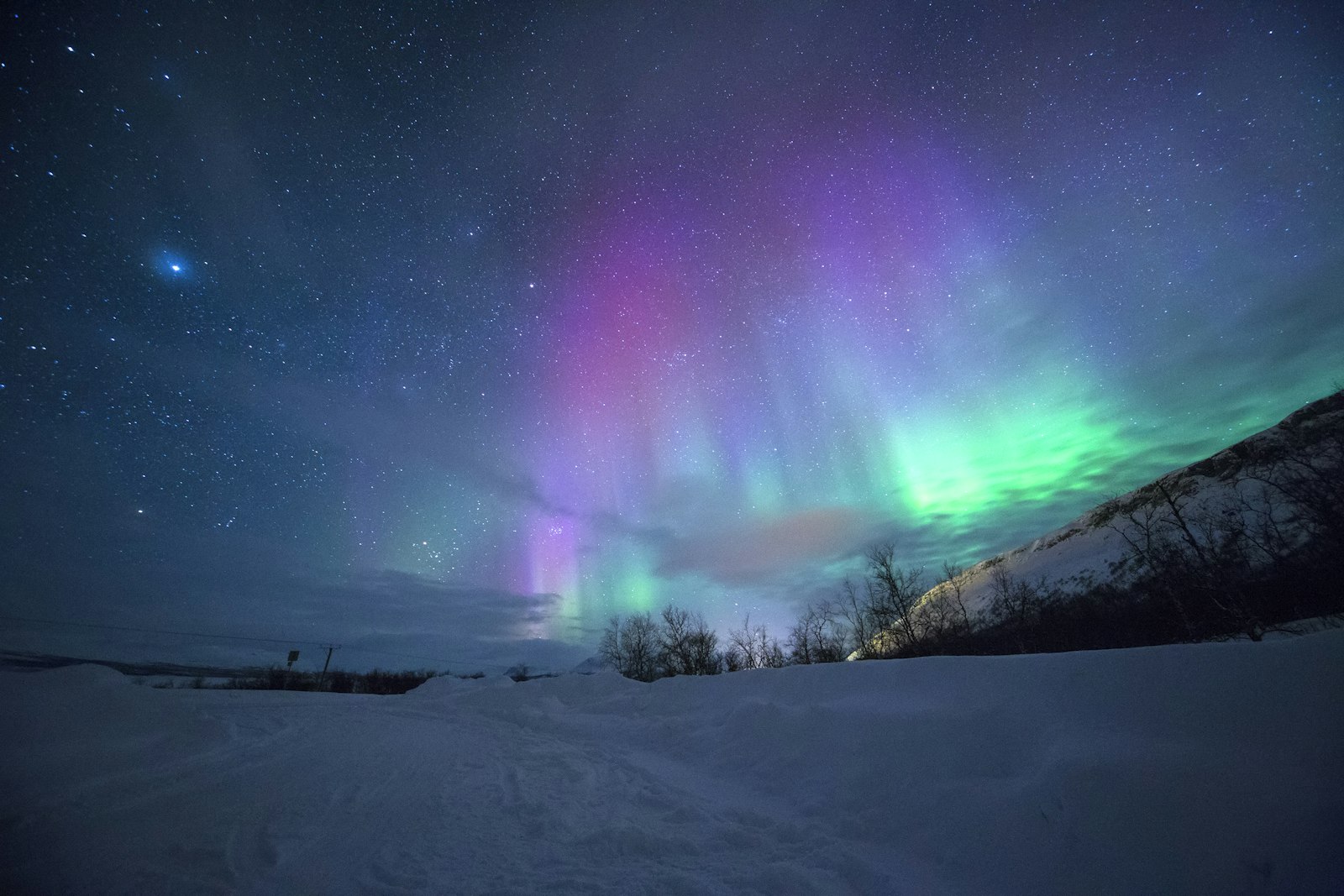
The northern lights in Norway in February come with a bonus you don’t get earlier in winter: daylight. In Tromsø the polar night ends in mid-January, and by the end of February the city has around nine and a half hours of light, while nights are still long and dark enough for the aurora. That makes February one of the best months to pair aurora evenings with husky rides, fjord drives and snowy hikes by day. This guide covers where to stay, what the weather really means for your chances, how to read the forecast each evening, the events that fill the calendar, and what to book first.

When to Go guides
Choose your country, then your month
24 country guides, each about 100 pages: every month rated for weather, crowds and prices, region by region, with a 7-day booking plan. Six guides per region bundle.
Browse the 24 guides · $19 eachRegion bundles: Europe, Asia & Pacific, Sun Souks & Safari, Americas · $47 each
Quick answer
Where and how can you see the northern lights in Norway in February?
The northern lights in Norway in February are best seen above the Arctic Circle in Tromsø, Alta, Senja or Lofoten, where nights stay long and dark. Clear sky matters more than location: Alta is drier, while Tromsø has the most tours and flights. Stay three or four nights, check the cloud forecast each afternoon and book early.
Key facts
- Norway’s aurora season runs from roughly late September to early April.
- Tromsø’s daylight grows from about five hours to about nine and a half in February.
- Alta gets about 30 mm of February precipitation, against about 95 mm in Tromsø.
- Whale-watching tours from Tromsø usually end around 31 January.
- February is peak season in Tromsø: book rooms and tours early.
- Tromsø averages −0.7 °C by day and −5.7 °C at night in February.
Seeing the northern lights in Norway in February works best above the Arctic Circle in Tromsø, Alta, Senja or Lofoten, where nights are long and dark from early evening until early morning Clear sky matters more than location: Alta’s drier inland climate gives it an edge on cloudy coastal weeks, while Tromsø offers the most tours and flights. Stay at least three or four nights, check the cloud forecast each afternoon and book rooms early, because February is peak season.
✅ Key takeaways
- ✓February sits well inside Norway’s aurora season, which runs from roughly late September to early April.
- ✓Daylight grows fast: Tromsø goes from about five hours on 1 February to about nine and a half by the end of the month.
- ✓Alta is drier and more continental than the coast, with about 30 mm of precipitation in February against about 95 mm in Tromsø.
- ✓Whale-watching tours from Tromsø usually end around 31 January, so February is for aurora, snow and Sámi culture rather than orcas.
- ✓February is peak season in Tromsø: book rooms and tours early and avoid the priciest mid-month holiday weeks if you can.
Why February Is a Strong Month for the Northern Lights in Norway
The aurora is out there whenever the sky is dark and clear; what changes through the winter is how much darkness you get and what you can do in the daytime. In December and early January, northern Norway is in the polar night and days are blue twilight. By February the sun is back above the horizon, the snow is deep, and you still have twelve or more hours of darkness every night.
≈5 hrs
daylight in Tromsø on 1 February
≈9.5 hrs
daylight by 28 February
−0.7 / −5.7 °C
Tromsø average high / low
≈30 hrs
sunshine in Tromsø in the whole month
| Date (Tromsø) | Sunrise | Sunset | Daylight | What it means |
|---|---|---|---|---|
| 1 February | ≈09:25 | ≈14:31 | ≈5 hours | Short daytime outing, long aurora evening |
| 28 February | ≈07:15 | ≈16:39 | ≈9.5 hours | A full day out plus a dark night |
🗓️ Free: a 12-Month Map for your country
Every month on one page: best weeks, shoulder weeks and the ones to skip. Print it or keep it on your phone.
Civil twilight adds at least another hour at each end of the day. The catch is the weather: Tromsø averages about 95 mm of precipitation across 13 days in February and only around 30 hours of sunshine in the month. Cloud is your biggest enemy, not the aurora itself, which is why where you stay and how flexible you are matter so much.
🧰 Try it while you read: a free tool for this trip
Free trip timing tool
Northern Lights Window
Check whether your month falls in the aurora season our guides describe.
Loading the tool…
Where to See the Northern Lights in Norway in February
All four bases below sit above the Arctic Circle, under the auroral zone. The real difference between them is weather, access and what you do by day.
| Base | February weather | Why go | Best for |
|---|---|---|---|
| Tromsø | −0.7 / −5.7 °C, about 95 mm, 13 wet days | Biggest choice of flights, tours and restaurants | First-timers, short trips, no car |
| Alta | −3.6 / −10.3 °C, about 30 mm, 8 wet days | Drier, more continental climate | Clearer-sky odds, igloo hotel |
| Senja | Coastal, similar to Tromsø | Wild fjords and peaks, few people | Self-drivers, photographers |
| Lofoten | Milder (about −5 to 3 °C), frequent storms | Mountains rising from the sea, fishing villages | Scenery, photography, longer stays |
Tromsø: the easiest base
Tromsø is where most aurora trips start, and for good reason: it has the most flights, the widest choice of guided aurora chases, and plenty to do on cloudy nights. Guided tours earn their price here because the guides watch the cloud forecast and drive to wherever the sky is clearest, sometimes a long way out of town. By day, the city is a base for dog sledding, reindeer visits with Sámi hosts and snowshoe walks. February is a peak month, so expect higher prices and book early.
Alta: the dry-weather choice
Alta, in Finnmark, has a relatively dry climate compared with the west coast; climate data describes it as more continental and arid than Tromsø, Hammerfest or the North Cape. In February that means about 30 mm of precipitation over eight days, against roughly 95 mm in Tromsø, but also colder air, with average lows around −10 °C. The town is home to the Northern Lights Cathedral, a modern church whose lines are inspired by the aurora’s spirals, and the Sorrisniva Igloo Hotel. The long-distance Finnmarksløpet dog-sled race usually takes place in March.

The Smart Timing Bundle
Pick the month, book in the right order, pack once
Six printable timing tools for any trip: the Trip Timing Planner, When to Book, When NOT to Go, the Shoulder Season Playbook, the family timing guide and the Packing by Season System.
See the bundle · $37Six products, $100 separately · Digital download · All sales final
Senja: wild scenery for self-drivers
Senja, Norway’s second-largest island, is the scenic alternative to Tromsø, with jagged peaks dropping into the sea and very few lights. Tungeneset looks across the water to the Okshornan peaks, and Bergsbotn has a 44-metre viewing platform over the fjord. The drive from Tromsø takes several hours depending on your route, and in winter the roads can be narrow, icy and affected by storms, so this is for confident winter drivers or guided trips. Stay two nights or more to make the journey worthwhile.
Lofoten: mountains, sea and stormier weather
Lofoten sits in warm Gulf Stream waters, so it is much milder than most of the Arctic, with temperatures often between about −5 and 3 °C. The “real” winter there usually runs from January to mid-March, and the northern lights can be seen from September to March. The trade-off is weather: storms are frequent and can disrupt transport, so allow extra time and buy good travel insurance, as the official Visit Norway guide to Lofoten in winter advises. February is also the start of the skrei season, when Arctic cod arrive to spawn and fishing villages hang the catch on drying racks. Our full Lofoten Islands travel guide covers the islands in more depth.
When to Book
February is a peak month in northern Norway, and the best-located rooms and small-group tours go first. When to Book shows how far ahead to book flights and stays, which dates push prices up and how to plan around peak weeks, so you lock in the right February dates without overpaying.
See When to Book · $19 →Digital download · All sales final
How to Read the Sky: A Simple Evening Routine
Your chances come down to two things at the same moment: auroral activity and a clear patch of sky. In February, the clear sky is usually the harder part. Use this routine each day of your trip.
Afternoon: check the cloud forecast
Look at the local cloud-cover forecast for the evening hours. If the coast is cloudy and inland is clear, that tells you where tours will head.
Early evening: check the activity
An aurora forecast or app gives you the activity level. Treat it as a guide, not a promise, and read it together with the cloud.
Decide: tour, self-drive or stay put
If the sky looks mixed, a guided chase gives you the best odds. If it’s clear overhead, a short walk away from streetlights may be enough.
Dress for standing still
Displays come and go. Dress for an hour or more outside with layers, an insulated jacket, warm boots, a hat and mittens.
Give it several nights
One cloudy night is normal. Three or four nights give you several chances for a clear one.
Our free Northern Lights Odds tool compares months at a glance, and if you’re deciding between seasons, see what changes with the northern lights in September or the northern lights in March, when days are longer still.
February Events in Northern Norway
February isn’t just about the sky. A few events shape the month, especially in Tromsø:
- Nordlysfestivalen (Northern Lights Festival), usually late January into early February: a Tromsø music festival covering early music to opera, jazz, chamber and symphonic concerts, a good plan for cloudy evenings.
- Sámi National Day, on 6 February: celebrated across the north, with a week of events in Tromsø around it, usually including reindeer racing. Restaurants get busy, so reserve ahead that day.
- Skrei season, usually from February: in Lofoten, the Arctic cod arrive to spawn and the fishing villages are at their busiest.
- Finnmarksløpet, usually in March: Alta’s long-distance dog-sled race, worth knowing if your trip runs into early March.
In February, the aurora isn’t the hard part. The clear sky is. Give yourself the nights to find it.
A 5-Night February Plan: Tromsø Plus Senja or Alta
Night 1 · Arrive in Tromsø
Settle in, walk the centre in the afternoon light and join a guided aurora chase if the forecast is promising.
Day 2 · Huskies or reindeer
Spend the daylight on a dog-sled or reindeer trip with Sámi hosts, then keep the evening free for the sky.
Day 3 · Out to Senja (or fly to Alta)
Self-drivers head to Senja for two nights of dark skies. Without a car, take a short flight to Alta for drier weather.
Day 4 · Scenery by day, aurora by night
Senja’s viewpoints or Alta’s cathedral and igloo hotel by day; step outside after dark wherever you are staying.
Day 5 · Back to Tromsø
Return for your last night, with one more chance at the sky and a festival concert or museum as the cloudy-night backup.
Comparing with Iceland? Our guide to Iceland in January covers a similar trip further south, and our Svalbard polar expeditions guide is for those who want to go further north still.
When Not to Go: Timing Traps for a February Aurora Trip
February is a good month, but a few things catch people out. You can also check whether your month is a bad one for any destination or browse the When NOT to Go hub.
| Trap | Why it matters | What to do |
|---|---|---|
| Wanting whales and aurora together | Tromsø whale-watching tours usually end around 31 January | Go between November and January for both |
| Mid-February holiday weeks | February is a peak month; flights cost more around UK half-term | Travel in the first or last week of February |
| Lofoten on a tight schedule | Frequent winter storms can disrupt transport | Allow buffer days or choose Tromsø or Alta |
| Leaving it to April | By 1 April the sky in Lofoten is too bright for the aurora | Go by March at the latest |
Packing for the Northern Lights in Norway in February
Tromsø’s February averages are just below freezing, but inland tours can be far colder, and wind chill makes the coast feel colder still. Pack a merino base layer, a fleece mid-layer, an insulated, windproof jacket and trousers, warm waterproof boots with good grip, a hat, a neck warmer and mittens with thin gloves underneath for your phone. Microspikes help on icy pavements. Our winter packing list covers the layer system, and the Packing by Season Generator builds a list for your trip length.
5 Mistakes That Cost People the Northern Lights
1. Booking only two nights
Cloud can sit over the coast for a day or two. Three or four nights, ideally with one in a drier inland area, give you far better odds.

The complete kit
Every country guide, every timing tool
All 24 When to Go country guides, the six Smart Timing tools and every 12-Month Map, with a Start Here that tells you what to open first.
See the kit · $127The five bundles cost $225 separately · Digital download · All sales final
2. Watching the activity number and ignoring the cloud
High activity behind thick cloud means nothing. Check the cloud forecast first.
3. Staying in the brightest part of town
City lights wash out faint displays. A short trip away from streetlights, or a rural stay, makes a big difference.
4. Under-dressing for waiting outside
Most aurora watching is standing still in the cold. Dress for an hour outside, not a five-minute walk.
5. Booking late for a peak month
Good rooms and small-group tours fill early for February. Lock in the bed and the first-night tour before anything else.
Northern Lights in Norway in February: Your Questions
The northern lights in Norway in February reward patience more than luck: pick a base above the Arctic Circle, give yourself several nights, read the cloud forecast every afternoon and book early for a peak month. For more ideas, browse our best travel destinations in February, more Norway travel guides, our pick of romantic winter getaways in February, the best cold-weather destinations in February, or plan any month from the month-by-month travel planner.
Still choosing? Compare all the options in where to go in February, rated by real weather and crowds.
Free download
See the whole year before you book
Our free 12-Month Map puts every month for one country on four pages: when the weather works, when the crowds and prices peak, and the weeks to skip.
- 24 countries to choose from
- Region-by-region verdicts
- Printable PDF
Your download page opens as soon as you sign up. 24 countries available.