

Flights, stays, permits, insurance, trains, tables. Seven decisions, one correct sequence — and four hard deadlines that decide it for you.
You’ve got four tabs open, a rough set of dates, and the creeping suspicion you’re about to do this in the wrong order. That suspicion is correct more often than not. Figuring out what to book first when planning a trip isn’t fussy optimisation — it’s the difference between a trip that costs what you expected and one that quietly bleeds $200 to $600 through locked dates, missed refund windows and sold-out permits. Here’s the exact sequence, the deadlines that force it, and the one situation where the whole order flips.
Book in this order: confirm passport validity and entry rules, lock your travel window, buy flights, reserve accommodation with free cancellation, grab anything with a hard capacity cap (permits, timed entry, sleeper trains), buy travel insurance within two weeks of your first payment, then ground transport, then restaurants. Flights come early because they’re the least flexible and most volatile price in the whole trip. Everything after them is reversible.
Disclosure: Some links on this site are affiliate links for booking platforms and travel gear. If you book or buy through them, we may earn a small commission at no extra cost to you. It never changes the order we recommend or the tools we name.
What to Book First When Planning a Trip: The 7-Step Order That Never Breaks

The correct sequence runs from least flexible to most flexible, and every step exists because something downstream depends on it. Most planning advice hands you a checklist. A checklist doesn’t tell you what happens when step four contradicts step two — this does.
Open your passport and read the expiry date out loud. Many countries want six months of validity beyond your arrival; the Schengen area wants at least three months beyond your planned departure and a passport issued within the last ten years. Then check whether your nationality needs a visa or an electronic travel authorisation. This step costs nothing and takes eleven minutes.
Decide the month and a flexible five-day band inside it. Not “14–21 October” — “mid-October, ideally a Tuesday-to-Tuesday.” That flexibility is worth real money in the next step, and it’s the last moment it costs you nothing to keep.
Seats on a specific aircraft on a specific day are a genuinely fixed supply. Hotel rooms aren’t. Buy the flight and the trip acquires a spine — every later decision now has a fixed anchor to hang off.
Within 48 hours of buying flights, reserve a bed on a refundable rate. You’re not buying a hotel yet. You’re buying certainty that you won’t sleep in a train station, with the right to change your mind for free.
Permits, timed-entry palace and museum slots, sleeper-train berths, small-boat crossings, twelve-seat cooking classes. If a fixed number of humans per day can do it, it belongs here — ahead of anything replaceable.
Buy it while the flight receipt is still on screen. The strongest benefits are tied to a countdown that starts at your first trip payment, not at departure. Wait a month and you’re buying a thinner product for the same money.
Airport transfers, car hire, regional trains, day tours, restaurant tables, seat selection. Cheap to change, rarely scarce, and much easier to judge once the rest of the trip has shape.
Steps 3 and 4 should happen in the same sitting. The gap between “flights bought” and “somewhere to sleep confirmed” is where people lose evenings to second-guessing. Give yourself ninety minutes, do both, close the laptop.
The 6-Month Countdown: Which Deadline Bites on Which Week

Every step above has a real-world clock attached, and three of those clocks are set by institutions that don’t care about your dates. Put this table into your notes app and work backwards from your departure.
Morocco runs on six clocks, not one. The full guide works each region out separately, then shows you where the answers overlap.
Read what's inside
Two of those rows come straight from the agencies themselves. The U.S. State Department publishes current passport processing times — routine at 4–6 weeks, expedited at 2–3 weeks for an extra $60 — and is explicit that mailing time sits outside those figures, adding up to two weeks on each end. It also notes that demand peaks between late winter and summer, which is precisely when most people discover their passport problem.
The health row is the one people skip and then regret. The CDC’s pre-travel guidance asks you to see a provider at least four weeks before departure, because several travel vaccines need multiple doses spaced across weeks, and a single dose given three days before your flight is close to decorative. If your trip involves rural Southeast Asia, sub-Saharan Africa or the Amazon basin, treat six weeks as your real floor.



Why Booking the Hotel First Backfires (and the 20-Minute Fix)

Booking accommodation first feels like progress because it’s the part of the trip you can picture. That’s exactly why it’s a trap. The moment you commit to a hotel, you’ve committed to dates — and dates are the single biggest lever on airfare. You’ve spent your most valuable planning asset on your least valuable decision.
There’s a real exception, and it’s not “I found a nice place.” It’s supply. If your destination has genuinely thin accommodation — a small island, a national park gateway town, a village hosting a festival — then beds are scarcer than seats and the order flips. Everywhere else, the hotel can wait ninety minutes.
Before you buy anything, run this check. It takes twenty minutes and it catches the expensive surprises:
- Open a hotel search for your candidate week and note the median nightly rate for the neighbourhood and standard you’d actually accept. Write the number down.
- Shift the dates three days earlier, then three days later. If the median moves more than about 25%, something is happening in that city — a conference, a festival, a public holiday. Find out what before you buy a single ticket.
- Check availability, not just price. Fewer than roughly fifteen viable properties on your dates means real scarcity, and the order flips: reserve a refundable room now, buy flights afterwards.
- Add the nightly median × nights to your flight estimate. If that total already exceeds your budget, change the month rather than the standard — it’s the cheaper lever by a wide margin.
Once the trip is booked, the savings shift from timing to technique — rate types, loyalty status matching, room-category quirks and the small levers covered in our guide to hotel booking tweaks that cut the nightly rate. That’s a separate skill from sequencing, and it stacks on top of it.
Non-refundable hotel rates typically save 8–15%. Booking one before your flights is a bet that you’ll find acceptable airfare on exactly those dates. Lose that bet once and you’ve wiped out the savings from your next ten bookings.
The Flight Window Almost Everyone Gets Wrong
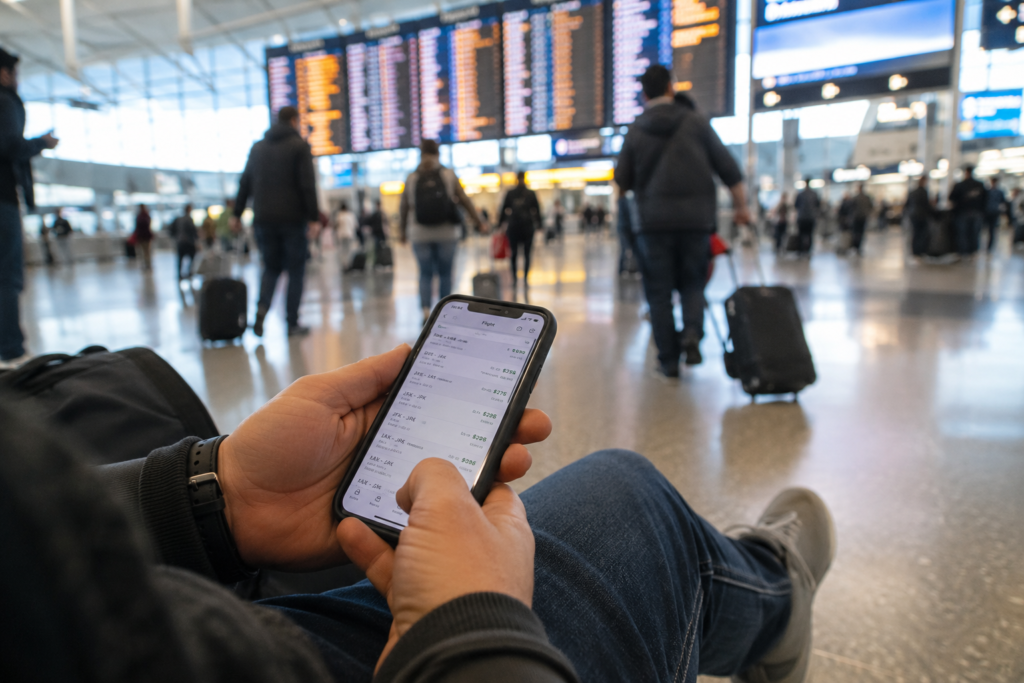
Booking earlier is not the same as booking cheaper, and the ticketing data has been saying so for years. Airlines withhold their deepest discount fare classes until they can see how a specific flight is filling, which means the earliest fares on sale are frequently conservative and high.
The ARC and Expedia ticketing analysis, drawn from one of the largest air-ticket databases in the industry, puts the domestic buying point at a minimum of 34 days before departure, worth up to 25% against last-minute purchase. For international flights, travellers who bought 18 to 29 days out saved up to 17% compared with those who booked more than two months ahead. The same dataset found Sunday the cheapest day to purchase, August the cheapest month to fly in economy, and March the priciest.
Now the part the headlines flatten. That 18-to-29-day international window is an average, and averages hide their outliers. It’s dominated by short and medium-haul leisure routes with lots of competing capacity. It does not describe a long-haul flight into peak season on a route with two carriers and one daily departure. Use the decision rule below instead of the average.
| If your trip is… | Then buy flights… | Because |
|---|---|---|
| Domestic, flexible dates | 34–86 days out, on a Sunday | Discount buckets are open and demand is still readable |
| Short-haul international, off-peak | 3–5 weeks out | Airlines discount unsold leisure seats late |
| Long-haul, peak season or school holidays | 4–6 months out | Limited capacity, price only moves upward |
| Fixed dates you cannot change | As soon as the fare is acceptable | You have no flexibility to trade for savings |
| Award seats using points | The day the schedule opens, 330–360 days out | Award inventory is capped per flight, not priced dynamically |
That last row is why points travel breaks every rule in this article. Award seats are a fixed allocation released the moment schedules load, so the cheap-fare logic inverts completely — a subject we unpack in our guide to using points and miles for near-free flights.
If your itinerary touches the United States and you book at least seven days before departure, U.S. Department of Transportation rules give you 24 hours to cancel for a full refund. That’s a free overnight to sanity-check dates against accommodation — use it every single time.
A month-by-month timing atlas scoring 50 countries on weather, crowds, cost and conditions, a crisis playbook for when a booking collapses mid-trip, and 150+ ready-to-paste AI prompts that turn a blank page into a costed itinerary. Built to sit beside the sequence on this page.
Book What Can Sell Out Before You Book What Can’t

The sharpest sorting rule in trip planning has nothing to do with price: it’s whether a thing has a headcount cap. Capped supply disappears on a schedule you don’t control. Elastic supply just gets more expensive, which is annoying but survivable.
Here’s the decision rule, and it’s blunt on purpose: if fewer than a few hundred people per day can physically do the thing, book it before your hotel. A room is a commodity with a hundred substitutes. A permit isn’t. I’ve watched people plan an entire trip around a single hike and then buy the flights first out of habit — arriving to find the permit window closed four months earlier.
Guided experiences deserve their own caution. Capacity caps are why the good operators sell out, but capacity isn’t quality — vet the operator before you commit money to a date, as our account of what happens when you hire the wrong tour guide makes uncomfortably clear.
“Book the irreplaceable before the replaceable. Everything else in trip planning is just an argument about money.”
Travel Insurance Has a Clock, and It Starts With Your First Payment

Insurance is the most commonly mis-sequenced purchase in travel, and the reason is a design detail almost nobody reads. Comprehensive policies carry two tiers of benefit: the standard cover you get whenever you buy, and a set of time-sensitive benefits that only unlock if you purchase within a short window of your first trip payment — commonly around 14 to 21 days, depending on the insurer.
Those time-sensitive benefits are usually the ones that matter most: the pre-existing medical condition waiver, “cancel for any reason” upgrades, and cover if a supplier goes bankrupt. Buy the same policy two months later and you’ll pay a similar premium for a materially thinner product. Nothing on the checkout page will tell you what you just gave up.
The three questions that decide your policy in four minutes
- Does my existing health insurance work abroad? Often it doesn’t, or it reimburses you months later. The CDC is explicit that travellers are typically responsible for hospital costs on the spot at most destinations.
- Do I need medical evacuation cover? If your itinerary includes remote areas, mountains, small islands or diving, the answer is yes — evacuation is the line item that turns a bad week into a five-figure bill.
- What am I actually protecting? Add up the non-refundable spend. If it’s small, a basic medical-only policy is honest value. If you’ve prepaid a lodge, a permit and long-haul flights, cancellation cover earns its keep.
The moment your flight confirmation arrives, set a calendar reminder for ten days later titled “insurance window closes.” That single reminder is worth more than any comparison site, because it forces the decision while the benefits are still on the table.
The Refundable-First Method: Lock the Plan, Not the Money

Good planners aren’t people who decide early. They’re people who reserve early and decide late, using free-cancellation inventory as a parking space. The method has four moves and takes about ten minutes of maintenance across the whole trip.
Book two refundable options in different neighbourhoods. Costs nothing, buys you a real comparison later.
Every free-cancellation date goes in your calendar the day you book, with the confirmation number in the note.
Once at 30 days, once at 10 days. If the same room is 15% cheaper, rebook and cancel the original.
Two days before each deadline, kill the option you’re not using. Never let a placeholder become a charge.
One document holds all of it: dates, confirmation numbers, cancellation deadlines, total committed spend. A note on your phone is fine — the format matters far less than having a single place where “what have I actually committed to?” has an answer. If you’d rather run this from an app, our roundup of travel tech tools worth installing covers the ones that hold up on the road.
How Your Travel Month Rewrites What to Book First When Planning a Trip

The sequence above assumes normal conditions. Seasonality is what turns a normal trip into an unusual one, and it’s the variable most planning guides ignore entirely. The question isn’t just when you’re going — it’s which resource becomes scarce in that month.
That last row bites more people than the first. Off-season looks like a bargain until you land somewhere with three flights a week, a closed cable car and a restaurant scene that reopens in April. Before you commit to a low-season month, confirm that the specific things you’re travelling for are running — mountain passes, ferry routes, seasonal lodges and smaller museums all keep their own calendars.
This is where month-first planning earns its keep. Picking the month before the destination, rather than the reverse, means you never fight a calendar you can’t win: our month-by-month destination guides exist precisely to make that call before any money moves. If you’re locked to a busy period, the counter-move is timing your days rather than your months, in the style of our guide to dodging crowds in peak December. And if the trip needs to land under a firm number, start from the budget travel section before you touch a booking site.
Five Booking-Order Mistakes That Cost Experienced Travellers Real Money

These aren’t beginner errors. Every one of them is something a competent traveller does because it feels efficient at the time.
1. Buying flights before reading your own passport
“It’s valid until next March” is not the same as “it’s valid for this trip.” Plenty of destinations require six months of remaining validity from your arrival date, and the Schengen area additionally requires that your passport was issued within the previous ten years — which quietly invalidates older documents that had extra months added on renewal. Check the expiry and issue date, against your specific destination, before the first purchase.
2. Applying the international “sweet spot” to a long-haul peak-season flight
Waiting until three weeks out works on competitive short-haul leisure routes with spare capacity. On a long-haul route into high season, it’s a straightforward way to pay double. The average in a dataset is not a strategy for your specific route — match the rule to your trip type using the table above.
3. Treating insurance as a final checkout item
Buying it the week before departure is technically insurance. It just won’t include the waiver or cancellation flexibility you probably assumed you were paying for. Buy within days of your first payment, not your last.
4. Booking a return flight that’s flush against the last activity
A 6am departure the morning after a full-day excursion turns a good final day into a logistics exercise, and a single delay on the excursion becomes a missed flight with no cover. Leave a buffer night. It’s the cheapest insurance in the trip and it improves the holiday even when nothing goes wrong.
5. Self-connecting on separate tickets to save $40
Two separate bookings mean two separate contracts. If the first flight is late, the second airline owes you nothing — no rebooking, no refund, no hotel. Either book it as one ticket or give yourself a genuinely long buffer, ideally an overnight, and price the risk honestly before you take it.
Booking Order FAQ
When To Go: The Travel Timing Atlas scores 50 countries across all twelve months on weather, crowds, cost and conditions — so you choose the window before you touch a booking site. 141 pages, no fluff, one PDF.
View the Timing Atlas →Deciding what to book first when planning a trip isn’t really about saving a few dollars on airfare — it’s about spending your commitments in the right order, so the irreversible choices happen while you still have information and the reversible ones stay open until you don’t need them anymore. Get the sequence right once and it becomes muscle memory. Every trip after that starts with a passport check and ends, weeks later, with someone else stressing about dinner reservations while you’re already packing.
More planning frameworks, month-by-month timing calls and destination-specific timing notes live in the travel tips library.
Stop planning trips the hard way.
Get the best of all three of our travel books in one free 21-page PDF — crisis protocols, country timing scorecards, and 5 AI travel-planning prompts.
Free · Instant download · No spam, ever