
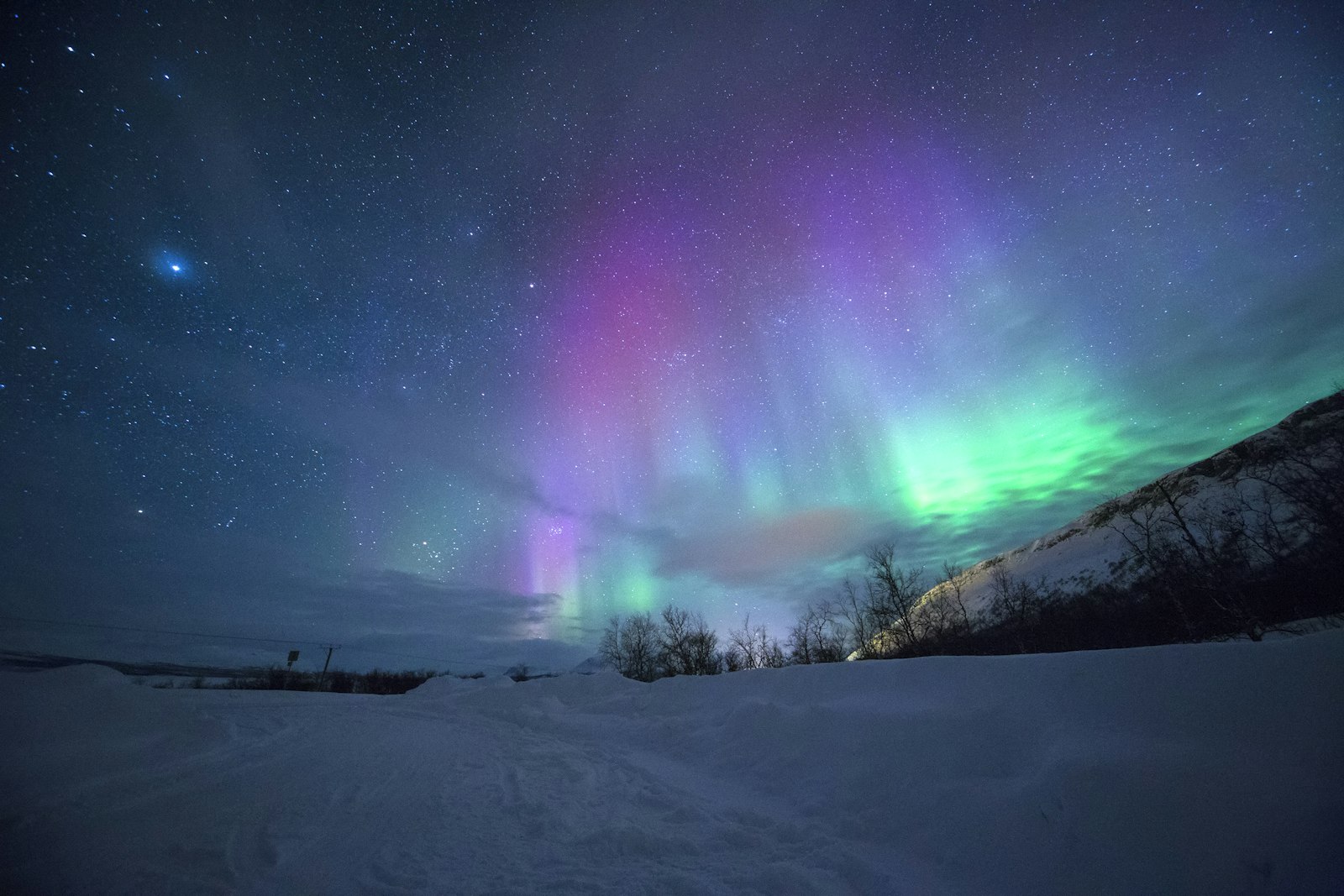
Lofoten in March sells itself with photos of red cabins under snowy peaks, but the photos don’t tell you that it might rain on that snow tomorrow, that the famous viewpoint hike is off the table, or that the aurora season has about four weeks left. You need the real conditions before you book flights to the Arctic. This guide gives you the numbers, the honest trade-offs and a plan built around what March actually allows.

The complete kit
Every country guide, every timing tool
All 24 When to Go country guides, the six Smart Timing tools and every 12-Month Map, with a Start Here that tells you what to open first.
See the kit · $127The five bundles cost $225 separately · Digital download · All sales final
Lofoten in March is a good time to visit if you want winter landscapes with usable daylight: days grow from roughly 9½ to 13½ hours, long-term averages sit around 2 °C by day and −1 to −2 °C at night, the northern lights are still visible on clear nights and the cod-fishing season is in full swing. Expect fast-changing weather, snow that can’t be guaranteed at sea level and most summit hikes out of reach.
✅ Key takeaways
- ✓March daylight in Lofoten grows by about four hours across the month, so late March gives you long sightseeing days while nights are still dark enough for the aurora.
- ✓Pack for wet, wind and ice rather than deep cold: averages hover around freezing, and rain can follow snow within a day.
- ✓Treat the northern lights as a bonus on every clear night, and plan at least four nights to give cloud a chance to break.
- ✓Leave Reinebringen and other steep summits for summer; choose roadside beaches, villages, guided snowshoeing or a boat trip instead.
- ✓The E10 is the only road through the islands, so check the forecast each morning and keep one spare day for storms.
What Lofoten in March Is Really Like: Weather, Snow and Light
March is late winter in Lofoten, and the Gulf Stream keeps it far milder than the latitude suggests. Long-term normals from the Skrova weather station, on the sheltered eastern side near Svolvær, give a March daytime high of 2.2 °C (36 °F), a night-time low of −0.9 °C (30 °F) and about 65 mm of precipitation. Leknes, on the Atlantic-facing side, averages a similar 2 °C by day and −2 °C at night but is much wetter, at around 160 mm for the month. The sea is at its coldest of the whole year, about 3 °C (37 °F).
2 °C / 36 °F
typical March daytime high
−1 to −2 °C
typical March night
9½ → 13½ hrs
daylight, 1st to 31st of March
3 °C
sea temperature, the yearly low
Read those averages as a centre line, not a promise. Temperatures sitting this close to freezing mean the same week can bring powder snow, sleet, rain and a clear frosty night. A photographer who lives on the islands has described recent winters in which a good snowfall was followed by warm rain and a long mild spell, and some visitors saw very little snow at sea level. The mountains stay white; the roadsides are a gamble.
The light is the real reason to pick March. Lofoten has no sunrise at all from early December to early January, and February days are still short. By 1 March you get roughly nine and a half hours between sunrise and sunset; by the end of the month it’s about thirteen and a half, with long blue twilight at both ends. Clocks in Norway also go forward an hour on the last Sunday of March, which pushes sunset later into the evening.
| Early March | Mid-March | Late March | |
|---|---|---|---|
| Daylight (Svolvær, approx.) | about 9½ hours | about 11½ hours | about 13½ hours |
| Feel | Still deep winter | Winter with long afternoons | Winter scenery, spring light |
| Northern lights | Long dark evenings | Dark from mid-evening | Late-night viewing only; season ending |
| Best for | Aurora-first trips | A balance of both | Photography, skiing, road trips |
🗓️ Free: a 12-Month Map for your country
Every month on one page: best weeks, shoulder weeks and the ones to skip. Print it or keep it on your phone.
🧰 Try it while you read: a free tool for this trip
Free trip timing tool
Northern Lights Window
Check whether your month falls in the aurora season our guides describe.
Loading the tool…
Northern Lights in March: The Last Reliable Weeks of the Season
March is the closing month of the aurora season in Lofoten. Norway’s tourist board puts the season at September to March and notes that by the start of April the sky is too bright. So the darkness is on your side for the whole of March, but less of it each week: in early March it’s properly dark by early evening, while in the last week you’ll be waiting until late at night.
Cloud is the bigger obstacle. The outer coast makes its own weather, and a strong aurora behind thick cloud is invisible. Local advice is to join a guide who will drive to wherever the sky has opened, or to do the same yourself: check the cloud forecast, pick the clear side of the islands and stand somewhere with an open view north. Beaches such as Uttakleiv, Haukland and Skagsanden work well because they face open sea with little artificial light. Our Northern Lights Odds tool gives you a feel for how month and latitude change your chances, and our guide to the northern lights in March compares Lofoten with other aurora destinations.

The Smart Timing Bundle
Pick the month, book in the right order, pack once
Six printable timing tools for any trip: the Trip Timing Planner, When to Book, When NOT to Go, the Shoulder Season Playbook, the family timing guide and the Packing by Season System.
See the bundle · $37Six products, $100 separately · Digital download · All sales final
Check cloud cover before aurora activity
A modest display under a clear sky beats a strong one behind cloud. Look at the cloud map for the evening first, then at the activity forecast.
Go where it is clear, not where it is famous
The two sides of the islands often have different weather. Be ready to drive 30 to 60 minutes along the E10 to reach a gap.
Be outside in the dark hours
In early March that means from early evening; in late March, from about 10 p.m. onwards. Dress for standing still: it feels far colder than walking.
Park properly
Use lay-bys and car parks only. Stopping on the E10 itself to watch the sky is dangerous and causes accidents every winter season.
Cod Season: Why March Is the Month Lofoten Works Hardest
March is the heart of the Lofoten fishery, the one season when the islands are busy for their own reasons rather than for visitors. Each winter, Arctic cod known as skrei migrate from the Barents Sea to spawn in the waters around Lofoten, and the seasonal fishery runs from about January to April. Harbours are full of working boats, and fish goes onto the tall wooden drying racks, called hjell, from late winter. It hangs outdoors until late spring to become stockfish, the dried cod that has been exported from here for centuries.
Two things follow for you. First, fresh skrei is on menus across the islands, and it’s the dish to order: firm, white and mild. Second, Svolvær usually hosts the World Championship in Cod Fishing in March, an open competition on the Vestfjord that has run every year for more than three decades and draws around 80 boats and several hundred anglers, with events on land too. You don’t need to compete: fishing trips run from Svolvær on most days in season, weather permitting.
The Shoulder Season Playbook
Lofoten isn’t one of our country guides, so here is the product that fits this trip honestly: a practical guide to travelling in the in-between weeks, when prices and crowds are lower and the weather asks for a plan. Useful if March in the Arctic is the first of several off-peak trips.
See The Shoulder Season Playbook · $19 →Digital download · All sales final
Where to Go at Road Level (and What to Skip Until Summer)
In March, the best of Lofoten is at road level: villages, beaches and viewpoints you can reach from a car park. The single main road, the E10, runs the length of the islands over bridges and through undersea tunnels, and nearly everything worth seeing sits on it or a short side road away.
| Place | Why go in March | Good to know |
|---|---|---|
| Reine and Hamnøy | The classic view: red cabins, fjord and steep snowy peaks, photographed from the bridges. | Very limited parking; walk the bridges on the pedestrian side. |
| Å | The village at the western end of the road, with old fishing buildings. | Quiet in March; check opening times of museums before driving out. |
| Nusfjord | A small, old fishing village in a sheltered bay on Flakstadøya. | Reached by a narrow side road; take it slowly after snow. |
| Haukland and Uttakleiv beaches | White sand against snow, open views north for evening aurora. | Roadside access, no hike needed. |
| Skagsanden beach | Wide tidal beach by the E10, known for reflections and aurora photos. | Easy stop between Leknes and Reine. |
| Svolvær | The main town: boat trips, restaurants, the cod-fishing harbour. | Best base without a car; buses and the airport bus stop here. |
Hiking: the honest answer
Most of Lofoten’s famous hikes are summer hikes. Reinebringen, the 448-metre viewpoint above Reine with its stairway of nearly 2,000 stone steps, is the one everyone asks about, and a respected local hiking guide is blunt: it is not a winter hike. Slabs high on the mountain send avalanches and icefall across the route, and the summit ridge carries cornices above a 400-metre drop. The same caution applies to other steep routes while snow lies on them. Norway’s official warning service, Varsom, run by the national water and energy directorate with the meteorological institute, publishes daily avalanche bulletins by region: check it before any walk that leaves flat ground.
What works instead
- Ski touring or snowshoeing with a guide: March is prime touring season, with snow in the mountains and enough daylight for a full day out. The tourist board’s advice is to always go with a local guide.
- Boat trip into Trollfjord: RIB and boat tours from Svolvær run into the narrow fjord, where white-tailed sea eagles gather.
- Winter sea kayaking: guided trips in sheltered water, with dry suits supplied by the operator.
- Horse riding and surfing: both run year-round in Lofoten for those who want them, with thick wetsuits for the 3 °C sea.
- Beach walks: flat, free and often the best light of the day.
Getting There and Driving the E10 in Late Winter
Reaching Lofoten in March takes a little planning, because winter timetables are thinner than summer ones. You have three realistic routes.
Fly to Leknes or Svolvær
Both towns have small airports with short regional flights. This is the fastest way in; small aircraft are sensitive to wind, so avoid tight same-day connections.
Fly to Harstad/Narvik (Evenes) and drive or take the bus
Evenes has direct flights from Oslo. From there the Lofast road links the mainland to Lofoten with no ferry, and an airport express bus runs to Svolvær.
Take the ferry from Bodø to Moskenes
The crossing takes about three and a half hours and lands you near Reine. Passengers must register their name, nationality and date of birth with the operator before boarding. Winter sailings are fewer than in summer and rough seas can cancel them.
On the islands, a rental car gives you the freedom to chase clear sky, but winter driving here deserves respect. The local tourist office is direct about it: the E10 is the only road linking the islands, so there is no quick detour if it is icy or a bridge closes. Their advice is to leave early, drive well under the speed limit, keep your distance, never drive on unploughed roads and stop only in lay-bys. Storms occasionally close exposed stretches, which is why one spare day in your plan is worth more than one extra sight. Norway’s national planner, Entur, covers buses and ferries if you’d rather not drive at all. The official Visit Norway guide to winter in Lofoten also recommends allowing extra time for delays and buying good travel insurance.
In Lofoten in March, the forecast writes the itinerary. Your job is to leave room for it.
A 5-Day Lofoten in March Itinerary That Leaves Room for Weather
Five days is the shortest trip that gives the weather a fair chance. This plan runs east to west and keeps drives short, so a bad day costs you little.
Arrive and settle in Svolvær
Pick up the car, walk the harbour, eat skrei for dinner. If the sky is clear, drive out of town after dark for a first look north.
Svolvær and the Vestfjord
Morning boat trip into Trollfjord for sea eagles, or a half-day fishing trip. Afternoon free for a slow drive along the coast and an early night or an aurora watch.
West to the beaches
Drive to Haukland and Uttakleiv for a midday walk, continue to Skagsanden, then take the side road to Nusfjord. Sleep near Leknes or Reine; return to a beach after dark if it is clear.
Reine, Hamnøy and Å
Photograph the bridges at Hamnøy in morning light, walk around Reine, drive to the end of the road at Å. Keep the evening free: this is the darkest, most open stretch of coast.
The flexible day
Use it for whatever the weather stole: a guided snowshoe or ski tour, a kayak trip, or simply the drive back east in daylight for your flight or ferry.
Stay in a rorbu if you can. These former fishermen’s cabins, many of them built on stilts over the water, are the traditional Lofoten accommodation, and March rates are usually lower than in high summer, though fewer places are open in the smaller villages. If the cabin life is what draws you, our piece on a Scandinavian cabin getaway has more ideas across the Nordic countries.
What to Pack for Late Winter in the Arctic
Pack for wet, wind and ice rather than for extreme cold: that is the local tourist office’s own summary, and it’s right. You are dressing for 0 °C with spray and gusts, not for −20 °C.
The complete kit
Every country guide, every timing tool
All 24 When to Go country guides, the six Smart Timing tools and every 12-Month Map, with a Start Here that tells you what to open first.
See the kit · $127The five bundles cost $225 separately · Digital download · All sales final
- Wool base layers, top and bottom, plus wool socks.
- An insulating mid-layer: fleece or a light down jacket.
- A fully waterproof, windproof shell, jacket and trousers.
- Waterproof boots with real grip and pull-on ice spikes for car parks and paths.
- Hat, buff and two pairs of gloves, one thin enough to work a camera.
- A headtorch and a power bank: cold drains phone batteries fast.
- Sunglasses: low sun on snow and water is fierce by late March.
For a full list by layer, see our winter packing list, or build one for your dates with the Packing by Season Generator.
When Not to Go to Lofoten
There is no closed season in Lofoten, but some weeks suit far fewer travellers. Early December to early January is the dark time, when the sun doesn’t rise at all: fine for aurora specialists, hard for a first visit. High summer brings the midnight sun, which lasts from late May to mid-July, along with the heaviest traffic of the year on a road network with very little parking, and no chance of the northern lights. April into early May is the awkward gap: the aurora season is over, the snow is rotting and many trails are still not safe. Within March itself, the one weekend to plan around is the cod-fishing championship in Svolvær, and the week before Easter if it falls in March, when cabins book up earlier. You can check whether your month is a bad one for other destinations too, or browse the full when not to go hub.
5 Mistakes People Make When Planning a March Trip to Lofoten
Planning around Reinebringen
It is the image that sold the trip, and it is unsafe in snow. Build the plan around the bridges at Hamnøy and the beaches instead; the views are just as strong at sea level.
Booking three nights and expecting the aurora
Three cloudy nights in a row is ordinary on this coast. Four or five nights changes the odds far more than any app.
Assuming snow at sea level
Averages near freezing mean rain is always possible. If deep snow matters, plan a guided day in the mountains, where it lasts.
Driving a summer schedule
Ice, wind and photo stops slow everything. Halve what you think you can cover in a day and never plan a long drive straight before a flight.
Arriving without bookings in the west
Fewer restaurants and cabins open in March around Reine and Å. Reserve beds and check where you will eat dinner before you set off.
Lofoten in March: Frequently Asked Questions
Lofoten in March rewards the traveller who plans for weather and takes the light as it comes: winter mountains, working harbours and a last run of dark, aurora-ready nights. Give it five days and a flexible mind. For more ideas, browse our best travel destinations in March and other Norway travel guides, compare a winter trip to Iceland in January, a high-Arctic voyage in our guide to polar expeditions to Svalbard or the North Atlantic alternative in things to do in the Faroe Islands, and plan any other month from the month-by-month travel planner.
Free download
See the whole year before you book
Our free 12-Month Map puts every month for one country on four pages: when the weather works, when the crowds and prices peak, and the weeks to skip.
- 24 countries to choose from
- Region-by-region verdicts
- Printable PDF
Your download page opens as soon as you sign up. 24 countries available.
[…] further north afterwards? Our Lofoten Islands travel guide covers a similar landscape of fishing villages and sea cliffs on the Norwegian […]
[…] with our Croatia guide, compare Colmar in March for a different kind of old town, or go north for Lofoten in March. Any other month starts at the month-by-month travel […]
[…] when Arctic cod arrive to spawn and fishing villages hang the catch on drying racks. Our full Lofoten Islands travel guide covers the islands in more […]