Mediterranean sea caves are at their best on a calm, sunny day between late May and late September, when boats can slip through low entrances and sunlight turns the water inside electric blue or emerald green. The catch is that almost every famous cave depends on the sea: a swell, a strong wind or a grey sky can close the entrance or flatten the colour. This guide covers six caves worth planning a trip around, the months and hours that give you the best chance, and the access rules that now limit swimming, landing and kayaking at several of them.

Six caves, one calendar
Mediterranean sea caves at a glance
Benagil Cave
Algarve, Portugal
Best: Jun to Sep
GoBoat or guided kayak; no landing, no swimming
Melissani Cave
Kefalonia, Greece
Best: May to Sep
GoUnderground lake by boat; best near midday
Blue Cave
Biševo, Croatia
Best: Jun to Sep
Go with careCalm days only; best light 11 to 12
Blue Grotto
Capri, Italy
Best: May to Sep
Go with careRowboat, lie flat; shut in rough seas
Grotta della Poesia
Puglia, Italy
Best: Jun to Sep
Go with careSummer ticket; no swimming or diving
Blue Grotto
Malta
Best: May to Sep
GoShort boat trips; morning light
Verdicts assume you want to enter the cave, not just see it from a cliff. Every visit depends on the sea on the day.
The short answer
The best time for Mediterranean sea caves is June and September. Seas are usually calmer, the water is warm, days are long and dry, and September has thinner crowds than July and August. Go in late morning or around midday for the strongest colour. From November to March many trips are cut back or cancelled by wind and swell, so keep winter for clifftop views.
Key takeaways
Calm sea and bright sun matter more than the month: a perfect June day beats a windy August one.
Late morning to midday gives the best light at Melissani, the Biševo Blue Cave and Malta’s Blue Grotto; Capri’s grotto is brightest in the morning.
At Benagil you can no longer swim in, land on the inner beach or paddle in alone; you need a boat or a guided kayak.
Swimming inside Capri’s Blue Grotto is not allowed during visiting hours, and the Grotta della Poesia summer ticket does not allow swimming or diving.
Book the first boats of the day in July and August, and keep a spare day in case the sea closes the cave.
Mediterranean Sea Caves: The Six Worth Planning Around
This section compares the six caves side by side, so you can see which ones suit your route and your tolerance for rules and early starts. One honest note first: Benagil sits on Portugal’s Algarve coast, which faces the Atlantic, not the Mediterranean. It is included because it is the cave most travellers search for alongside the Mediterranean ones, and its calendar works the same way.
| Cave | Where | How you see it | Best light | Rule to know |
|---|---|---|---|---|
| Benagil Cave | Near Lagoa, Algarve, Portugal | Boat, or kayak and SUP with a certified guide | Bright, calm days | No landing on the inner beach; no swimming in |
| Melissani Cave | Near Sami, Kefalonia, Greece | Walk down, then a short boat tour on the lake | Around midday | Hours change by season |
| Blue Cave (Modra špilja) | Balun bay, Biševo, near Vis, Croatia | Small flat boat through a low entrance | 11:00 to 12:00 | Open on calm days only |
| Blue Grotto (Grotta Azzurra) | North-west coast of Capri, Italy | Rowboat for up to four, lying back to enter | Morning | No swimming in visiting hours; closes in rough seas |
| Grotta della Poesia | Roca Vecchia, Melendugno, Puglia, Italy | Viewing from the rocks, with a summer ticket | Daytime | No swimming or diving in the pool |
| Blue Grotto | Wied iż-Żurrieq, south coast of Malta | Short boat trip past a group of caves | Early morning to midday | Weather permitting |
🗓️ Free: a 12-Month Map for your country
Every month on one page: best weeks, shoulder weeks and the ones to skip. Print it or keep it on your phone.
The pattern is clear: boat caves close when the sea gets up, and colour caves need high sun. Comparing whole beach holidays instead? Our guide to Mediterranean beaches in September covers the wider coast.
🧰 Try it while you read: a free tool for this trip
Free trip timing tool
Beach Water Temperature Picker
Set the sea temperature you like; see which countries reach it in your month.
Loading the tool…
Benagil Cave, Algarve: Boat or Guided Kayak Only
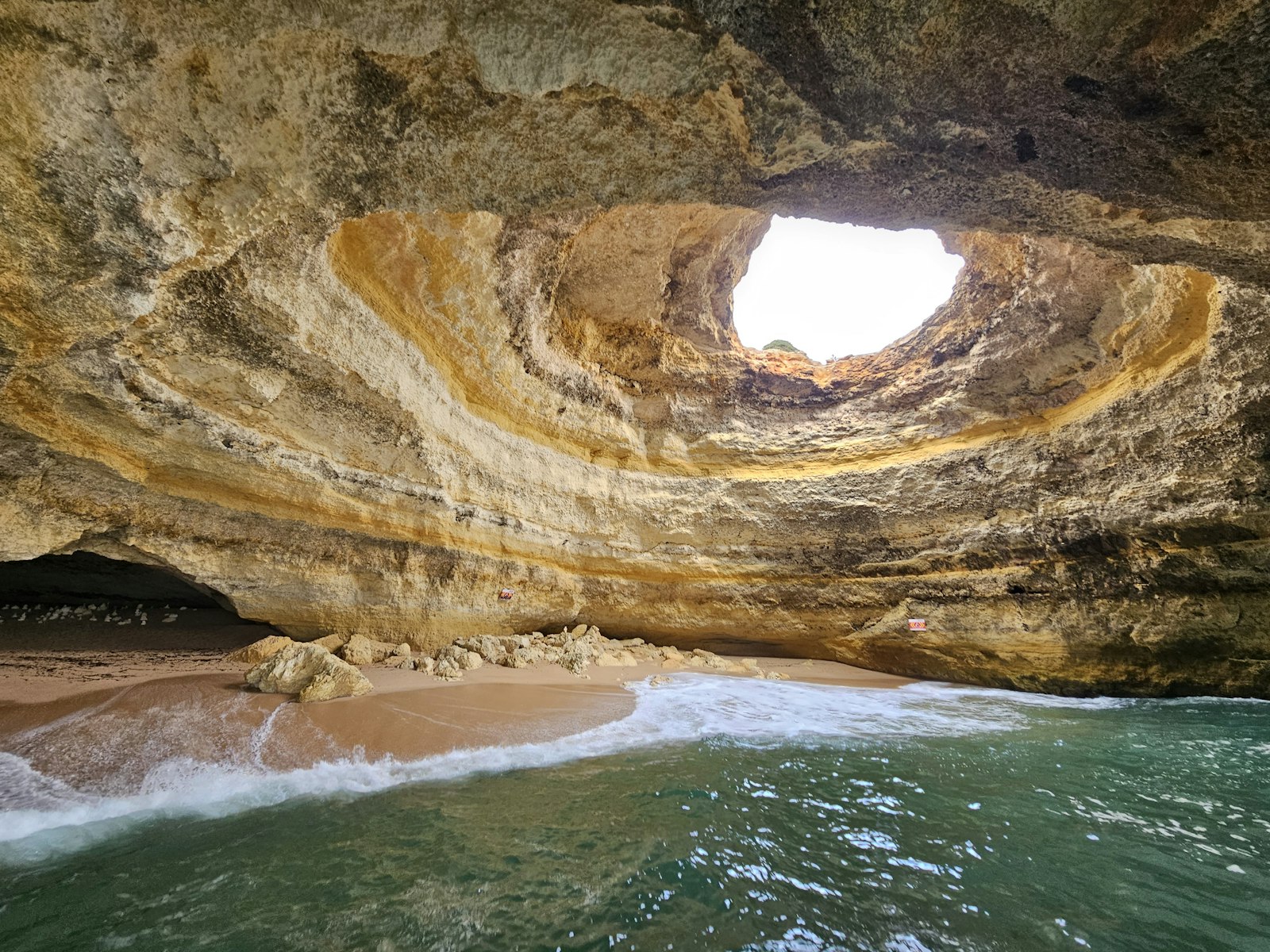
This section covers the cave with the round hole in its roof, the most photographed sea cave on the Iberian coast and the one with the strictest new rules. Swimming over from the beach and lying on the sand inside are now off the table.
Under navigation rules introduced in recent summers and summarised by Full Suitcase, the cave stays open year round, but entry depends on sea and weather conditions. You can enter by boat. Swimming into the cave is no longer allowed, and you can’t use floating devices to get in. Landing on the small beach inside is forbidden. Kayaks, canoes and paddleboards may enter only with a certified guide, who can lead a small group, so independent kayak rental for the cave is no longer possible. Only a few small boats, or one larger one, may be inside at once, and only for a short stay.
Important
Rules at Benagil have been tightened and clarified more than once, and operators have sometimes waited for details. Ask your boat or kayak company what is allowed on the day you book, and never swim across from the beach.
The Algarve calendar is simple. From June to September rain is close to zero (about 5 mm in June and none in July or August at Faro), and the sea warms from about 19.5 °C in June to about 21.5 °C in August and September, according to Climates to Travel. Sea breezes tend to build in the afternoon, so the morning is usually the calmer half of the day for small boats. July and August bring the crowds: on a busy summer day dozens of boats can circle the cave mouth. June and September give you the same weather with more space.
Benagil works best as part of a longer coastal stay. Our guide to the best places to visit in the Algarve helps you choose a base.

The Smart Timing Bundle
Pick the month, book in the right order, pack once
Six printable timing tools for any trip: the Trip Timing Planner, When to Book, When NOT to Go, the Shoulder Season Playbook, the family timing guide and the Packing by Season System.
See the bundle · $37Six products, $100 separately · Digital download · All sales final
Melissani Cave, Kefalonia: The Lake Under a Collapsed Roof
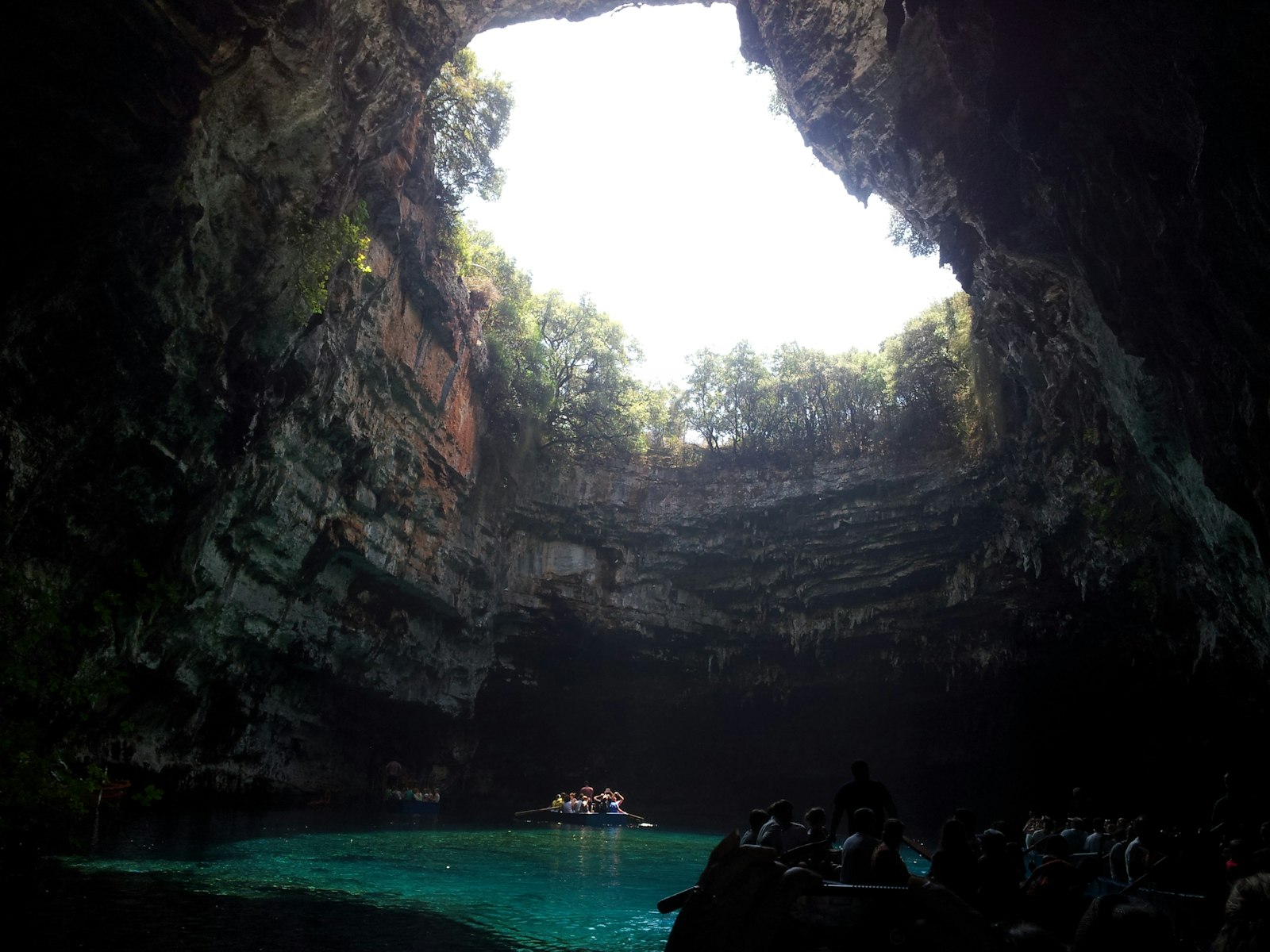
This section covers the Greek cave that is not on the open sea at all. Melissani is an underground lake just outside the village of Sami on Kefalonia’s east coast. Part of the roof fell in centuries ago, and sunlight now drops straight onto the water.
You walk down a tunnel and board a small boat that circles the sunlit chamber, then passes through a narrow channel into a second, darker hall. The water is a brackish mix of fresh water and sea water that flows in at one end and out at the other, and the lake is about 20 to 30 metres deep, according to Greeka. The visit is short, so it pairs well with a beach afternoon on the same side of the island.
Tip
Time your visit for around midday, when the sun is high enough to shine through the open roof and light the water from below. Morning and late-afternoon visits are calmer but the colour is weaker. Opening hours change through the year, so check them locally before you drive across the island.
Melissani is sheltered, so rough seas matter less here. Kefalonia’s numbers from Climates to Travel show why late spring and early autumn work so well: rain falls to about 20 mm in May and about 5 mm in June, the sea reaches about 22.5 °C in June and stays above 25 °C until September, and the island lies outside the zone where the strong summer Meltemi wind blows.
The Blue Cave on Biševo and the Blue Grotto on Capri
This section covers the two classic blue caves of the Adriatic and Tyrrhenian seas. Both are lit by sunlight entering through an underwater opening, and both are only as good as the sea on the day.
Blue Cave, Biševo, Croatia
The Blue Cave sits in a small bay called Balun on the east side of Biševo, about 4.5 nautical miles from Komiža on the island of Vis. Its natural opening is below sea level; a man-made entrance large enough for small boats was cut in the late 19th century. According to Wikipedia, the ideal time to see the blue light is between 11:00 and 12:00, depending on the season. The cave runs on calm days only, and small flat boats are the largest that fit, so passengers duck or lie back as they pass under the low rock (Showcaves).
Boats run from Komiža, and longer day tours leave from Split and Hvar; see things to do in Split.
Blue Grotto, Capri, Italy
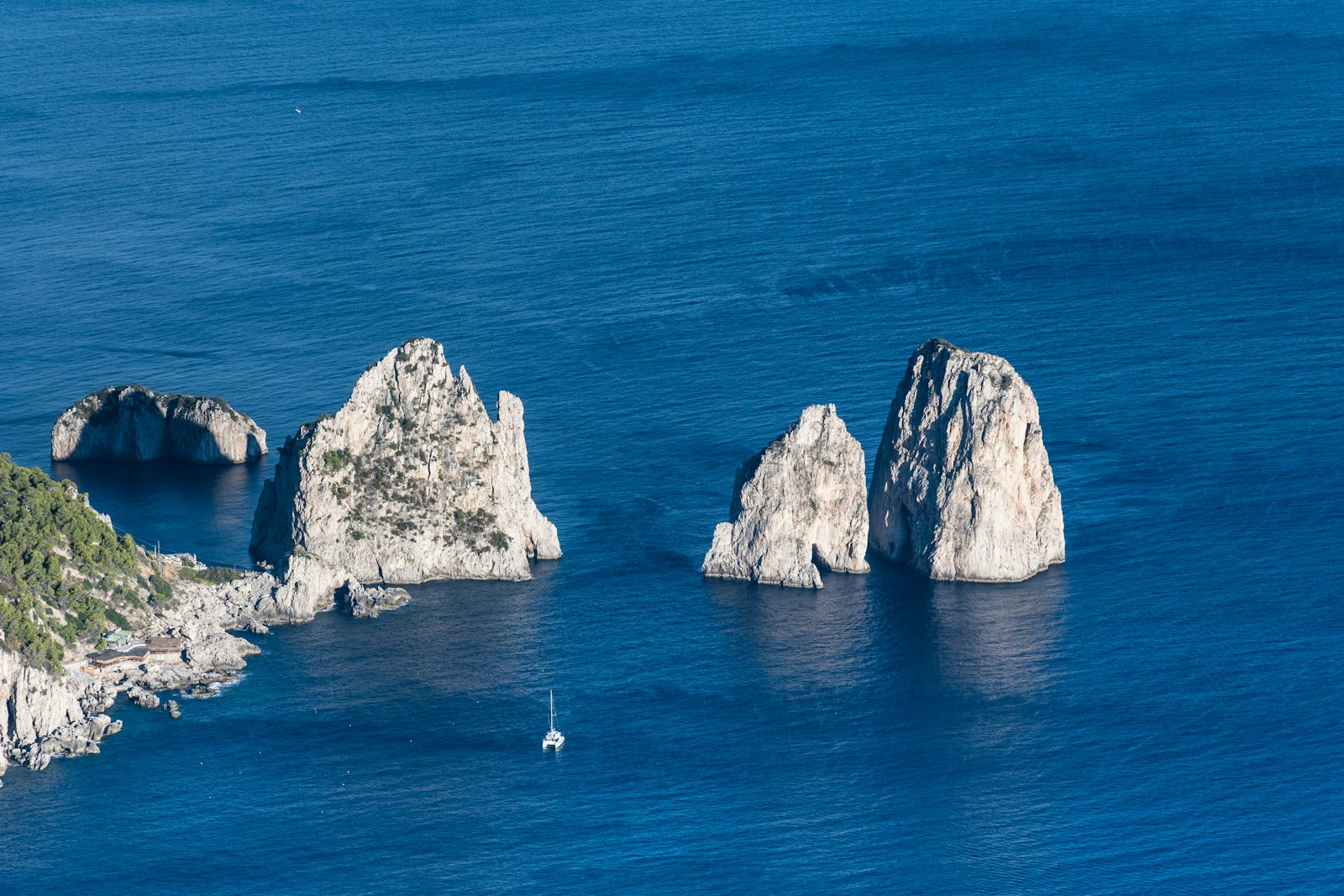
Capri’s Grotta Azzurra has an entrance only about two metres wide and one metre high. You transfer to a small rowboat that holds up to four people, lie back, and the boatman pulls you in along a chain fixed to the rock. Inside, the water glows silver-blue. The Capri Tourism site says the morning gives the most vivid colour and fewer crowds, and that the cave may close in rough seas or high winds. Swimming inside is not allowed during visiting hours.
Hours follow the seasons: the longest day runs from April to September, shorter afternoons apply in early October, and from mid-October to March the cave usually closes in the early afternoon. Reach it by bus from Anacapri or on a weather-dependent boat tour from Marina Grande. For the mainland coast, see Amalfi Coast in September.
Grotta della Poesia and Malta’s Blue Grotto
This section covers two caves that are easier to reach than they are to plan: one on a clifftop in Puglia and one on Malta’s south coast.

The complete kit
Every country guide, every timing tool
All 24 When to Go country guides, the six Smart Timing tools and every 12-Month Map, with a Start Here that tells you what to open first.
See the kit · $127The five bundles cost $225 separately · Digital download · All sales final
Grotta della Poesia, Puglia
The Grotta della Poesia at Roca Vecchia, in the municipality of Melendugno, is a natural pool of clear sea water ringed by limestone and linked to the sea by a tunnel. For years its fame came from people jumping in. That is no longer the plan. The municipality has introduced a summer ticket, sold online through the ArcheoRoca site or at two ticket counters on site, running until the end of September. According to The Wom Travel, the ticket does not allow swimming or diving in the cave, and residents of Melendugno enter free.
Treat it as a viewpoint, not a swim spot, and go early or late on summer days. For more of the region, read our guide to southern Italy’s coast and historic towns.
Blue Grotto, Malta
Malta’s Blue Grotto is a group of seven sea caves on the south coast, with a main arch about 30 metres high. Boats leave from the tiny harbour of Wied iż-Żurrieq, set in a narrow inlet in the cliffs, and trips last about 20 minutes, usually daily and weather permitting. The colour comes from sunlight bouncing off the pale sandy seabed, so Malta Uncovered recommends going from early morning to around midday on clear summer days. Boats usually start around 9 in the morning.
Best Months for Mediterranean Sea Caves
This section rates each month for a cave trip, using long-term averages for Kefalonia and Faro and the caves’ seasonal hours.
Sea cave month verdicts
Jan
SkipShort hours, rough seas, sea about 16 °C
Feb
SkipColdest sea of the year, about 15 to 16 °C
Mar
SkipWindy, cool water; clifftop views only
Apr
Go with careLonger hours return; sea still cool
May
GoCalmer seas, quiet boats, about 19 °C
Jun
GoDry, long days, sea about 20 to 22 °C
Jul
Go with careWarm and calm, but the busiest boats
Aug
Go with careWarmest water, biggest crowds
Sep
GoWarm sea, thinner crowds, best balance
Oct
Go with careShorter hours, rain rising, still warm
Nov
SkipRain and swell cancel many trips
Dec
SkipWettest, shortest days
Based on Climates to Travel averages for Kefalonia and Faro and the caves’ seasonal hours. Every year and every day differs.
| Month | Sea off Kefalonia | Sea off Faro | Rain, Kefalonia | Rain, Faro |
|---|---|---|---|---|
| May | about 19 °C | about 18 °C | about 20 mm | about 25 mm |
| June | about 22.5 °C | about 19.5 °C | about 5 mm | about 5 mm |
| July | about 25 °C | about 21 °C | about 10 mm | almost none |
| August | about 26.5 °C | about 21.5 °C | about 10 mm | almost none |
| September | about 25.5 °C | about 21.5 °C | about 55 mm | about 30 mm |
| October | about 23 °C | about 20.5 °C | about 80 mm | about 55 mm |
Sources: Climates to Travel for Kefalonia and Faro. The Mediterranean is clearly warmer than the Atlantic Algarve. Rain stays very low from June to August on both coasts, then rises through October.
September is the sweet spot for most travellers. The water is at or near its warmest, school holidays are over in much of Europe, and boat operators are still running full timetables. For island ideas in the same window, see Mediterranean islands in September.
Sea Conditions, Light and Time of Day
This section covers how to get inside and see the colour. Most failed cave trips come down to swell, wind or the wrong hour.
Check the sea, not just the sky
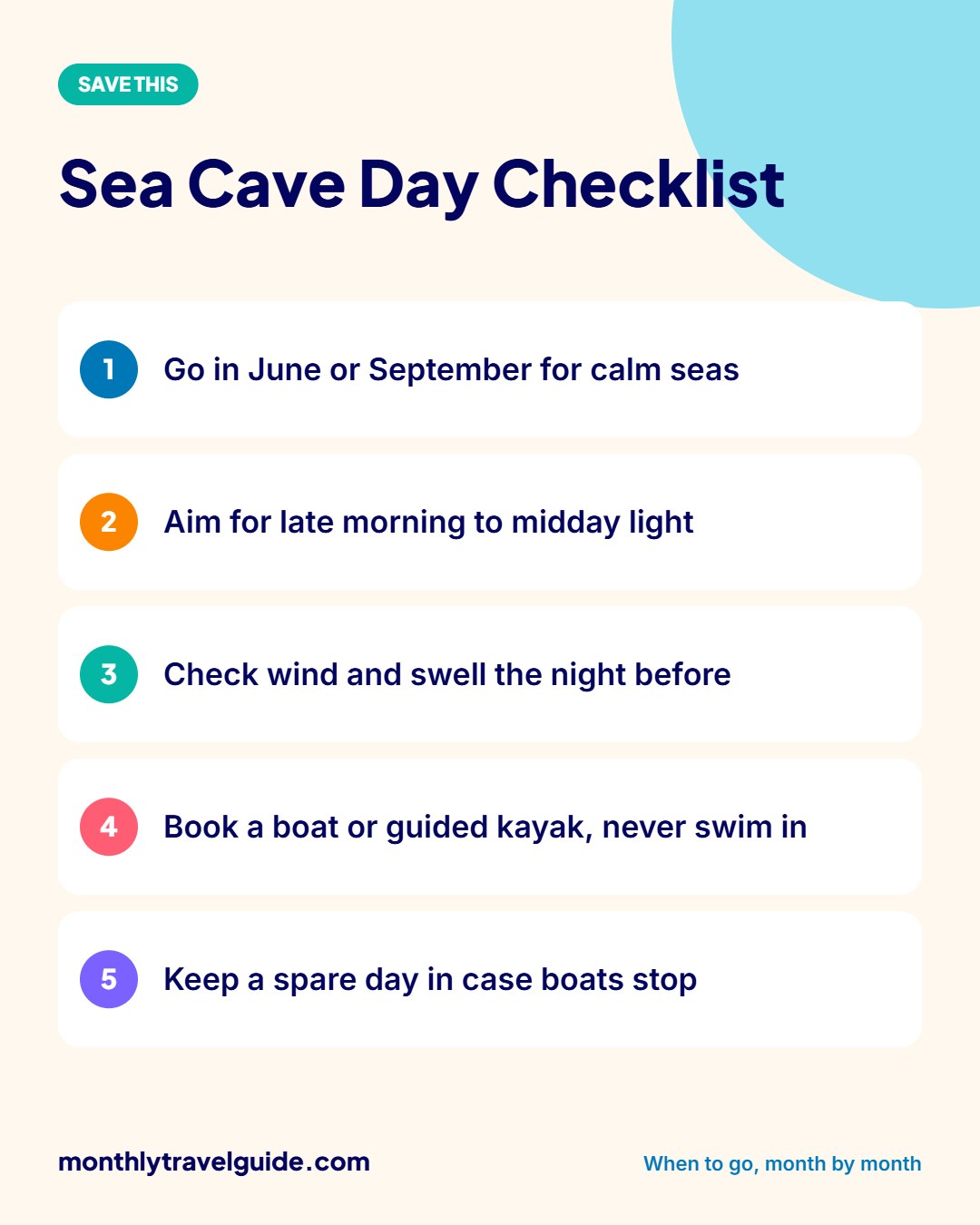
A sunny day with a strong wind can still close a low entrance. Look at wind and wave forecasts the evening before and again in the morning.
Go between late morning and midday
Light enters blue caves through the water or a roof opening; the higher the sun, the stronger the colour. Capri is the exception, with the best colour in the morning.
Take the first boats in peak season
Early departures beat the queues at Capri and Benagil, and the sea is often calmer before the afternoon breeze.
Keep a spare day
If a cave is the reason for the trip, plan it for your first full day on the coast so you can try again.
Follow the rules on the day
Operators and harbour authorities can change access with the conditions. If the boatman says no, it is for a reason.
Warning
Never swim into a sea cave on your own. Swell inside a cave behaves differently from the open beach, and several of the best-known caves now ban swimming outright.
Use the free Shoulder Season Detector to compare quieter weeks for any coast, and the Storm Season Check if your dates fall at the start or end of summer.
When Not to Visit Mediterranean Sea Caves
This section is the honest part. A few dates and conditions can turn a cave trip into a wasted morning.
| Avoid | Why | Do this instead |
|---|---|---|
| November to March for boat entry | Swell and wind cancel many trips; hours are short | Go in May or September |
| Peak weeks of July and August at midday | Queues of boats at Capri and Benagil | Take the first departure of the day |
| The day after a storm | Swell lingers even under clear skies | Leave a spare day in the plan |
| Late afternoon at blue caves | Low sun means weak colour | Go between late morning and midday |
| October for Grotta della Poesia access | The summer ticket season ends with September | Go in June or early September |
Better Month If You Want Something Else
This section helps if the caves are part of a bigger trip with other priorities.
If you want
The warmest swim
Go in August or early September, when the sea off Kefalonia reaches about 26 °C.
If you want
Quiet boats and soft light
Go in May or the second half of September.
If you want
A wider spring trip in Europe
Go in May; our guide to where to travel in Europe in May covers the options.
5 Common Mistakes on a Sea Cave Trip
1. Planning the cave for your last day
If the sea is rough on your only chance, there is no second try. Put the cave early in the trip.
2. Expecting to swim inside
Benagil, Capri’s Blue Grotto and the Grotta della Poesia all limit or ban swimming in the cave itself. Plan your swim at a beach or a supervised stop outside.
3. Renting a kayak to paddle into Benagil alone
Independent kayaks and paddleboards can no longer enter. Book a guided kayak tour or a boat trip instead.
4. Going in the late afternoon
The famous blue and emerald colours depend on high sun. A late visit often means a dim cave and a disappointing photo, even on a clear day.
5. Ignoring the wind forecast
Blue sky does not mean calm water. A strong breeze or leftover swell can close a low entrance, so check the marine forecast.
Mediterranean Sea Caves FAQ
What is the best month to visit Mediterranean sea caves?
June and September are the best months for most travellers. Seas are usually calmer, days are long and dry, and the water is warm, at about 22.5 °C in June and 25.5 °C in September off Kefalonia. September also has fewer crowds than July and August. From November to March, wind and swell cancel many boat trips, and opening hours are shorter.
Can you swim in Benagil Cave?
No. Under the newer rules, swimming into Benagil Cave is not allowed, floating devices can’t be used to enter, and landing on the small beach inside is forbidden. You can enter by boat, or by kayak or paddleboard only with a certified guide. The cave stays open year round, but entry depends on sea and weather conditions on the day.
What time of day is best for the Blue Cave in Croatia?
Late morning is best. The ideal time to see the blue light in the Blue Cave on Biševo is between 11:00 and 12:00, depending on the season, when sunlight enters through the underwater opening. Early morning visits are much darker. The cave only runs on calm days, so check conditions before you leave Komiža, Split or Hvar.
Can you swim in the Blue Grotto on Capri?
Not during visiting hours. Capri’s tourism site says swimming inside the Blue Grotto is not allowed while boats are operating, and it warns that swimming in after hours is dangerous and not recommended. Visits are by small rowboat for up to four people, and you lie back to pass through the low entrance. The grotto may close in rough seas.
Can you still swim at Grotta della Poesia?
No. The summer ticket now required at the Grotta della Poesia in Roca Vecchia does not allow swimming or diving in the cave pool. Tickets are sold online through the ArcheoRoca site or at ticket counters on site, and the ticket season runs until the end of September. Treat it as a scenic and archaeological stop, and swim at a nearby beach instead.
Is Melissani Cave worth visiting?
Yes, especially around midday on a sunny day. Melissani is an underground lake near Sami on Kefalonia, lit by sunlight through a roof that collapsed centuries ago. A short boat ride takes you around the bright chamber and into a darker second hall. Because it is sheltered, it is less affected by rough seas than open-water caves like Capri.
The Bottom Line
Plan Mediterranean sea caves for June or September, go between late morning and midday, and leave a spare day for the sea to calm down. Book boats or guided kayaks rather than swimming in, and check each cave’s current rules before you go. For more trips across the region, browse our Europe travel guides.
Portugal, Italy, Greece and beyond
Time every stop on your Europe route
The Europe Bundle brings our European When to Go country guides together, with month-by-month verdicts, sea and weather notes, crowd peaks and the weeks to book early, so the caves, beaches and cities on your list each land in their best weeks.
See The Europe Bundle →Digital download · All sales final
Free download
The 12-Month Map, free
The whole year for one country on four printable pages, so you can see the right months before you read anything else.
- Good, shoulder and avoid months at a glance
- Region by region, not one average for the whole country
- Prints cleanly on US Letter
Your download page opens as soon as you sign up. 24 countries available.