
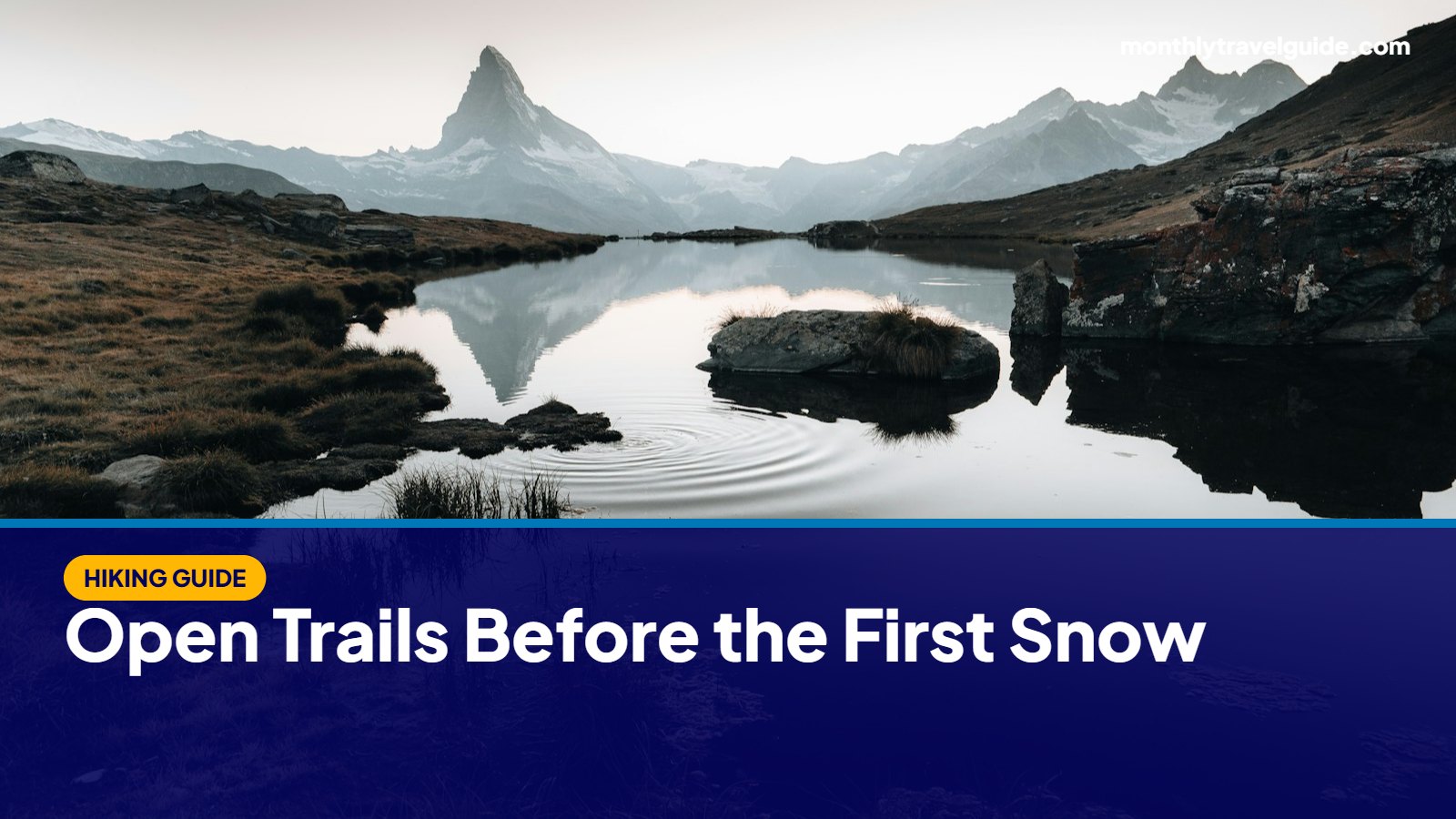
Swiss Alps hiking in September gives you the best of the summer trail network with fewer people on it: the high paths are usually free of old snow, the lifts still run and the school holidays are over. The catch is that the month changes as it goes. Early September still feels like late summer, while the last week brings cold mornings, shorter lift hours, the first huts closing and a real chance of fresh snow on the highest passes. This guide shows which regions and trails to pick in each half of the month, what closes and when, and how to plan around the first snow.

When to Go guides
Choose your country, then your month
24 country guides, each about 100 pages: every month rated for weather, crowds and prices, region by region, with a 7-day booking plan. Six guides per region bundle.
Browse the 24 guides · $19 eachRegion bundles: Europe, Asia & Pacific, Sun Souks & Safari, Americas · $47 each
September in the Swiss Alps
Week by week on the trails
Week 1
Late-summer feel
Main lifts and most huts open; crowds still moderate after the holidays end.
Week 2
The sweet spot
Stable days are common, trails busy only at the big viewpoints.
Week 3
Thinner crowds
Cooler mornings; check hut dates before a multi-day route.
Week 4
Quietest, coldest
Some small lifts cut hours; fresh snow possible above about 2,500 m.
Crowd and lift notes from Tour Switzerland; snow line from the same source. Every year differs, so check forecasts before high routes.
Quick answer
September is one of the best months to hike in the Swiss Alps. Nearly all marked trails are open, the main lifts run all month and crowds fall after the first two weeks. Do the high routes around Zermatt, the Jungfrau region and Aletsch in the first half, and keep the last week for lower valley and lake walks, because huts start closing and the first snow can reach the highest ground.
Key takeaways
The first half of September is the safest window for high routes and hut-to-hut treks.
Valley resorts at 1,500 to 2,000 m usually see about 8 to 16 °C; above 2,500 m it can drop below freezing late in the month.
Big lifts run all month, but some smaller cable cars cut hours or close for maintenance in the last week.
Mountain huts close on different dates, some at the end of September and others in October, so check each one.
The famous golden larches usually come later, from about the third week of October, though Zermatt can start at the end of September.
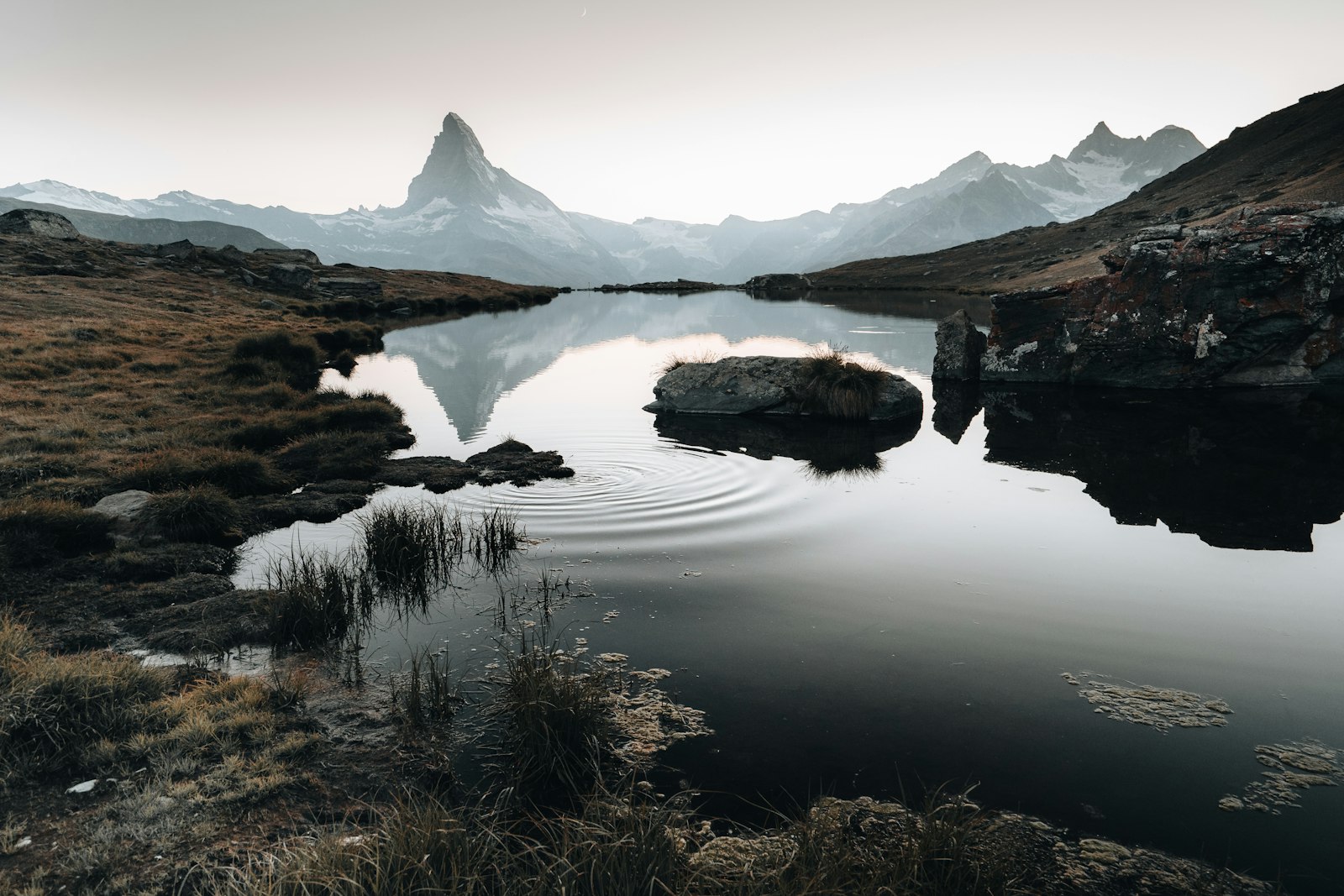
Swiss Alps Hiking in September: Weather and Altitude
This section covers what the weather actually does on the trails, because in the Alps altitude matters more than the date. A sunny 15 °C afternoon in a valley village can be close to freezing on a pass a few hours above it.
Zermatt, at about 1,600 m, is a useful benchmark. Long-term averages from Climates to Travel give a September range of about 5 to 15 °C, around 50 mm of precipitation over roughly seven days, and about five hours of sunshine a day. October drops to about 1 to 11 °C with slightly more precipitation, which shows how fast the season turns.
| Altitude band | Typical September temperatures | What it means on the trail |
|---|---|---|
| Valley towns (Interlaken, Lucerne) | About 16 to 22 °C | Lake and low valley walks in light layers |
| Resorts at 1,500 to 2,000 m | About 8 to 16 °C | Cool starts, warm middays, the best hiking band |
| High alpine above 2,500 m | About 0 to 6 °C early in the month | Gloves and a warm layer; can fall below freezing late in the month |
| Highest passes and ridges | Fresh snow possible from late September | Check forecasts; turn back if paths are icy |
🗓️ Free: a 12-Month Map for your country
Every month on one page: best weeks, shoulder weeks and the ones to skip. Print it or keep it on your phone.
Ranges come from Tour Switzerland and are long-term patterns, not forecasts. Weather in the mountains can change within an hour, so the daily forecast and the local tourist office matter more than any average. Most Swiss hiking guides, including MySwissAlps, rate July to September as the main hiking season because snow cover is at its lowest, while noting that access always depends on current conditions.
Warning
First snow on the highest terrain is possible by late September or early October. A dusting can make steep paths slick, especially on north-facing slopes that stay in shade. If a red-and-white route crosses a pass above about 2,500 m, plan it for the first half of the month or have a lower backup.
🧰 Try it while you read: a free tool for this trip
Free trip timing tool
What Kind of Traveller Are You?
Seven quick taps pick your travel type, then show the countries and months where it shines.
Loading the tool…
The Best September Hiking Trails by Region
This section groups the classic trails by region and tells you which half of September suits them best. Distances and times vary with the start point and lift you use, so check the route on the official Swiss hiking map or with the local tourist office before you set off.
September verdicts by region
Zermatt
GoMatterhorn views, Five Lakes Walk, Riffelsee
Best: Early to mid
Jungfrau region
GoFirst to Bachalpsee, Schynige Platte, Männlichen
Best: Early to mid
Kandersteg
GoOeschinensee lake trails
Best: All month
Aletsch Arena
GoGlacier viewpoints from Eggishorn and Fiescheralp
Best: Early to mid
Engadin
GoMorteratsch Glacier, Lake Staz, Val Trupchen
Best: All month
High passes and huts
Go with careMulti-day routes above 2,500 m
Best: First half
Blue-and-white alpine routes
Go with careGlacier and scrambling terrain
Best: Only with gear and skills
Lavaux terraces
GoLow vineyard walk by Lake Geneva
Best: Bad-weather backup
Verdicts by the Monthly Travel Guide editorial team, based on lift seasons, snow line and hut notes in the sources below.
Zermatt and the Matterhorn
Zermatt gives you the most famous views in the country, and September is a strong month for them because the high trails are clear of old snow and the lakes above the village hold still water on calm mornings. The Five Lakes Walk links small lakes with Matterhorn reflections, and the Riffelsee area below Gornergrat is the classic sunrise spot. The Gornergrat railway and the Rothorn lifts run through the month, so you can ride up and walk down if your knees prefer. Go early in the day: by mid-morning wind often ruffles the water.
The Jungfrau region
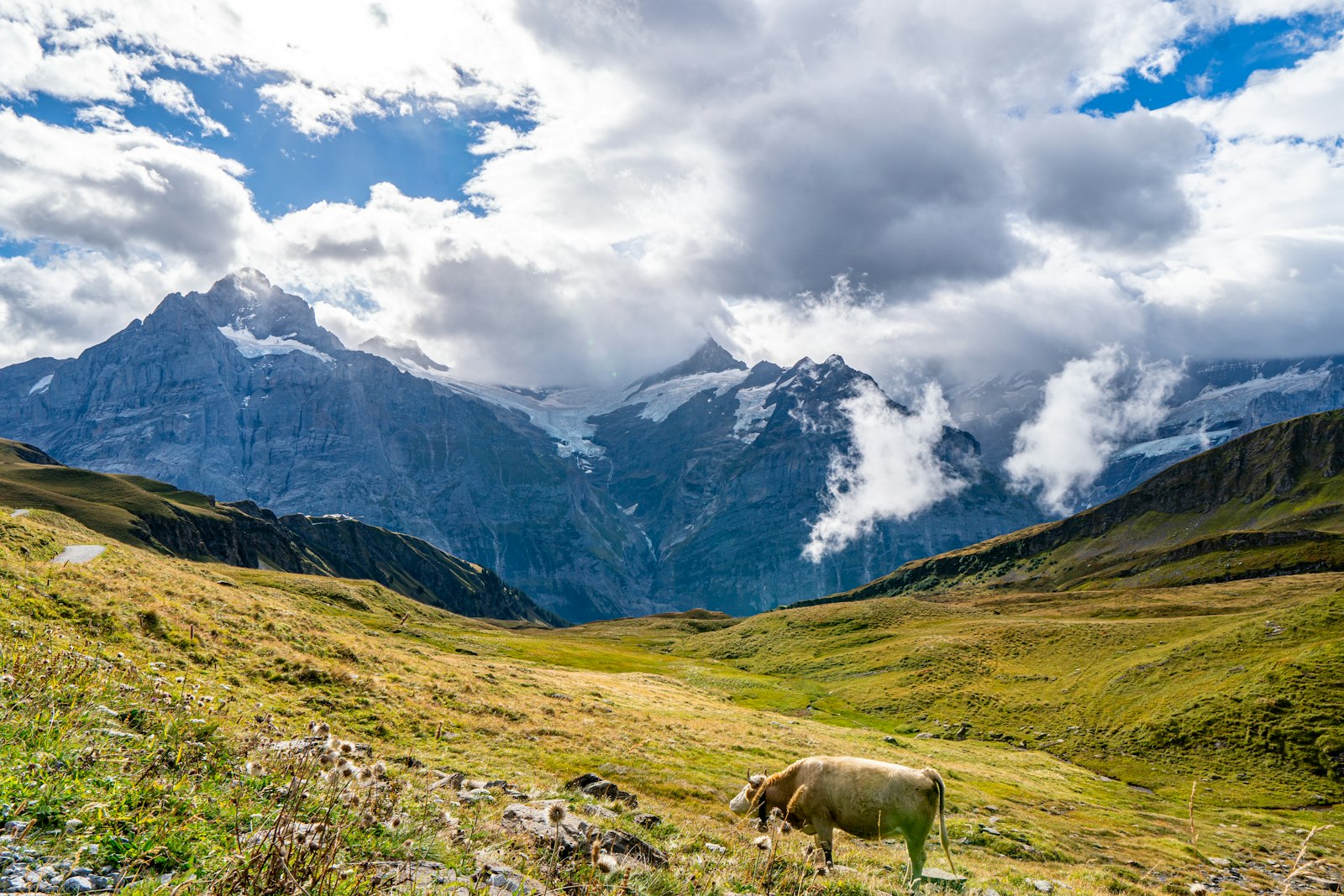
Grindelwald, Wengen, Mürren and Lauterbrunnen offer the densest network of lift-assisted trails in the Alps. From First you can walk to Bachalpsee, the Schynige Platte railway reaches a ridge trail with views over the lakes and the big north faces, and the Männlichen area links to Kleine Scheidegg with easy downhill walking. These lifts usually run into late October, so September gives you full access with shorter queues than in August. Cows are often still on the high pastures in early September, which is part of the charm.

The Smart Timing Bundle
Pick the month, book in the right order, pack once
Six printable timing tools for any trip: the Trip Timing Planner, When to Book, When NOT to Go, the Shoulder Season Playbook, the family timing guide and the Packing by Season System.
See the bundle · $37Six products, $100 separately · Digital download · All sales final
Kandersteg and Oeschinensee
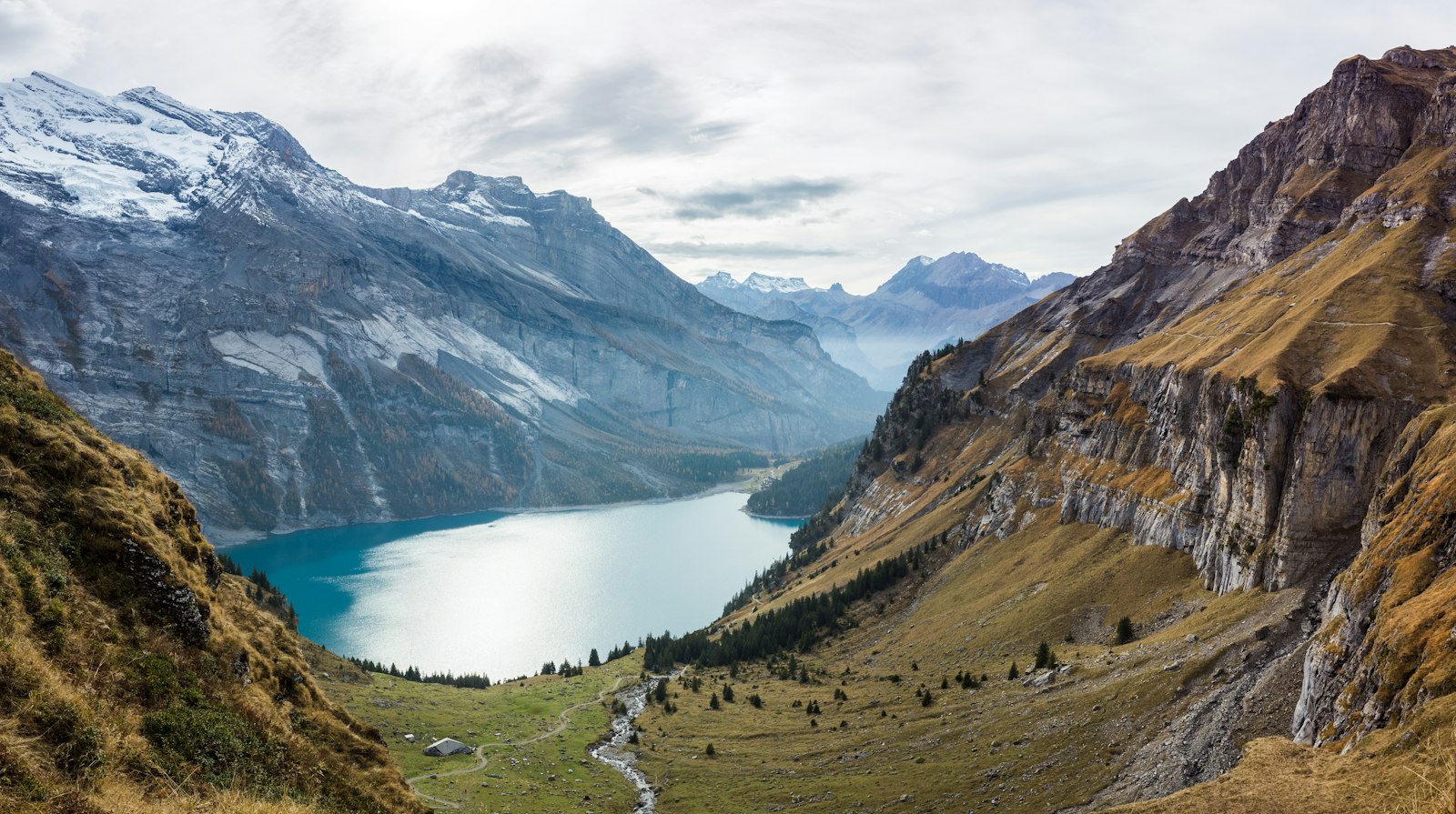
Oeschinensee is a deep blue lake under steep cliffs above Kandersteg. A cable car shortens the climb, and you can choose between the flat lakeshore path and the higher panorama trails above the water. Because the cableway usually runs into early November, this is one of the safest picks for the end of September, when some higher areas start to wind down.
The Aletsch Arena
The Great Aletsch Glacier is best seen from the ridge trails above Fiescheralp, Bettmeralp and Riederalp, with the Eggishorn lift giving the highest viewpoint. The Eggishorn summit lift usually closes in mid to late October, so September is a safe time for it. Stay on marked paths: glacier ice itself is blue-and-white alpine terrain that needs equipment and experience.
The Engadin
The Engadin around St. Moritz and Pontresina is a high, wide valley whose trails suit the whole month. The walk to the Morteratsch Glacier, the forest path to Lake Staz and the side valley of Val Trupchen are easy to moderate. The valley is famous for its larch forests, which turn gold later in autumn, and some cattle descents take place here too.
Lower trails for poor weather
If cloud sits on the peaks, drop down. The Lavaux vineyard terraces between Cully and Lutry above Lake Geneva make a gentle half-day walk of about 14 km. Lake paths around Lucerne and Interlaken, and lower forest trails in every region, keep the day useful when the high routes are a bad idea.
Lift and Hut Closures Later in the Month
This section explains what closes and when, which is the main planning issue for Swiss Alps hiking in September. The short version: the big mountain railways and cable cars run all month, but the small things start to change in the last week, and huts close on their own schedules.
| Lift or railway | Usual end of summer season | September impact |
|---|---|---|
| Schynige Platte railway | Late October | Runs all month |
| Grindelwald to First, Männlichen | Late October | Runs all month |
| Lauterbrunnen to Mürren | Late October | Runs all month |
| Glacier 3000, Eggishorn | Mid to late October | Runs all month |
| Kandersteg to Oeschinensee | Early November | Runs all month |
| Pilatus cogwheel railway | Late November | Runs all month |
Season ends above are typical patterns listed by Holidays to Switzerland; exact dates change from year to year, so check the operator’s timetable before you travel. Smaller cable cars and mountain restaurants are the ones to watch: some reduce hours in the last week of September, and a few close for annual maintenance during the month.
Mountain huts
Staffed huts close on different dates, and there is no single national rule. Some close at the end of September, while others stay staffed into October, as the hut list from Haute Route huts shows for the Valais. A few keep an unstaffed winter room, but these have no meals or bedding service. If your trek depends on a hut later in the month, confirm the closing date with the hut itself, and book ahead even in September: weekends with good forecasts still fill.
Tip
Plan multi-day routes for the first half of September and build in one spare day. If the forecast turns, you can wait out a front instead of crossing a high pass in wind or fresh snow.
Trail Signs, Grades and Safety
This section covers how Swiss trails are graded, because choosing the right grade matters more in late September than in midsummer. The network is about 60,000 km long, and every path is signed with one of three markings, according to Alpenwild.
Late in September, a red-and-white trail that was easy in July can become harder: mornings are colder, grass slopes stay wet with dew or frost, and days are shorter, so you have less spare time if something goes wrong. Start early, carry a headlamp, and plan to be off the high ground by mid-afternoon.

The complete kit
Every country guide, every timing tool
All 24 When to Go country guides, the six Smart Timing tools and every 12-Month Map, with a Start Here that tells you what to open first.
See the kit · $127The five bundles cost $225 separately · Digital download · All sales final
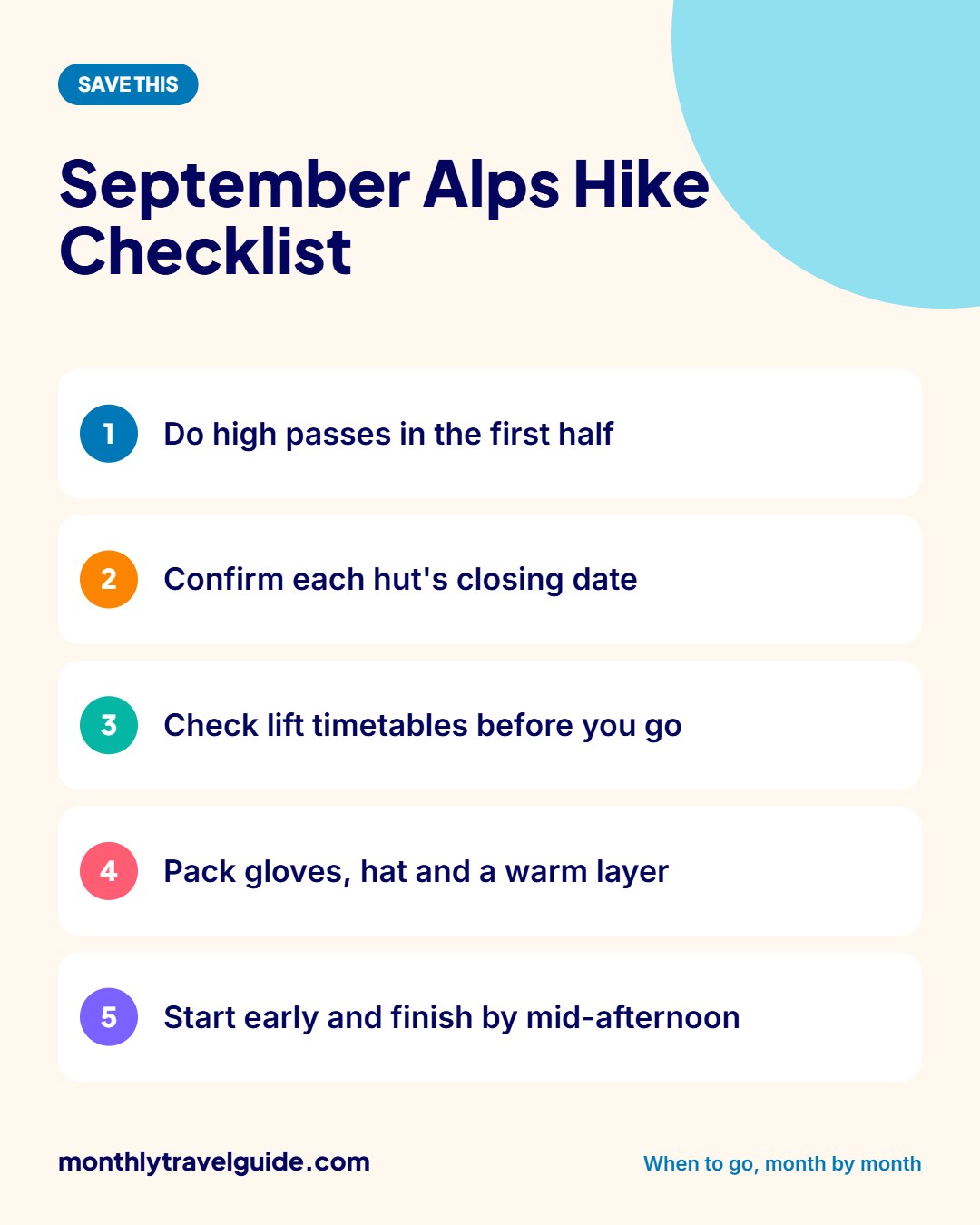
Late-September pack list
- Warm layer, hat and gloves even on sunny days
- Waterproof jacket and trousers
- Boots with good grip for wet or icy patches
- Headlamp and a charged phone
- Lift and hut closing dates written down
- Offline map of the route
For a full list by temperature, try the free packing generator, and our guide to packing for adventure travel in September covers layering for mixed conditions.
Larch Colour and Autumn Light
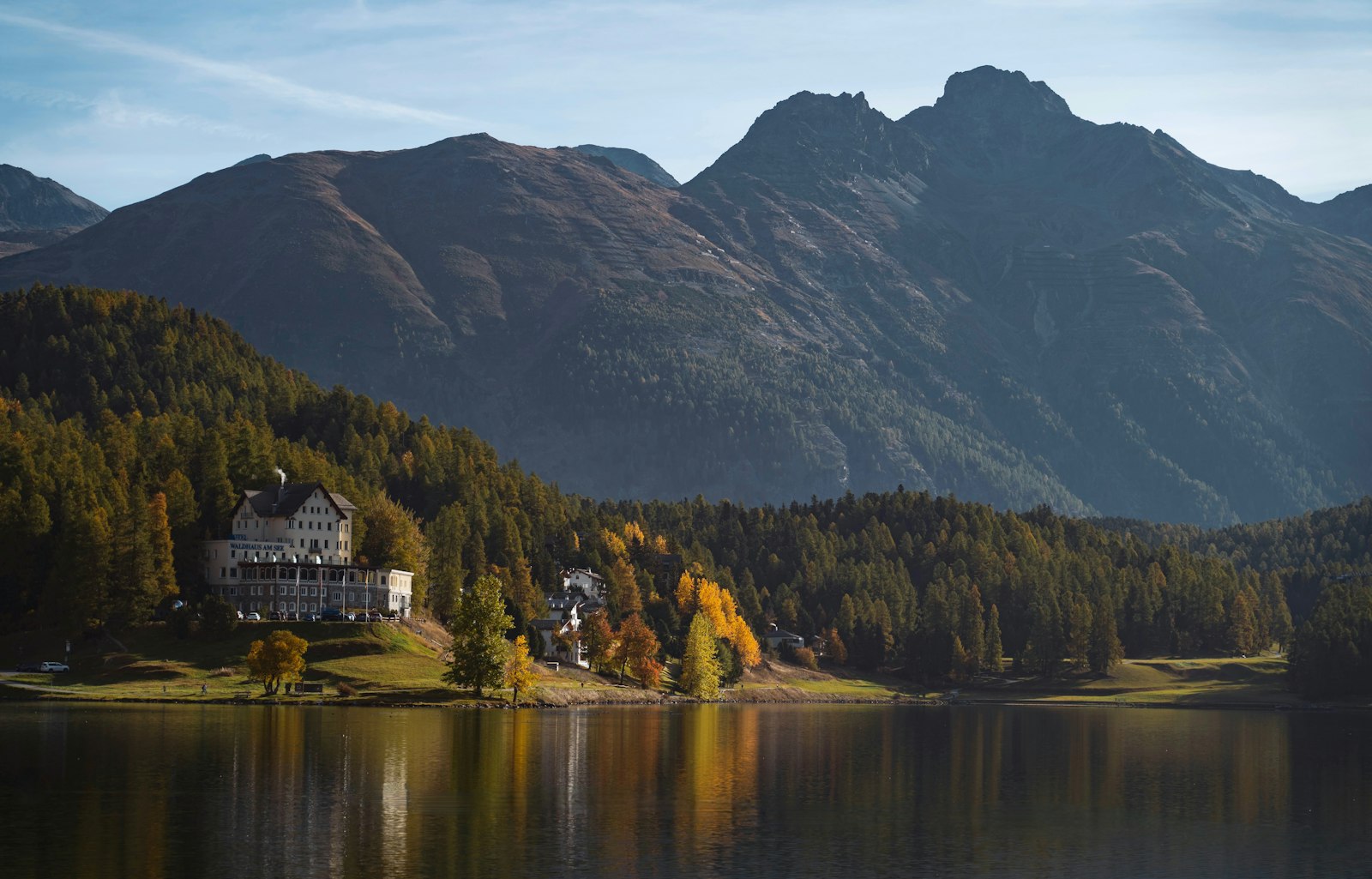
This section answers a common question: will you see the golden larches in September? Usually not at their peak. According to Swiss Family Fun, the larches typically turn from about the third week of October into early November, with the Engadin the strongest region and Zermatt, the Aletsch Arena and Oeschinensee also good. In some years the first trees around Zermatt start to colour at the end of September.
What September does give you is the start of autumn colour at mid-elevation, clear air after cold fronts and long, low light in the evenings. If golden larches are the main reason for your trip, move it to mid or late October, but accept that many lifts and huts are closing by then. If you want open trails first and colour second, late September is the compromise.
Cattle descents
From September into October, herds come down from the high pastures in decorated processions known as Alpabzug or désalpe. They take place in many areas, including the Bernese Oberland, Appenzell and the Engadin. Dates are set locally each year and are usually confirmed only a few weeks ahead, so ask the tourist office in the valley you plan to visit.
Crowds and Booking in September
This section covers how busy the trails are. Crowds drop after school terms start again in early September, and Tour Switzerland describes the first two weeks as still moderate, the third week as noticeably thinner and the fourth week as the quietest. The busiest lifts and viewpoints, such as the Jungfraujoch and Gornergrat, still draw visitors on clear days, so go early.
Accommodation in Zermatt and the Jungfrau villages can still be busy on good-weather weekends. Book main bases ahead and keep a flexible night if you are chasing a weather window. For dates that dodge crowds across Europe, our guide to avoiding crowds in September and the free shoulder season detector can help.
When Not to Hike the High Alps
This section is the honest part. September is a strong month, but some plans clash with it.
| Avoid | Why | Do this instead |
|---|---|---|
| High passes in the last week | Fresh snow and ice can reach the highest ground | Cross them in the first half of the month |
| Hut treks booked for the end of the month | Some huts close at the end of September | Confirm each hut’s closing date, or move the trek earlier |
| A trip timed for golden larches | Peak colour is usually in late October | Go from about the third week of October |
| Small lifts in the last week | Some cut hours or close for maintenance | Check timetables, use the big lifts |
| Glacier walking without a guide | Blue-and-white routes need gear and skills | Book a certified mountain guide |
Run your dates through the free When Not to Go checker if you want a quick second opinion.
Better Month If You Want Something Else
This section helps if your idea of an Alpine trip differs from a classic September hike.
If you want
Wildflowers in the meadows
Go in early summer, when the high pastures flower.
If you want
Golden larch forests
Go from about the third week of October, mainly in the Engadin and Valais.
If you want
Longest days and all huts open
Go in July or August and accept bigger crowds.
For more trail ideas around the world, see September hiking trails around the world and national parks in September; if the Alps are one stop on a longer trip, our guide to Europe in September covers the rest of the continent.
5 Common Mistakes on a September Alps Hike
1. Packing for summer
A warm valley afternoon tells you little about a ridge at 2,500 m. Carry a warm layer, hat, gloves and full rain gear on every high hike, even when the forecast is clear.
2. Leaving the high trek until the last week
The end of September brings the quietest trails but also the highest chance of snow on passes and the first hut closures. Do the high, committing routes first and keep the last days for lower walks.
3. Trusting last summer’s timetable
Lift seasons and hut dates change from year to year. Check the operator’s timetable and the hut’s own page shortly before you go, not months earlier.
4. Starting too late in the day
Days are noticeably shorter than in July. A late start on a long red-and-white trail can leave you descending in fading light. Aim to be walking by early morning.
5. Expecting peak larch colour
Photos of golden forests are almost always from October. Enjoy the first autumn tones in September, or move your trip later if colour matters most.
Swiss Alps Hiking in September: FAQ
Is September a good time to hike in the Swiss Alps?
Yes. September is part of the main Swiss hiking season, when snow cover on the high trails is at its lowest and nearly all marked paths are open. The big lifts still run, and crowds fall once the school holidays end. The trade-offs are colder mornings, shorter days and, in the last week, a chance of fresh snow on the highest passes, plus the first hut closures.
What is the weather like in the Swiss Alps in September?
It depends on altitude. Valley towns such as Interlaken see about 16 to 22 °C, resorts between 1,500 and 2,000 m about 8 to 16 °C, and the high ground above 2,500 m about 0 to 6 °C early in the month. Zermatt averages about 5 to 15 °C with roughly 50 mm of precipitation. Late in the month, temperatures on the highest terrain can fall below freezing.
Does it snow in the Swiss Alps in September?
It can, mainly on the highest ground. First snow on the high peaks and passes is possible by late September or early October, and cold fronts can leave a dusting at any time. Valley trails are rarely affected. If your route climbs above about 2,500 m, plan it for the first half of the month and keep a lower alternative ready in case fresh snow or ice appears.
Are mountain huts open in September in Switzerland?
Most staffed huts are open for at least part of September, but they close on different dates. Some close at the end of September, while others stay open into October. A few keep an unstaffed winter room with no meals. Always confirm the closing date with the hut before you set off on a multi-day route, and book ahead for weekends with a good forecast.
When do the larches turn yellow in Switzerland?
Larches usually turn golden from about the third week of October into early November. The Engadin around St. Moritz is the best region, with the Valais, the Aletsch Arena and Oeschinensee also good. Around Zermatt, the first trees can start to colour at the end of September, but September trips usually see only the start of autumn colour rather than the full golden forests.
Are cable cars open in Switzerland in late September?
The major ones are. In the Jungfrau region, the Schynige Platte railway, First and Männlichen usually run into late October, Glacier 3000 and Eggishorn into mid to late October, and the Oeschinensee cableway into early November. Some smaller cable cars cut their hours in the last week of September or close for maintenance, so check each operator’s timetable before you plan a route.
The Bottom Line
Swiss Alps hiking in September works best if you do the high routes and hut treks in the first half of the month and save the last week for lakes, valleys and lower trails. Pack for cold mornings, check lift and hut dates shortly before you go, and come back in October if golden larches are the goal. For more ideas, browse our September travel guides and the September travel guide.
Open trails, fewer people
The Shoulder Season Playbook
September in the Alps is a textbook shoulder season. The playbook shows how to find these windows anywhere: the weeks when crowds drop but services still run, what closes first and how to plan around it.
Digital download · All sales final
Free download
See the whole year before you book
Our free 12-Month Map puts every month for one country on four pages: when the weather works, when the crowds and prices peak, and the weeks to skip.
- 24 countries to choose from
- Region-by-region verdicts
- Printable PDF
Your download page opens as soon as you sign up. 24 countries available.
[…] Hiking the Porters Creek Trail when the wildflowers are in bloom […]