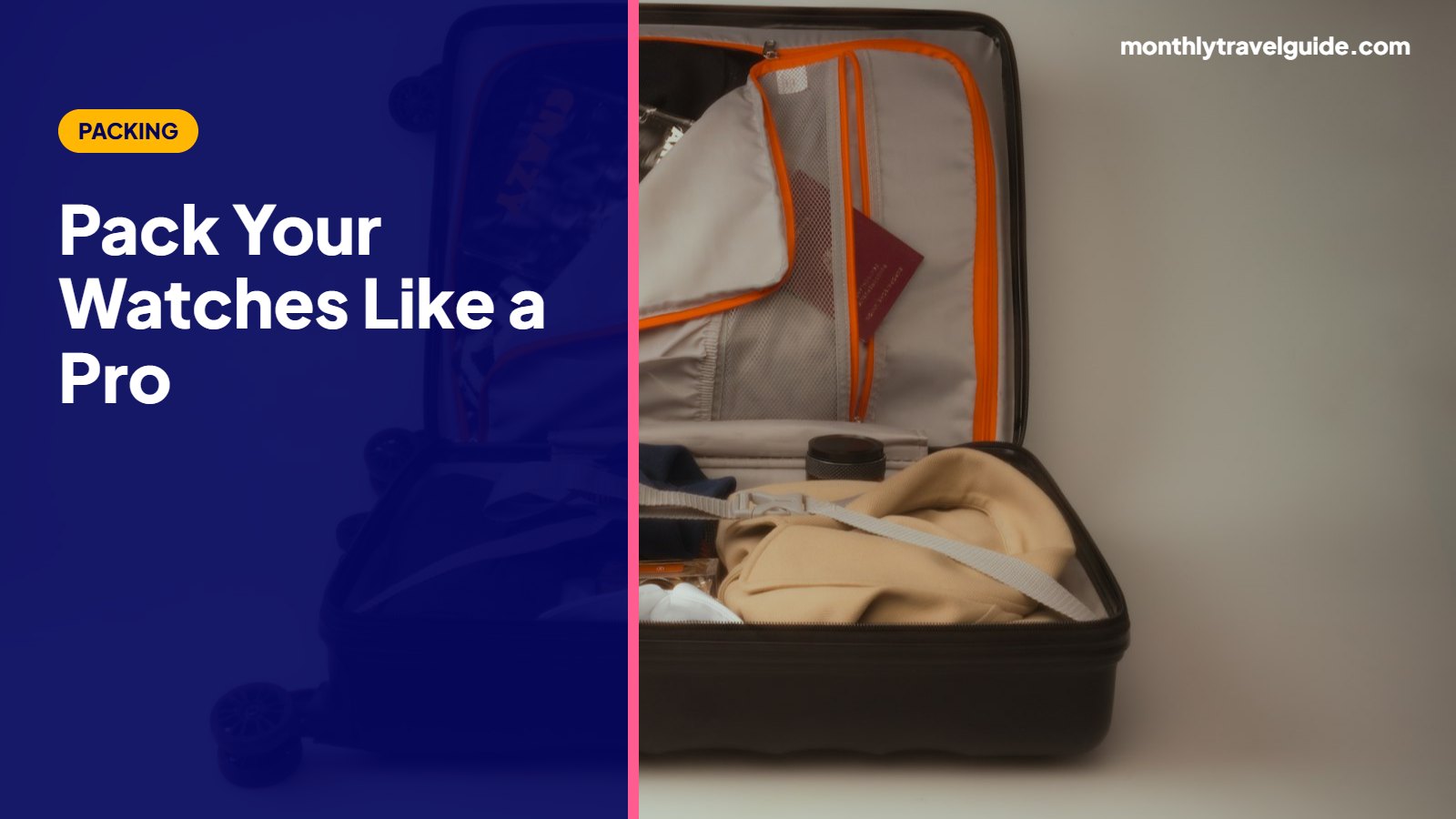
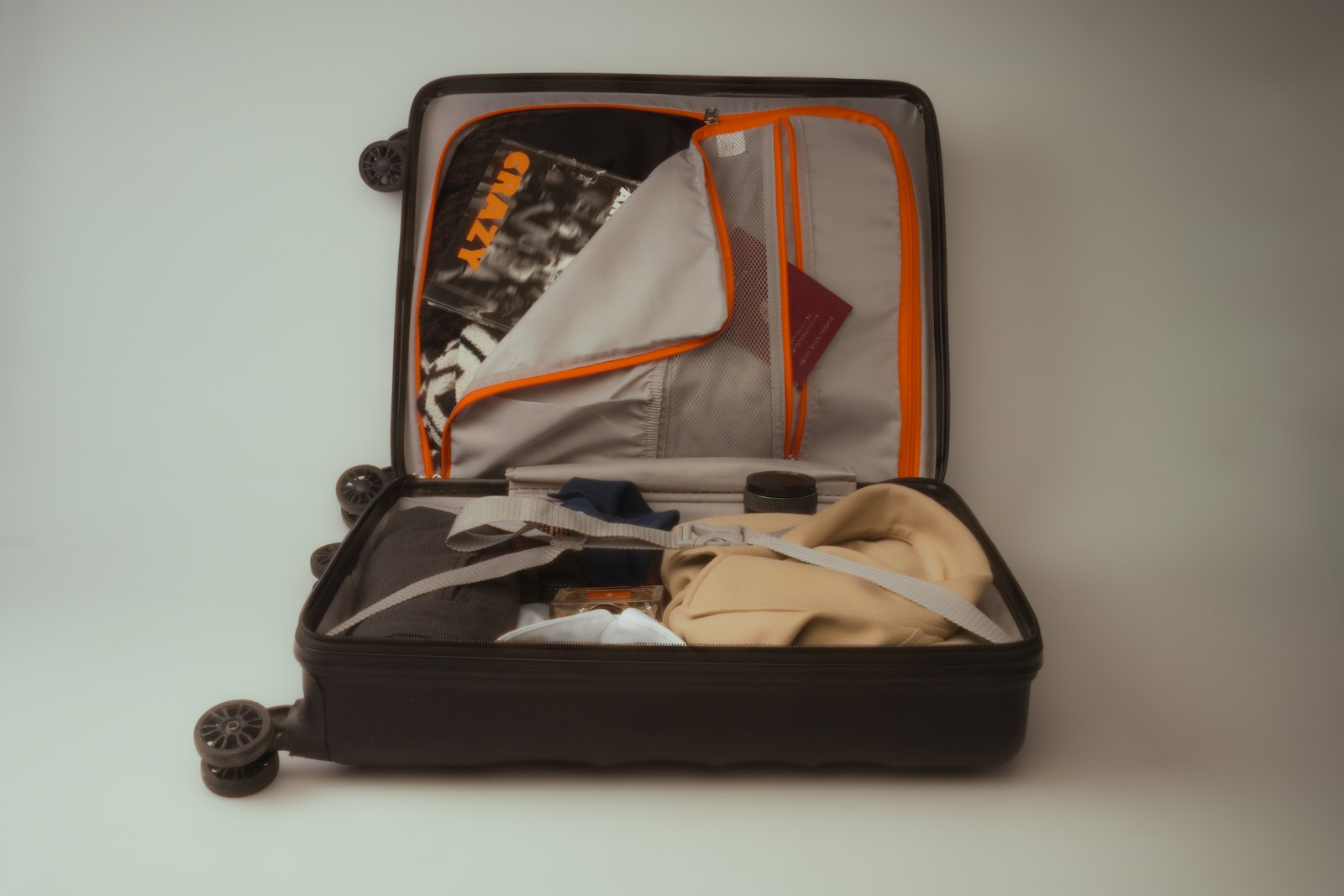
A watch travel case is a small padded box, roll or pouch that keeps one or more watches from scratching, knocking and drifting around your bag while you travel. The right one depends less on looks than on where and when you’re going: a humid wet-season beach, a dry desert summer and a ski week in the mountains each ask different things of your watches. This guide covers how to choose a case, how to pack it, how to get through airport security without a stray watch in a grey tray, and how to keep moisture, heat and magnets away on the road.

When to Go guides
Choose your country, then your month
24 country guides, each about 100 pages: every month rated for weather, crowds and prices, region by region, with a 7-day booking plan. Six guides per region bundle.
Browse the 24 guides · $19 eachRegion bundles: Europe, Asia & Pacific, Sun Souks & Safari, Americas · $47 each
Quick answer
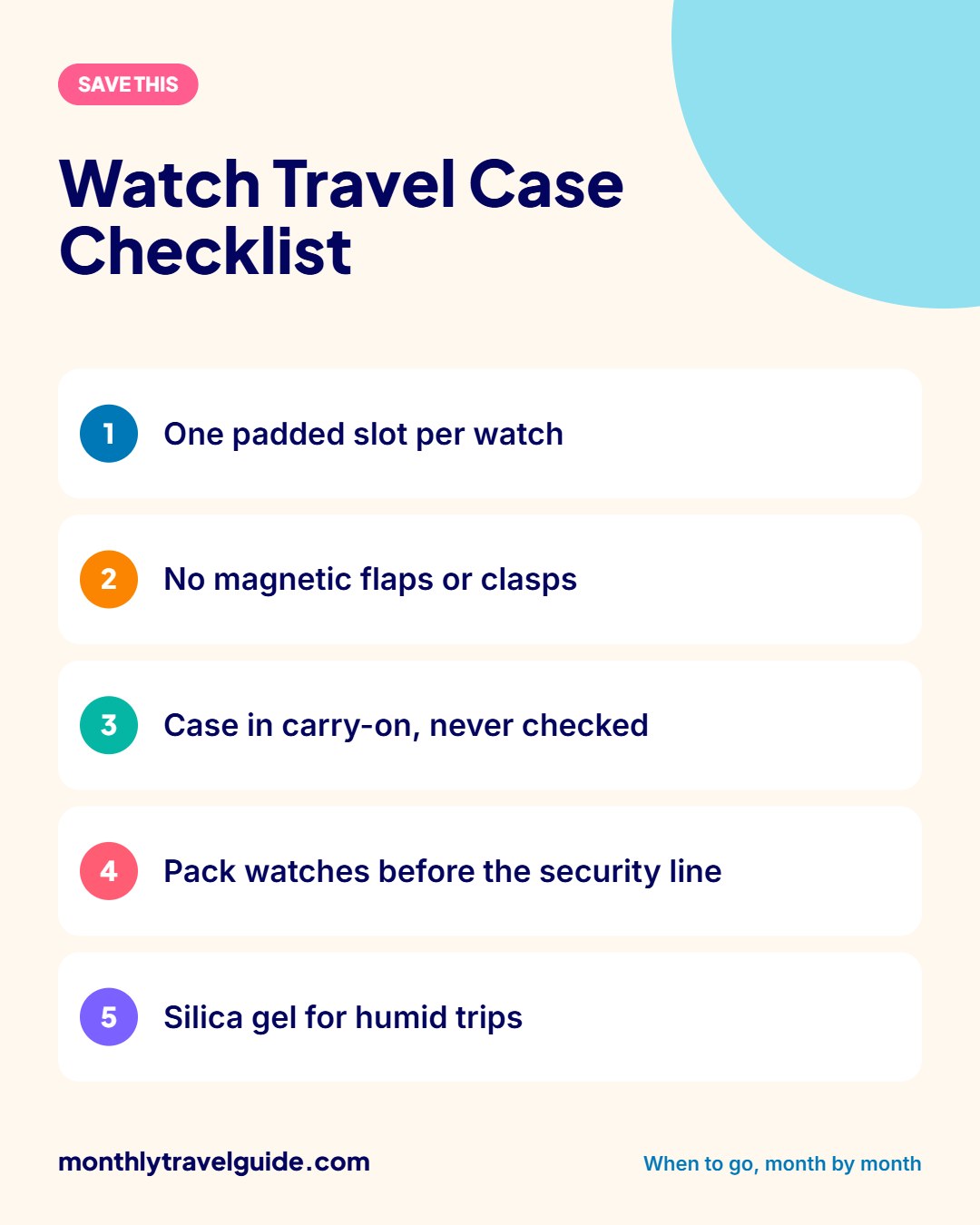
Choose a watch travel case with a firm shell, one padded slot per watch and a non-magnetic closure, sized to fit your carry-on. Put every watch in it before you join the security line, keep it with you rather than in checked bags, and add silica gel for humid trips. Smartwatches with lithium batteries belong in the cabin, and mechanical watches go through X-ray machines without harm.
Key takeaways
01
Airport X-ray machines are not magnetic and do not harm mechanical watches.
02
Everyday magnets do more damage: Seiko lists phones, tablets, AC adapters and bags with magnetic buckles.
03
The FAA lists watches among lithium-powered devices that should travel in carry-on bags.
04
TSA allows jewellery in both bags but advises keeping valuables with you, not in checked baggage.
05
In humid climates, moisture that gets inside a watch moves to the coldest part and can stay there.
06
Leather straps are not waterproof; pack a rubber, fabric or metal option for wet or sweaty trips.
Types of Watch Travel Case and Which One Fits Your Trip
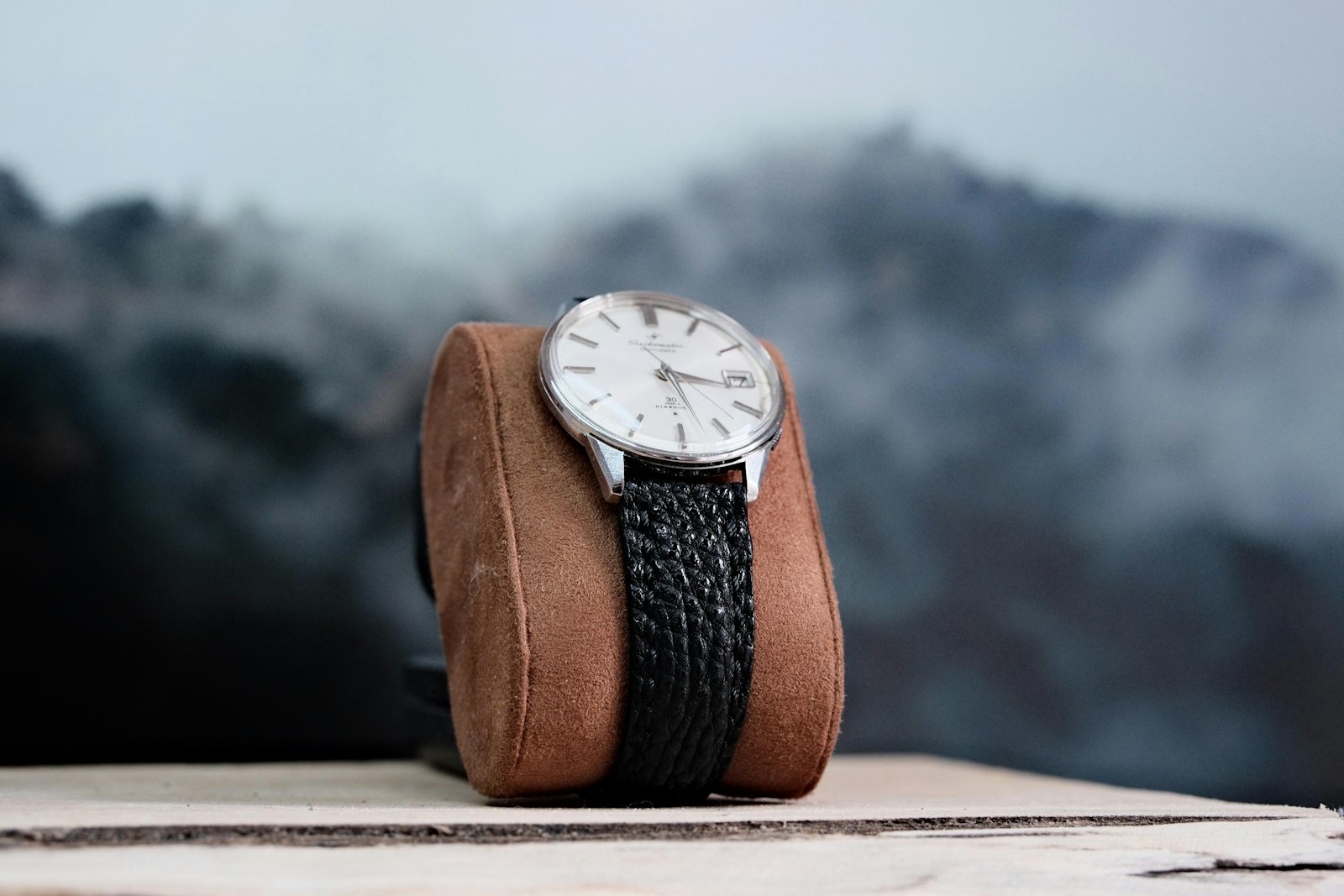
This section compares the main styles of watch travel case, so you can match one to the number of watches you carry and the kind of trip you take.
| Style | Holds | Best for | Weak point |
|---|---|---|---|
| Single-watch pouch | 1 | A city break with one watch on the wrist and one spare | Little crush protection; easy to lose in a big bag |
| Watch roll (soft) | 2 to 4 | Carry-on travellers who want a slim, flexible case | Watches can press together if the roll is packed too tight |
| Zip case, semi-rigid | 1 to 3 | Most trips; fits a backpack or tote and survives being squashed | Pillows can loosen over time |
| Hard-shell box | 2 to 6 | Longer trips, more valuable pieces, frequent flyers | Bulkier and heavier; harder to fit under a seat |
| Organiser with strap pocket | 1 to 2 plus straps | Trips where you swap leather for rubber or fabric | Not built for a large collection |
🗓️ Free: a 12-Month Map for your country
Every month on one page: best weeks, shoulder weeks and the ones to skip. Print it or keep it on your phone.
For most people, a semi-rigid zip case with two or three slots is the safest middle ground. It fits a jacket pocket or the top of a backpack and is firm enough that a squashed bag won’t pass the impact to the crystal.
Tip
Look at the inside before the outside. Each watch needs its own pillow or slot, the pillow should be firm enough to hold a bracelet closed without stretching it, and there should be no metal zip teeth or rivets that can touch a case or crystal when the lid is shut.
🧰 Try it while you read: a free tool for this trip
Free trip timing tool
Packing by Season Generator
A packing checklist built from the month's temperature, rain and sea.
Loading the tool…
How to Choose a Watch Travel Case: Seven Checks
This section turns the spec sheet into a buying checklist. Skip any case that fails more than one.
Fit your carry-on
Measure the pocket or packing cube where it will live. A case that only fits in your big suitcase will end up in the hold.
One slot per watch
Two watches sharing a slot will rub. Count the slots against the most watches you’d ever take.
Crush resistance
Press the lid with your thumb. It should flex little or not at all on a case meant for a full backpack.
Closure type
Zips and press studs are simplest. Seiko’s guidance lists bags with magnetic buckles among items that can affect a watch.
Lining
Soft, lint-free lining avoids scratches on polished cases. Rough suede can leave fibres in bracelet links.
Room for extras
A spare strap, a strap tool and a small silica gel sachet should fit without forcing the lid.
Easy to spot
A bright lining or a colour that stands out makes it harder to leave behind in a hotel safe or a seat pocket.
Material matters less than the frame inside. If you travel a lot in wet or humid places, a water-resistant outer fabric and a zip with a storm flap are more useful than fine leather, which marks easily in rain.
Airport Security With Your Watch Travel Case
This section covers the moment most watches get scratched, dropped or forgotten: the security checkpoint. The scanners themselves are not the problem. Grey trays, crowded belts and rushed repacking are.
Start with the fact that worries people most. X-ray machines and body scanners do not use or produce the kind of magnetic field that affects a mechanical watch, as this explainer from a watch retailer explains. Walk-through metal detectors create a weak field, but it is far below the level that modern balance springs are built to resist. The international standard for antimagnetic watches, ISO 764, asks a watch to withstand a field of 4,800 A/m and keep its rate within about 30 seconds a day, according to Wikipedia’s summary of the standard.

The Smart Timing Bundle
Pick the month, book in the right order, pack once
Six printable timing tools for any trip: the Trip Timing Planner, When to Book, When NOT to Go, the Shoulder Season Playbook, the family timing guide and the Packing by Season System.
See the bundle · $37Six products, $100 separately · Digital download · All sales final
So the goal at security is speed and control, not shielding. The Canadian screening authority CATSA advises putting small metal items inside your carry-on before screening, and the same habit works for watches anywhere. The US Transportation Security Administration lists jewellery as allowed in both carry-on and checked bags, but tells travellers to keep valuables with them at all times, notes that you can ask to be screened in private, and makes clear that the officer at the checkpoint has the final say.
Step 1
Before the queue
Take off every watch you won’t wear through the scanner and put it in the case.
Step 2
Case in the bag
Zip the case into your carry-on, not loose in a tray, so it stays inside one item on the belt.
Step 3
Wearing one?
A simple watch can often stay on; if asked, remove it straight into a pocket or the case, never the open tray.
Step 4
At the end
Collect your bag first, then check the case is closed and every slot is full before you walk away.
Step 5
Smartwatch
Keep it on you or in the cabin bag; it’s a lithium battery device.
Important
Smartwatches and fitness trackers contain lithium batteries. The FAA PackSafe guidance lists watches among portable electronic devices that should be carried in the cabin; they may go in checked bags only if fully switched off and protected from damage, and spare lithium batteries are not allowed in checked bags at all. Airline rules can be stricter, so check yours before you fly.
Timing helps too. In peak weeks, leave extra time so you can repack calmly. Our guide to the January airport rush covers the worst queues of the year, and peak season travel explains how holiday weeks change the whole trip.
Climate and Season: How to Pack a Watch Travel Case for the Weather
This section looks at the trip conditions that matter for watches and how to adjust what goes in your watch travel case for each.
Bring your best watch? Trip-by-trip verdicts
Go · Go with care · Skip
Humid tropics, wet season
Go with careSilica gel in the case; rubber or metal strap; screw crowns down
Beach and pool trips
Go with careCheck the water rating; rinse after salt water or chlorine
Dry desert heat
GoKeep the case out of direct sun and hot cars; fabric strap
Cold winter cities
GoAvoid going straight from frozen street to steamy spa
Ski and snow trips
Go with careWear a sturdy watch; the dress watch stays in the case
Monsoon city breaks
Go with careWater-resistant case fabric; swap leather for rubber
Long-haul flights
GoCase in the cabin bag, not the overhead locker edge
General guidance by the Monthly Travel Guide editorial team. Always follow your watch maker's instructions.
Humid and wet-season trips
Humidity is the quiet risk. A watch-care guide from Define Watches warns that moisture which gets inside a watch, often showing as fog under the crystal after a flight or a cold-to-warm change, travels to the coldest part of the watch, usually the movement, and does not simply disappear when the fog clears. The same guide advises keeping watches away from humid shower and spa conditions, making sure crowns and pushers are fully closed, and keeping seals up to date with regular servicing, including a pressure test for watches rated above 5 bar. If you see moisture inside, take the watch to a watchmaker rather than waiting.
For your case, that means a small sachet of silica gel inside the lid, a case that zips fully shut, and a habit of putting watches away dry. Don’t store a damp watch in a closed case overnight. Let it air at room temperature first.
Hot, dry and cold trips
In heat, keep the case out of direct sun and don’t leave a smartwatch charging in a hot car. In cold places, the risk is the jump from a frozen street to a hot sauna, exactly when condensation forms, so leave the watch in the case before the spa.
If you’re packing for very different climates on one trip, the free Packing Generator builds a list by destination and month, and the Best Month Finder shows when a place is at its wettest or most humid.
Straps, Spares and What Goes Inside the Case
This section covers the small things that make a watch travel case useful on the road.
Leather is the strap most often ruined on holiday. As Marathon Watch points out, leather is not waterproof: it stiffens with repeated moisture, takes on sweat, and cracks if you dry it with a hair dryer or in direct sun. Let a wet strap dry naturally in a shaded spot. For beach, rainy-season or very hot trips, pack a rubber, fabric or metal bracelet instead and keep the leather for evenings.

The complete kit
Every country guide, every timing tool
All 24 When to Go country guides, the six Smart Timing tools and every 12-Month Map, with a Start Here that tells you what to open first.
See the kit · $127The five bundles cost $225 separately · Digital download · All sales final
| Item | Why it earns its space | When to pack it |
|---|---|---|
| Spare rubber or fabric strap | Handles water, sweat and sunscreen | Beach, tropics, summer cities |
| Small strap tool | Quick swaps in a hotel room | Any trip with a spare strap |
| Silica gel sachet | Soaks up moisture in the closed case | Humid and wet-season trips |
| Soft microfibre cloth | Wipes salt, sweat and sunscreen off cases | Every trip |
| Charging cable for a smartwatch | Easy to forget; often brand-specific | Every trip with a smartwatch |
| Small card with serial numbers | Helps with insurance or a theft report | Trips with valuable watches |
Water resistance ratings are easy to misread. The same rainy-season guide suggests, as a rough rule, not swimming with a watch rated below 10 bar (100 m), and always following the maker’s own instructions, which override any general rule. Rinse a watch in fresh water after salt water or chlorine so grit doesn’t build up around the crown and pushers.
Keep Magnets Away From Your Watch Travel Case
This section covers magnetism, which affects mechanical watches more often than airport machines do. A magnetised watch usually runs fast, sometimes by minutes a day, or stops, and needs a watchmaker to demagnetise it.
Seiko’s own instructions, published on its instruction pages, list everyday sources that can affect a watch: smartphones and tablets including their speakers and cover magnets, AC adapters, bags with magnetic buckles, AC-powered shavers, magnetic cooking devices, portable radios with speakers and magnetic necklaces. For watches with no antimagnetic marking on the case back, Seiko advises keeping them more than 5 cm from such items; for watches marked to the higher JIS level 2, more than 1 cm.
So don’t store your watch travel case in the same pocket as a phone or a tablet with a magnetic cover, and don’t rest watches on a laptop or speaker. A case in its own pocket solves most of this.
Warning
If a mechanical watch suddenly gains several minutes a day after a trip, magnetism is a likely cause. It’s usually a quick fix for a watchmaker. Don’t open the case back yourself.
Packing for a season, not a guess
The Packing by Season System
The watch case is one small part of a bag. This system packs by the weather you will actually meet, with lists for wet seasons, dry heat, cold cities and shoulder months, so straps, layers, rain gear and electronics are right for the place and the month before you zip the case shut.
See the Packing by Season System →Digital download · All sales final
Using a Watch Travel Case at the Hotel and on the Road
This section covers the rest of the trip. Most losses happen after the flight: on a bathroom shelf, in a beach bag, at a pool lounger or in the hotel safe on checkout day.
Give the case a fixed home in your room, ideally the safe, and put any watch you are not wearing straight back into its slot, never on a steamy bathroom shelf. On checkout day, check the case before the drawers. If you want a slimmer kit overall, our guides to packing light without losing comfort and travel tech that earns its space cover how to cut the rest of the bag down so a case fits in your personal item.
When Not to Bring Your Best Watches
This section is the honest part. Some trips are simply hard on watches, and the best case in the world can’t change that.
| Avoid | Why | Do this instead |
|---|---|---|
| A valuable watch on an adventure or ski trip | Knocks, falls and gloves; little time to take it off | Wear a sturdy, cheaper watch and leave the good one at home |
| Leather straps in the wet season | Leather is not waterproof and stiffens with moisture | Pack rubber or fabric |
| Watches in checked luggage | Out of your control; TSA advises keeping valuables with you | Carry-on, every time |
| Wearing a watch in the spa or steam room | Steam and heat can push moisture past ageing seals | Leave it in the case in your room or locker |
| A collection on a short city break | More to lose, more to repack at security | One on the wrist, one spare at most |
If the trip is a winter one, our winter packing list covers the rest of a cold-weather bag, and for a humid island, what to pack for Zanzibar shows how a tropical list changes by season. Unsure whether your dates fall in a wet season? Run them through the free When Not to Go checker.
A Better Choice If You Want Something Else
This section helps if your situation doesn’t match the standard advice.
If you have
Only one watch
A single pouch or a slim zip case, worn the rest of the time.
If you have
A smartwatch plus a mechanical
A two-slot case, kept away from the phone, with the charger packed beside it.
If you have
Vintage watches
A hard-shell box, silica gel and no swimming with them, whatever the case back says.
If you have
Backpacking for weeks
A crush-resistant semi-rigid case and one sturdy watch, not a collection.
If you have
Mostly business trips
A slim leather case with room for a spare strap to switch from day to evening.
5 Common Mistakes With a Watch Travel Case
1. Packing it in checked luggage
A watch case in the hold is out of your sight for hours and can be crushed under heavier bags. Keep it in your carry-on or personal item, and keep smartwatches in the cabin, as aviation rules on lithium devices expect.
2. Dropping watches loose into a security tray
Trays slide, tip and get stacked. Put watches in the case and the case in your bag before the queue, so nothing small travels alone on the belt.
3. Choosing a case with a magnetic closure
A magnetic flap sits right next to the watches every time the case is shut. Choose a zip or press stud instead, and keep the case away from phones and tablet covers.
4. Closing a damp watch in the case
After rain, a pool or a humid day, let the watch dry at room temperature before you put it away. A sealed case keeps moisture in as well as out.
5. Bringing the wrong strap for the season
A leather strap on a wet-season trip or a beach week wears out fast. Pack the strap for the weather, not for the look you had at home.
Watch Travel Case FAQ
Can I put my watch in checked luggage?
You can, as jewellery is allowed in both carry-on and checked bags under TSA rules, but it isn’t a good idea. TSA advises keeping valuables with you at all times rather than in checked baggage. A watch travel case in your carry-on stays in your control, avoids crushing under heavier bags and is easy to reach on arrival.
Do airport scanners damage mechanical watches?
No. X-ray machines and millimetre-wave body scanners don’t use or produce magnetic fields strong enough to affect a mechanical watch. Walk-through metal detectors create a weak field, far below the 4,800 A/m that the ISO 764 antimagnetic standard asks watches to withstand. Everyday magnets in phones, tablet covers and bag clasps are a bigger risk than the checkpoint.
Do I have to take my watch off at airport security?
It depends on the airport and the officer. Many travellers can keep a simple watch on, while bulky jewellery is often removed. The safest habit is to put any watch you won’t wear into its case and the case into your carry-on before the queue, so nothing small travels loose in a tray. The officer always has the final say.
Can you take a smartwatch on a plane?
Yes. The FAA lists watches among portable electronic devices with lithium batteries that should travel in carry-on bags. They may go in checked bags only if fully switched off and protected from damage, and spare lithium batteries must stay in the cabin. Pack the charger next to it, because smartwatch chargers are easy to forget and often hard to replace abroad.
How do I protect my watch from humidity when travelling?
Keep crowns and pushers fully closed, avoid steamy bathrooms, spas and saunas, and add a silica gel sachet to your watch travel case. Let a damp watch dry at room temperature before you shut it in the case. If you see fog under the crystal, have a watchmaker check it, because moisture can move into the movement even after the fog clears.
What size watch travel case should I buy?
Buy one slot more than the number of watches you usually travel with, and make sure the case fits the carry-on pocket or packing cube where it will live. For most people that is a two or three-slot semi-rigid zip case. Bigger hard boxes suit longer trips or collections, while a single pouch suits short trips with one spare watch.
The Bottom Line
The best watch travel case is the one that fits your carry-on, gives each watch its own padded slot, closes without magnets and has room for silica gel and a spare strap. Pack it before security, keep it with you, and match straps and spares to the season you’re travelling in. For more practical advice, browse our travel tips.
Free download
Which month for your country?
Get the free 12-Month Map: every month marked good, shoulder or avoid, region by region, on four printable pages.
- Greece to Japan, Morocco to Peru: 24 countries
- See the crowd and price peaks before you book
- Free, no purchase needed
Your download page opens as soon as you sign up. 24 countries available.