

These hotel booking tips are about timing: when to reserve your room, how long to keep a free cancellation open, which room to ask for in each season and what time to turn up at the front desk. The same hotel can be a bargain in one week and fully booked in the next, and the same room can be quiet in winter and loud in summer. Get the dates right first, then the rate, then the room. Everything below works for any destination, from a city break to a beach week.

When to Go guides
Choose your country, then your month
24 country guides, each about 100 pages: every month rated for weather, crowds and prices, region by region, with a 7-day booking plan. Six guides per region bundle.
Browse the 24 guides · $19 eachRegion bundles: Europe, Asia & Pacific, Sun Souks & Safari, Americas · $47 each
Booking window by trip type
How far ahead should you book?
6+ months out
Fixed-date events, school holidays, festivals
Book early2 to 3 months
Peak season at popular coasts and cities
Book flexible1 to 2 months
Ordinary dates in most places
Book flexible1 to 2 weeks
Shoulder and low season, big cities midweek
Book lateRules of thumb from booking-data guidance and hotel policy guides. Always book with free cancellation when the date is far away.
The short answer
For ordinary dates, booking a month or two ahead is usually enough, and in low season the last week or two can be cheaper still. For school holidays, festivals, big sporting events and peak coastal summers, book early on a free-cancellation rate and recheck the price later. Choose your room by season: high and away from lifts for noise, shaded and air-conditioned for heat, and confirm check-in and late-arrival rules before you travel.
Key takeaways
When you stay changes the price far more than the day you click book.
Free cancellation is your price insurance: book early, then rebook if the rate drops.
Cancellation deadlines get longer and stricter in peak season and around big events.
A high floor away from lifts, ice machines, bars and the main entrance is the classic quiet room.
In hot months, ask for a room facing away from the afternoon sun with its own air conditioning.
Check-in usually opens mid-afternoon; early access is a request, not a promise.

Hotel Booking Tips: When to Book, Season by Season
This section covers the booking window, which depends far more on the season you travel in than on any trick of the calendar. Price-tracking guidance from KAYAK puts it plainly: when you stay matters more than when you book. A quiet Tuesday in a shoulder month will almost always beat a Saturday in high summer, however cleverly you time the reservation.
For ordinary dates in most places, booking a month or two ahead is a safe middle path. KAYAK’s guidance notes that booking much earlier than that usually means paying more, unless you travel in a peak period, and that in quiet periods some of the best rates appear in the last week or two, when hotels try to fill rooms that other guests have just cancelled.
| When you travel | Booking approach | Why |
|---|---|---|
| School holidays and national holiday weeks | Book early, on a free-cancellation rate | Family rooms and connecting rooms run out first |
| Festivals, big concerts, sporting events, conventions | Book as soon as dates are fixed | Rooms can sell out and stricter rate rules often apply |
| Peak summer at the coast | Two to three months ahead, flexible rate | Summer prices are generally higher at coastal destinations |
| Ski resorts in winter | Book early for holiday weeks | Winter is cheap in most places, but not in snow resorts |
| Shoulder season (spring and autumn) | A month or two ahead, or later | More choice and fewer sell-outs |
| Low season in cities | Late booking is often fine | Hotels compete for fewer guests |
🗓️ Free: a 12-Month Map for your country
Every month on one page: best weeks, shoulder weeks and the ones to skip. Print it or keep it on your phone.
Two patterns hold in most markets. Summer prices are generally higher, especially in coastal destinations, and winter prices are generally lower, except in winter sports resorts and around the big holidays. KAYAK’s data also points to January as the cheapest month for hotels, with November close behind. For trips abroad, the same source finds Friday and Saturday the most expensive nights to check in, with midweek check-ins cheaper.
Tip
Before you lock in dates, check the local and national holiday calendar and any convention or trade-fair calendar for the city. A single large fair can fill a mid-sized city’s hotels for a week. The free Festival Month Matcher and Shoulder Season Detector help you spot clashes before you book.
If you are planning a whole trip, the hotel is rarely the first thing to book. Flights, rail passes and any timed-entry sight usually come first; our guide on what to book first when planning a trip sets out the order. And if your dates fall in a high season you cannot move, read our peak season travel tips before you commit.
🧰 Try it while you read: a free tool for this trip
Free trip timing tool
When to Book Calculator
Tells you how early to lock in flights and rooms for your month and country.
Loading the tool…
Cancellation Windows: Read Them Before You Pay
This section explains the cancellation terms that sit behind every rate, because they decide what a change of plan will cost you. The cheapest rate on the screen is often the strictest one, and the difference only shows up when something goes wrong.
Hotel policy guides from Engine describe the common patterns. A flexible rate often lets you cancel up to 24 to 48 hours before check-in without a fee, but the cutoff can be 72 hours, or even a whole week, especially in busy seasons and around special events. Cancel inside the last 24 hours and you often pay at least the first night. Non-refundable rates charge the full amount whatever happens, and missing your stay without cancelling usually costs at least one night, sometimes the whole booking.

The Smart Timing Bundle
Pick the month, book in the right order, pack once
Six printable timing tools for any trip: the Trip Timing Planner, When to Book, When NOT to Go, the Shoulder Season Playbook, the family timing guide and the Packing by Season System.
See the bundle · $37Six products, $100 separately · Digital download · All sales final
Peak season changes the rules. Hotels may enforce stricter terms during holidays and summer, with earlier deadlines or bigger penalties, and around major conferences, festivals and sporting events you may meet non-refundable-only rates, longer notice periods or full payment up front. That is exactly when a flexible rate booked early is worth the slightly higher price.
Important
Write the cancellation deadline in your calendar the day you book, with the hotel’s local time zone. Many deadlines are set in the property’s local time, and a few hours’ difference can turn a free cancellation into a paid night. If the terms are unclear, ask the hotel in writing and keep the reply.
The smartest use of a flexible rate is to keep shopping. Book a refundable room once your dates are fixed, set a price alert, and rebook if the same room drops before the deadline. Prices do not fall at a set hour of the day, so a weekly check is enough. For more ways to cut the bill without cutting comfort, see our budget travel tips and how to stay somewhere special for less.
Choosing a Quiet Room
This section covers noise, the most common reason for a bad night in a good hotel. Noise also changes with the season: open windows and terrace bars in summer, holiday parties in December, wedding weekends in late spring and early autumn.
Advice gathered by CBS News is a good checklist. Ask for a high floor, away from the main entrance and the street. Avoid rooms next to housekeeping closets, ice and vending machines, the restaurant or the bar. A room facing an inner courtyard is often calmer, as long as it does not overlook the bin collection area. If the room sits beside a lift shaft or has a connecting door to the next room, ask for another one.
High floor, courtyard side, end of the corridor, no connecting door
Lifts, ice machines, service closets, the bar, the main entrance
Renovation work, double-glazed windows, nightlife on the street
Skip party weekends, big sports events and wedding season if you can
Two more checks save a lot of trouble. Ask whether the hotel is being renovated or extended; if it is, ask for a room far from the work or look elsewhere. And ask about the windows, since even smart properties can have thin, single-pane glass. When you arrive, don’t unpack until you’re sure the room is quiet enough; moving is far easier in the first ten minutes than at midnight.

Remember that busy weeks are noisy weeks. A city hotel that is calm on a winter Tuesday can be loud during a festival, and a beach resort fills with groups in school holidays. If quiet matters most, match the room request to a quieter week. Our guide to avoiding crowds when you travel shows how to find those weeks.
Choosing a Room for the Season: Heat, Cold and Light
This section covers the room choices that change with the weather. A south- or west-facing room with a big window feels wonderful in winter and can be hard to sleep in during a heatwave, so the best room in January is not always the best room in August.
For hot months, guidance from Zafigo is simple. Confirm the room has working air conditioning before you book, ask for a room facing away from direct sunlight, and look for proper blinds or curtains. Rooms with windows on opposite sides cool down better, and lower floors tend to cool faster after sunset. In older buildings, top-floor rooms under the roof can hold the day’s heat well into the night.
Warning
Air conditioning is not universal. As Wego points out, availability varies with the age of the building, the country and the type of property, and older or boutique hotels in parts of Europe may have none. Ask whether your specific room has its own unit and whether it runs all summer, and read reviews from the hottest months before you book.
Summer heat
Room away from the afternoon sun, own air conditioning, blackout curtains, shaded pool
Winter cold
Sunny side, good heating, double glazing, a room away from the entrance draught
Rainy season
Covered walkways, indoor spaces, a central location so you can step out between showers
Long summer evenings
Blackout curtains matter in the far north, where nights stay light
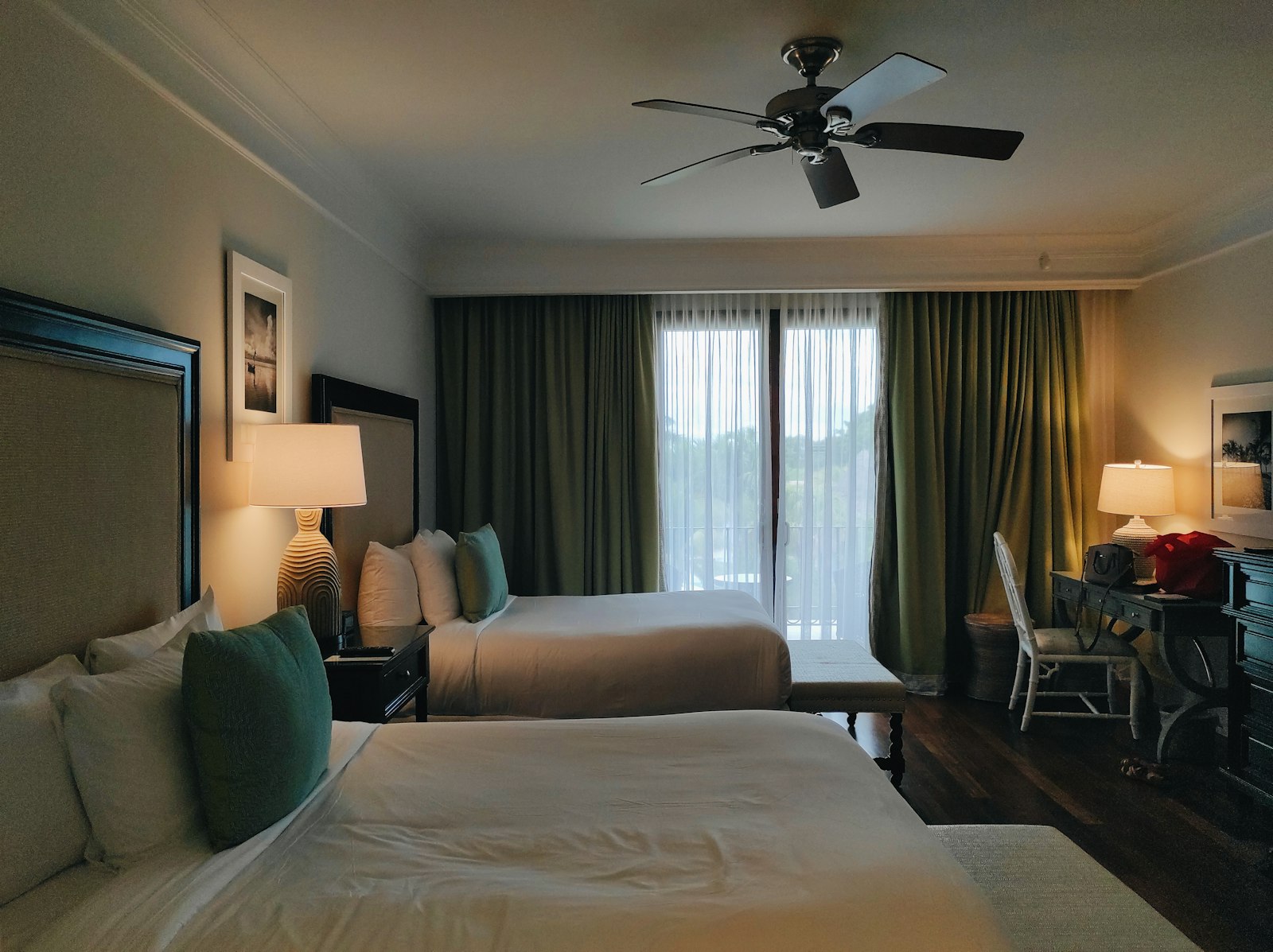
Light matters too. A room with a view over a beach faces the sun for much of the day, which is lovely in spring and tiring in midsummer. In winter, a bright room lifts the mood when days are short. If you are sensitive to light or arrive jet-lagged, ask for blackout curtains; our jet lag tips explain why a dark room on the first night helps.

The complete kit
Every country guide, every timing tool
All 24 When to Go country guides, the six Smart Timing tools and every 12-Month Map, with a Start Here that tells you what to open first.
See the kit · $127The five bundles cost $225 separately · Digital download · All sales final
Check-In Timing: Early Arrivals, Late Arrivals and Check-Out
This section covers arrival day, when timing problems are most common. Most hotels set check-in for mid-afternoon and check-out for late morning, and the gap between them is when rooms are cleaned for the next guest.
| Situation | What usually happens | What to do |
|---|---|---|
| Arriving in the morning | Check-in typically opens between 3 pm and 4 pm local time | Ask to store luggage; most hotels do this at the front desk |
| Want early check-in | Possible only if a room is free; not guaranteed | Request it 24 to 48 hours ahead, or book the night before |
| Arriving after midnight | Hold policies vary from hotel to hotel | Tell the hotel your arrival time in writing |
| Late flight home | Check-out is usually between 11 am and noon | Ask for late check-out, or store bags after you leave |
| Peak season weekend | Full hotels have fewer free rooms early | Expect the standard time; plan your first hours around it |
Source: hotel operations guidance from Prostay. In busy weeks, when a hotel is full every night, early check-in is less likely because rooms are turned around just in time. In low season, with empty rooms on every floor, a polite request at the desk often works. If you land at dawn after a long-haul flight and need a bed, booking the previous night is the only sure option.
Tip
Arriving late? Message the hotel with your arrival time, and if your flight is delayed, call before midnight local time. Hold policies for late arrivals vary from hotel to hotel, and a missed arrival can be charged as a no-show, so a short note protects the booking.
Checking out late works the same way. On a quiet Sunday it is often possible; on the morning before a big holiday weekend it rarely is. Ask the evening before, not at the desk on the last morning.
Hotel Booking Tips That Work in Any Season
This section brings the habits together into a short routine you can repeat for every trip. None of them needs special memberships or apps, only a little planning.
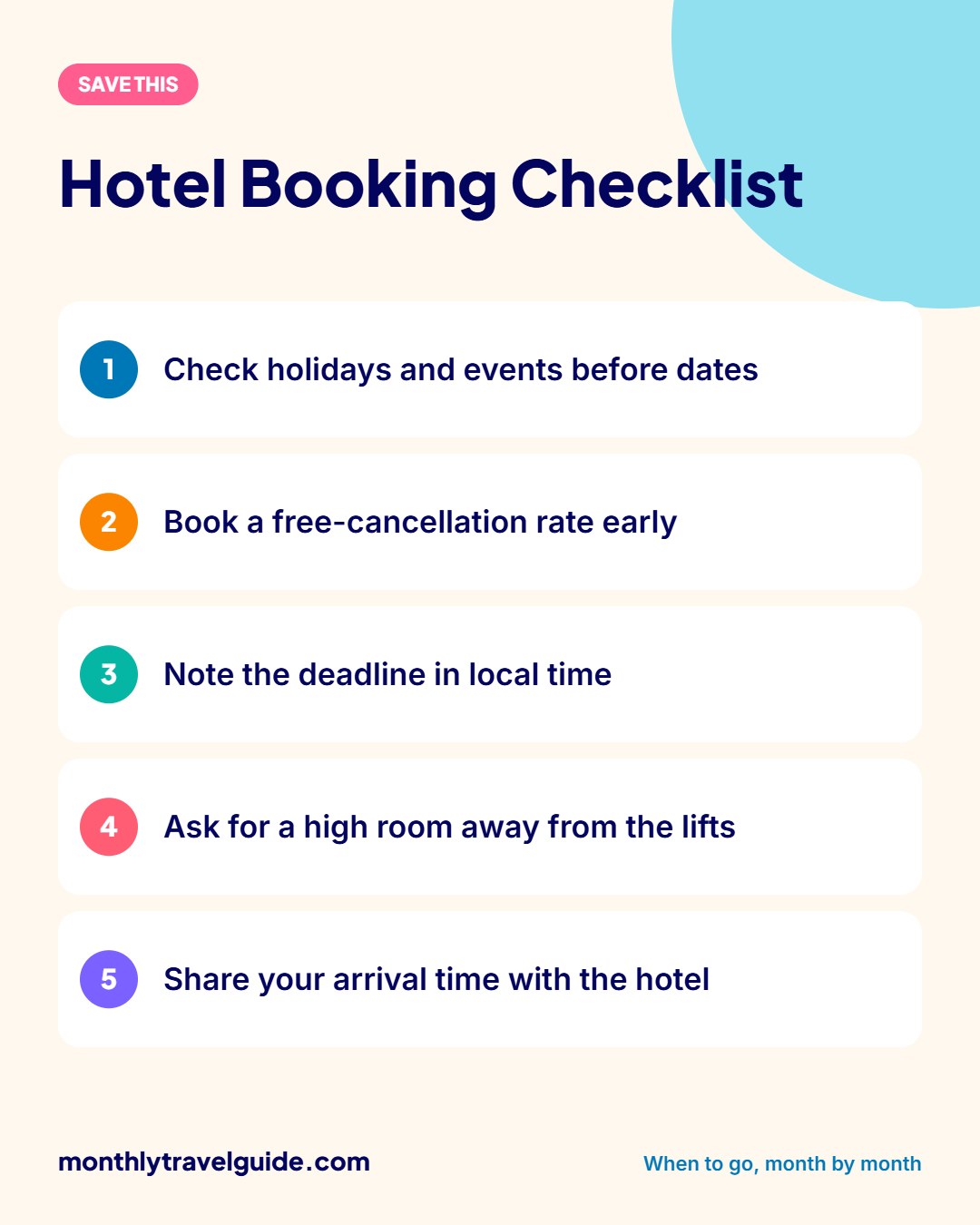
Fix the dates first
Check holidays, festivals and events for your destination before you search for rooms.
Book flexible early
Reserve a free-cancellation rate once dates are fixed; note the deadline.
Recheck the price
Look again every week or two, and rebook if the same room drops.
Request the right room
Ask for quiet, shade or sun as the season needs, in writing.
Confirm arrival
Share your arrival time and ask about luggage storage.
Searching for one traveller can also show lower rates in some places, since some hotels, especially in Europe, discount rooms for solo guests. And whatever site you use, read the full rate conditions on the final page before paying: the room type, the cancellation deadline, whether breakfast and taxes are included, and the payment date. The free When to Book calculator works out a sensible booking window for your trip.
When Not to Leave Your Hotel Booking Late
This section is the honest part. Last-minute booking can be a bargain, but in some weeks it leaves you with the worst rooms or none at all.
| Avoid booking late | Why | Do this instead |
|---|---|---|
| School holiday weeks | Family rooms and connecting rooms go first | Book early on a flexible rate |
| Festival and event dates | Rooms sell out; stricter rates apply | Book once dates are announced |
| Peak summer at the coast | Sea-view and shaded rooms go first | Book two to three months ahead |
| Holiday weeks at ski resorts | Winter’s lower prices don’t apply to snow resorts | Book early; move a week if you can |
| Small islands and villages | Few hotels, so little room to manoeuvre | Book as soon as transport is fixed |
Not sure if your dates are risky? Run them through the free When Not to Go checker.
Better Timing If You Want Something Else
This section helps if a better price, a calmer stay or a better room matters more than your exact dates.
If you want
Lower rates
Travel in the shoulder months of spring and autumn, or in January and November in many places, and check in midweek.
If you want
A quiet stay
Avoid weekends with big events, wedding season and school holidays; ask for a high, courtyard room.
If you want
The best room choice
Book early for peak weeks, when the best views and shaded rooms go first.
If you want
Easy arrival
Travel when hotels are not full, so early check-in and late check-out are more likely.
If you want
Fewer surprises
Pick a flexible rate and a shoulder week; read travel booking and planning for more on complex trips.
5 Common Hotel Booking Mistakes
1. Booking a non-refundable rate months ahead
A small saving is not worth losing the whole stay if plans change. Far-out bookings should almost always be flexible; save non-refundable rates for short trips with fixed dates, booked close in.
2. Ignoring the event calendar
A city can be cheap one week and sold out the next because of a trade fair, a final or a festival. Check local holidays and events before you choose dates, not after you have paid.
3. Accepting the first room you are given
If your room is beside the lift, above the bar or facing a busy road, ask to move straight away. It is easier before you unpack and while the hotel still has free rooms.
4. Assuming air conditioning or heating
Older hotels may have no air conditioning, or a central system that is only switched on for part of the year. Ask about your room’s own unit before you book a summer or shoulder-season stay.
5. Arriving late without telling the hotel
A delayed flight can turn into a lost room. Send your arrival time when you book, and call if you will be later than expected.
Hotel Booking Tips FAQ
How far in advance should you book a hotel?
For ordinary dates, a month or two ahead is usually enough, and in low season the last week or two can be cheaper. For school holidays, festivals, big events and peak coastal summers, book as soon as your dates are fixed, on a free-cancellation rate, then recheck the price and rebook if it drops before the deadline.
Is it cheaper to book hotels last minute?
Sometimes. In quiet periods, hotels try to fill rooms that other guests cancel in the final 24 to 48 hours, so late deals do appear. In peak season, during events and in small places with few hotels, waiting usually means higher rates or no rooms at all. Late booking is a low-season strategy, not a high-season one.
What day of the week is cheapest to stay in a hotel?
It depends on the place. In many leisure destinations, Friday and Saturday nights cost the most and midweek check-ins are cheaper. Travel-data guidance finds Tuesday among the cheapest check-in days abroad. Compare a few nearby dates before you book; moving a stay by one or two nights often changes the price more than booking earlier.
What is a good hotel cancellation policy?
A good policy lets you cancel free of charge until 24 to 48 hours before arrival. Some hotels set the cutoff at 72 hours or a week, especially in busy seasons and around events. Cancelling inside the last 24 hours often costs at least the first night. Always note the exact deadline, in the hotel’s local time, when you book.
How do I get a quiet hotel room?
Ask for a high floor, away from the lifts, ice machines, the bar and the main entrance, ideally on the courtyard side and without a connecting door. Ask whether any renovation work is planned. When you arrive, check the room before unpacking and ask to move at once if it is noisy. Avoiding party weekends and big events helps too.
Can I check in to a hotel early?
Often, but it is never guaranteed. Check-in usually opens between 3 pm and 4 pm local time, and an earlier room depends on what is free that morning. Ask 24 to 48 hours ahead and again at the desk. Most hotels will store your luggage, and booking the night before is the only certain option.
The Bottom Line
The best hotel booking tips come down to timing: choose the right week, book flexible when the date is far away, ask for the room the season needs and confirm your arrival. Do that and the rate, the room and the first night all improve. For more practical advice, browse our travel tips.
Plan the whole year
The Smart Timing Bundle
Rooms are only one part of good timing. The bundle brings together the core timing guides, including when to book, when not to go and how to use the shoulder season, so you can pick the right weeks, book at the right moment and avoid the dates that cost the most.
Digital download · All sales final
Free download
Which month for your country?
Get the free 12-Month Map: every month marked good, shoulder or avoid, region by region, on four printable pages.
- Greece to Japan, Morocco to Peru: 24 countries
- See the crowd and price peaks before you book
- Free, no purchase needed
Your download page opens as soon as you sign up. 24 countries available.