

Most budget advice starts too late. By the time you’re comparing hostels and packing instant noodles, the biggest cost decision has already been made: the week you chose to travel. This guide puts timing first. You’ll get 15 budget travel tips in the order you’d actually use them, from picking the month to booking flights and rooms to paying abroad, plus the passenger rules that stop a delay or cancellation from eating your savings.

The complete kit
Every country guide, every timing tool
All 24 When to Go country guides, the six Smart Timing tools and every 12-Month Map, with a Start Here that tells you what to open first.
See the kit · $127The five bundles cost $225 separately · Digital download · All sales final
The best budget travel tips are about timing: travel in shoulder season, avoid school-holiday and festival weeks, book long-haul flights well ahead (Google’s flight data shows US–Europe fares lowest from about 72 days out), fly midweek or with a layover, set price alerts, keep refundable room rates and re-check them, pay abroad in the local currency, and know your refund and compensation rights before anything goes wrong.
✅ Key takeaways
- ✓Choose the month before the destination: the same city can cost far less a few weeks either side of its peak.
- ✓Check school holidays, public holidays and big events for the place you’re visiting, not just at home, before you book a single night.
- ✓Turn on price tracking for your route as soon as you have rough dates, and treat the 24-hour cancellation window on US tickets as free thinking time.
- ✓When a card terminal or ATM abroad offers to charge you in your home currency, decline and pay in the local currency.
- ✓If an airline cancels, ask for the refund you’re entitled to instead of accepting a voucher by default.
Why Timing Is the Budget Travel Tip That Beats Every Coupon
Travel prices follow demand, and demand follows calendars. Flights, hotels and tours are priced dynamically, which means they climb when lots of people want the same dates and soften when they don’t. So the cheapest move isn’t a trick at checkout. It’s choosing dates the crowd isn’t choosing.
Think of any destination’s year in three bands. Peak season is when the weather is at its most reliable and schools are out, so prices and queues are highest. Low season is the opposite: rain, cold, heat or short days keep people away, and prices drop. Shoulder season is the weeks in between, when the weather is usually still good and the crowds have thinned. For budget travellers, shoulder season is the sweet spot because you save without trading the trip you actually wanted.
| Season band | What you pay | What you get | Best for |
|---|---|---|---|
| Peak | Highest flights and rooms; tours sell out | Most reliable weather, everything open, long queues | Fixed school-holiday dates you can’t move |
| Shoulder | Noticeably lower, with more choice | Usually good weather, thinner crowds, most things open | Most budget travellers, couples, solo trips |
| Low | Lowest, often with deals | Weather risk, shorter hours, some closures | City breaks, museums, flexible travellers |

Lisbon in October is a good example of how this works. Summer heat has eased, the light is still warm and the city’s busiest weeks are behind it. You don’t need a special deal to save money there; you just need to have picked October instead of August.
🧰 Try it while you read: a free tool for this trip
Free trip timing tool
Packing by Season Generator
A packing checklist built from the month's temperature, rain and sea.
Loading the tool…
Tips 1–4: Pick Dates the Crowd Isn’t Picking
These four budget travel tips cost nothing and do most of the saving. Do them before you open a booking site.
Tip 1 · Choose the month first, the place second
If your dates are flexible, decide on the type of trip (beach, city, hiking) and then find where that trip is in shoulder season. Our Best Month Finder suggests months for a country based on what you care about.
Tip 2 · Check the destination’s holiday calendar, not just yours
Prices rise when locals travel too. Japan’s Golden Week runs from 29 April to 5 May and brings a national surge in domestic travel. Lunar New Year falls between 21 January and 20 February, and the travel rush around it is known as the world’s largest annual migration. Europe’s school summer holidays push up beach prices through much of July and August.
Tip 3 · Search the event calendar before you book a room
A big festival, sports final or trade fair can fill a city’s hotels for a week. If an event isn’t your reason to go, move your dates around it. The Festival Month Matcher shows when major festivals usually happen.
Tip 4 · Go where it’s low season for a good reason
Low season isn’t always bad weather everywhere. Many cities are perfect for museums and food in winter, and southern-hemisphere destinations have their summer while the north has its winter. Ask what you’d lose (beach days? long daylight?) and whether you need it.
Need ideas that already apply this logic? Start with our picks of cheap places to travel in January, affordable vacation spots in September and affordable places to visit in November. Each one is built around a month when demand drops.
When to Go guides
Choose your country, then your month
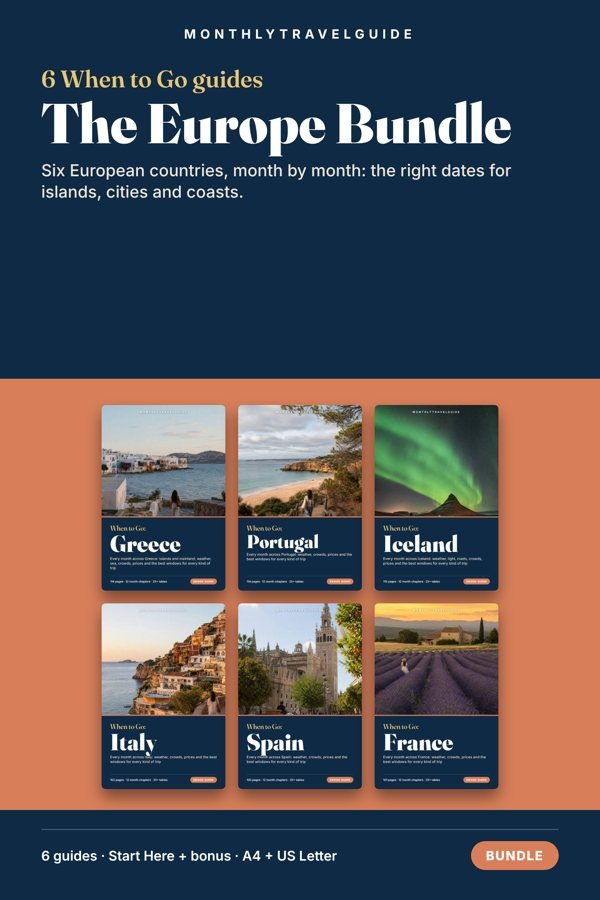
24 country guides, each about 100 pages: every month rated for weather, crowds and prices, region by region, with a 7-day booking plan. Six guides per region bundle.
Browse the 24 guides · $19 eachRegion bundles: Europe, Asia & Pacific, Sun Souks & Safari, Americas · $47 each
Tips 5–8: Book Flights in the Right Window, Fly in the Gaps
Flight prices reward people who book in the right window and stay flexible on the day. Google, which sees an enormous number of fare searches, has published what its own flight data shows, and the numbers are useful as a rule of thumb.
72+ days
before departure: when US–Europe fares have been lowest on average
54–78 days
the typical low-price window for mid-December holiday trips
24 hours
to cancel a US ticket free, if booked 7+ days before departure
Weekdays
avoiding weekend departures is one of the best ways to save
Tip 5 · Book long-haul in the window, not at the last minute. According to Google’s own analysis of Google Flights data, average prices for US-to-Europe trips have been lowest 72 days or more before departure, with fares generally rising as the date approaches, especially from about 10 weeks out. For trips starting in mid-December, the typical low-price window was 54 to 78 days ahead. The last-minute bargain does exist, but it’s the exception on long-haul routes, not the plan.
Tip 6 · Fly midweek, or take the layover. The same Google analysis names avoiding weekend departures and accepting a layover as among the best ways to save. If a direct Saturday flight is your default, price a Tuesday or Wednesday departure and a one-stop routing before deciding the convenience is worth the difference.
Tip 7 · Let the price come to you. Turn on price tracking for your route on Google Flights (you need to be signed in) and you’ll get an alert when the fare drops significantly. If your dates are loose, its “any dates” tracking emails you deals for the next few months. It replaces the habit of checking prices every evening, which mostly just raises your stress.
Tip 8 · Use the 24-hour rule as free thinking time. For US flights, the US Department of Transportation’s refund rules require airlines to either let you cancel for a full refund within 24 hours, or hold the fare for 24 hours without payment, as long as you book at least seven days before departure. Book the good fare when you see it, then confirm leave and plans the next morning. One catch: the rule applies to bookings made with the airline, not to tickets bought through travel agents or online agencies.
| Trip type | When to start watching | When to book (rule of thumb) |
|---|---|---|
| Long-haul, e.g. US–Europe | 4–6 months ahead | From about 72+ days out; don’t wait for the last few weeks |
| Peak holiday dates (Christmas, school breaks) | As soon as dates are fixed | Roughly two to three months ahead, earlier for school holidays |
| Short-haul in shoulder season | 6–8 weeks ahead | When an alert shows a clear drop |
| Flexible “anywhere cheap” trip | Any time | When a deal alert matches a shoulder-season month |

When to Book
If you’d rather not guess whether to buy now or wait, this guide sets out when to book flights, stays and big-ticket experiences for different kinds of trips, including peak holiday dates, so the money you saved by picking a good month doesn’t leak away at checkout.
See When to Book · $19 →Digital download · All sales final
Tips 9–11: Pay Less for the Same Bed
Accommodation is often the biggest line in a budget, and it’s just as calendar-driven as flights. These three budget travel tips work in almost any city.
Tip 9 · Match your nights to the city’s rhythm
Business-heavy cities tend to empty at weekends, so Friday and Saturday nights can be the better value there. Leisure destinations work the other way round: Sunday-to-Thursday stays usually beat weekends. Price both before you fix your dates.
Tip 10 · Book refundable, then re-check
When dates are fixed early, book a free-cancellation rate to lock in availability, then check the price again a few weeks out. If the same room is cheaper, rebook and cancel the first one inside its free window.
Tip 11 · Sleep one stop out
Staying one metro or train stop from the centre, or just outside an event zone, often cuts the nightly rate while adding only a few minutes of travel. Check the last-train time before you commit.
Want the opposite end of the budget scale for less? Our guide to luxury travel on a budget shows how timing puts five-star hotels within reach, and unique ways to save money while travelling covers more ideas beyond flights and hostels.
Tips 12–13: Spend Less Once You’ve Landed
On the ground, small daily costs add up fast. Two habits make the biggest difference.
Tip 12 · Eat your main meal at lunch. In much of southern Europe, restaurants offer a set-price lunch menu on weekdays (Spain’s menú del día is the best-known), and it’s typically much cheaper than ordering the same kind of food at dinner. Make lunch the big meal, and keep dinner simple: a market picnic, street food or tapas at the bar.

The Smart Timing Bundle
Pick the month, book in the right order, pack once
Six printable timing tools for any trip: the Trip Timing Planner, When to Book, When NOT to Go, the Shoulder Season Playbook, the family timing guide and the Packing by Season System.
See the bundle · $37Six products, $100 separately · Digital download · All sales final
Tip 13 · Always pay in the local currency. When a card machine or ATM abroad asks whether you’d like to pay in your home currency, it’s offering dynamic currency conversion: the merchant or machine does the exchange at its own rate. The European consumer organisation BEUC says this can add 5–6% to the transaction. Choose the local currency and let your card provider do the conversion instead. Better still, travel with a card that doesn’t charge a foreign transaction fee.

Low season shows up on the ground too. A city beach in November won’t give you swimming weather, but it gives you space, calmer restaurants and accommodation that’s usually easier on the budget than in high summer. For cities, that trade is often worth it.
Save on the date, then protect the saving. The two together beat any coupon.
Tips 14–15: Protect the Money You’ve Already Spent
A cancelled flight or a missed connection can wipe out every saving you’ve made. Knowing the rules in advance means you ask for the right thing at the desk, not the easiest thing for the airline.
Tip 14 · Know your refund and compensation rights. Under US rules, you’re entitled to a refund if the airline cancels or significantly delays or changes your flight and you choose not to travel, and you don’t have to accept travel credit instead. In Europe, the EU’s air passenger rights go further: on flights covered by the rules, arriving three hours or more late, or a cancellation with less than 14 days’ notice, can mean compensation of €250 to €600 depending on the distance, unless the airline can show extraordinary circumstances.
| Situation | US flights (DOT rules) | EU-covered flights |
|---|---|---|
| Airline cancels | Refund if you choose not to travel, whatever the reason | Refund or rerouting; compensation if told less than 14 days ahead (unless extraordinary circumstances) |
| Long delay | Refund if the delay is significant and you choose not to travel | Compensation for arriving 3+ hours late on most routes, €250–€600 by distance |
| You bought through an agency | 24-hour rule doesn’t apply; contact the agent first | Claim against the operating airline |
Tip 15 · Pack to the fare. Low-cost fares are often low because bags are extra. Decide what you’re packing before you choose a fare, and if everything fits in a cabin bag, you can skip the checked-bag add-on and the wait at the carousel. The free Packing by Season Generator builds a list for the climate you’ll actually meet, which makes travelling light much easier. Our guide to preparing for flight delays covers what to carry in case a disruption does happen.
🧾 Your 10-minute budget check before you pay
- ☐ Is this the destination’s shoulder or low season, and are the things I want open?
- ☐ Have I checked local school holidays, public holidays and big events for these dates?
- ☐ Is a price alert switched on for this route?
- ☐ Have I priced a midweek departure and a one-stop option?
- ☐ Is my room rate refundable, and do I know the exact cancellation deadline?
- ☐ Does my card charge foreign transaction fees?
- ☐ Do I know what to ask for if the flight is cancelled?
A Simple Budget Travel Calendar: Where Your Money Goes Further by Season
Here’s how the budget travel tips above translate into a year. It’s deliberately broad, because the exact turning points differ by destination; use it to shortlist, then check the specific place.
| When | Often good value | Usually expensive |
|---|---|---|
| January–February (outside holidays) | European cities after New Year, ski areas outside school breaks | Lunar New Year travel in East and Southeast Asia; Caribbean dry season |
| March–May | Mediterranean shoulder season before summer | Easter week in Europe; Golden Week in Japan |
| June–August | Southern-hemisphere cities in their winter; “green season” in parts of Southeast Asia | Mediterranean beaches during school holidays |
| September–October | Southern Europe after the summer peak; many US national parks after Labor Day | Major trade-fair and festival weeks in big cities |
| November–early December | European city breaks, quiet beaches for walking, not swimming | Thanksgiving week in the US |
Month-by-month ideas are in our guides to cheap places to travel in August and budget-friendly February destinations. And if you’re travelling over the holidays, our December travel tips to avoid crowds and save money show which December dates are busiest and when to book them.
Budget Travel Mistakes That Quietly Cost the Most
These are the errors that even experienced travellers make, usually because they look like savings at the time.
Chasing the cheapest flight, then paying peak hotel rates
A cheap fare into a festival week is not a cheap trip. Price the flight and three nights of accommodation together before you call anything a deal.
Waiting for a last-minute bargain on long-haul
On most long-haul routes, average fares rise as departure gets closer. Set an alert early and book when it drops, rather than gambling on the final weeks.
Accepting a voucher when you’re owed a refund
Vouchers are convenient for the airline. If your flight is cancelled and you don’t want to travel, ask for the refund the rules give you.
Saying yes to “pay in your home currency”
It feels clearer to see a familiar number, but it’s the more expensive choice. Pay in the local currency every time.
Booking low season without checking what’s open
A bargain island hotel isn’t a bargain if the ferries are reduced and half the restaurants are shut. Confirm the essentials first.
Budget Travel Tips: Your Questions Answered
The most useful of all these budget travel tips is also the simplest: decide when before you decide where, and the rest of your savings get easier. For more ideas, browse our travel tips and budget travel guides, or open the month-by-month travel planner and see which destinations are in their best-value season next.
Free download
The 12-Month Map, free
The whole year for one country on four printable pages, so you can see the right months before you read anything else.
- Good, shoulder and avoid months at a glance
- Region by region, not one average for the whole country
- Prints cleanly on US Letter
Your download page opens as soon as you sign up. 24 countries available.



[…] your trip well is the other big lever, and it’s a separate topic: our budget travel tips cover the date and booking moves that save money before you pack. This guide picks up where that […]