Southern Italy beaches are at their best from late June to mid-September, when the sea along Calabria, the Cilento coast, Maratea in Basilicata and the Salento peninsula of Puglia is warm enough for long swims. The catch is August: it brings the warmest water of the year and also the fullest beaches, the slowest roads and the hardest rooms to find. This guide compares the four coasts month by month, with sea temperatures, the weeks to avoid and the winds that decide which side of Salento you should drive to.
Four coasts, one sea season
Calabria · Cilento · Maratea · Salento
Best window
Late June to mid-September
Warmest sea
About 26 °C in August
Busiest week
Around 15 August
Coolest swim
June, about 22 °C
Sea temperatures are long-term averages from Climates to Travel for Lamezia Terme, Palinuro and Brindisi. Every summer differs.
The short answer
For warm water without the August crush, go in the first half of September or the last week of June to mid-July. The sea is about 25 to 26 °C from July to early September on all four coasts and about 22 °C in June. August is the warmest and busiest month, peaking around the 15th. From the second half of September, storms become more likely.
Key takeaways
The swimming season on all four coasts runs roughly from July to September; June is fine for hardy swimmers at about 22 °C.
August has the warmest sea, about 26 to 26.5 °C, and the heaviest crowds of the year around the Ferragosto holiday on 15 August.
The first half of September keeps water near 24 to 25.5 °C with far fewer people; bad weather becomes more likely later in the month.
Hot southern winds from Africa can push summer highs past 35 °C, and heat waves in Calabria can reach 40 °C.
In Salento, the wind picks the beach: a north wind favours the Ionian side, a south wind the Adriatic side.
Maratea and the Costa degli Dei are rocky, cliff-backed coasts; Salento’s Ionian shore has the long sandy beaches.

Southern Italy Beaches by Month: Sea Temperature and Verdict
This section rates every month for a beach trip to the south, using long-term sea temperature averages for three reference points: Lamezia Terme on the Tyrrhenian coast of Calabria, Palinuro on the Cilento coast and Brindisi at the top of Salento. The three coasts follow almost the same curve, so one grid covers them all; Salento runs about half a degree cooler in early autumn.
Month verdicts for a southern Italy beach trip
Bar = average sea temperature
15 °C
Jan
SkipCold sea, short days
14.5 °C
Feb
SkipColdest water of the year
14.5 °C
Mar
SkipCoastal walks only
16 °C
Apr
SkipSpring flowers, no swimming
18.5 °C
May
Go with careSunny, empty, sea still cool
22.5 °C
Jun
GoLong days, quiet beaches
25.5 °C
Jul
GoWarm sea, busier from mid-month
26.5 °C
Aug
Go with careWarmest sea, peak crowds
25.5 °C
Sep
GoBest balance in the first half
22.5 °C
Oct
Go with careMild swims, many lidi closed
19.5 °C
Nov
SkipRain and wind return
16.5 °C
Dec
SkipOff season
Sea figures for Lamezia Terme (Calabria) from Climates to Travel; Palinuro is within half a degree in every month, Brindisi up to 1.5 °C cooler in September and October.
The numbers from Climates to Travel for Calabria tell a clear story. The sea sits around 14 to 16 °C from December to April, warms to about 18.5 °C in May and 22.5 °C in June, then reaches about 25.5 °C in July and 26.5 °C in August. September holds about 25 to 25.5 °C on the Tyrrhenian side and about 24 °C at Brindisi (Climates to Travel for Salento), and October still averages about 21.5 to 22.5 °C. Air temperatures follow the same arc: average highs of about 29 to 30 °C in July and August, about 26 to 27 °C in June and September.
🧰 Try it while you read: a free tool for this trip
Free trip timing tool
Is This a Bad Month to Go?
Pick a country and a month. See if it is a month to skip, what goes wrong, and the better month next to it.
Loading the tool…
The Four Coasts Compared
This section sets the four beach regions side by side so you can match a coast to your trip. They share a climate but not a character: some are cliffs and coves, some are long ribbons of sand, and they draw very different crowds.
| Coast | Sea and shore | Best weeks | Watch out for |
|---|---|---|---|
| Calabria, Costa degli Dei (Tyrrhenian) | About 55 km from Pizzo to Nicotera: cliffs, coves, white sand at Tropea and Capo Vaticano | Late June to mid-July; first half of September | August crowds around Tropea |
| Calabria, Ionian coast | Long, open beaches and a drier climate, with under 600 mm of rain a year near Sibari | July to mid-September | Fewer services in quiet stretches |
| Cilento (Campania) | Rocky headlands and coves around Palinuro; sea about 26.5 °C in August | July; first half of September | Hot scirocco days above 35 °C |
| Maratea (Basilicata) | About 20 km of rocky Tyrrhenian coast, sandy beaches at Fiumicello and Acquafredda, sea caves | June and September | Small beaches fill quickly in summer |
| Salento (Puglia) | Sandy Ionian beaches in the west, limestone cliffs and caves on the Adriatic east | June; first half of September | Wind, plus heavy August traffic from Lecce |
🗓️ Free: the 12-Month Map for Italy
Every month on one page: best weeks, shoulder weeks and the ones to skip. Print it or keep it on your phone.
Sources: Italia.it for the Costa degli Dei, Rough Guides for Maratea, Climates to Travel and Palinuro data for climate, and The Wom Travel for the two Salento shores.
Tip
If you want sand under your towel, Salento’s Ionian shore and Calabria’s Ionian coast are the safest bets. If you want cliffs, clear water and snorkelling from the rocks, look at Maratea, Capo Vaticano and the Adriatic side of Salento. Pack water shoes for the rocky coasts.
Calabria: The Costa degli Dei and the Ionian Shore
This section covers Calabria, the toe of the boot, which has the longest coastline of the four regions and two quite different seas. The stretch most visitors see first is the Costa degli Dei on the Tyrrhenian side, about 55 km of coast running from Pizzo Calabro to Nicotera, according to Italia.it, the national tourism site.
Tropea is the centre of it. Its Church of Santa Maria dell’Isola stands on a rock almost surrounded by the sea, with beaches spread out below the old town. To the south, Capo Vaticano breaks the coast into a string of small coves, and Zambrone to the north has its own quieter bays. The water here is famously clear, which is exactly why the Tropea area is so busy in the middle of summer.

The Smart Timing Bundle
Pick the month, book in the right order, pack once
Six printable timing tools for any trip: the Trip Timing Planner, When to Book, When NOT to Go, the Shoulder Season Playbook, the family timing guide and the Packing by Season System.
See the bundle · $37Six products, $100 separately · Digital download · All sales final
Climate data for Lamezia Terme, on the same coast, puts the sea at about 25.5 °C in July, 26.5 °C in August and 25.5 °C in September. Climates to Travel calls July and August the best months for the beach, describes June as good but with a fairly cool sea, and warns that September can bring bad weather, especially in the second half (Climates to Travel). It also notes heat waves of African origin from June to August, when the lowlands can reach or pass 40 °C.
The Ionian side of Calabria, facing east, is drier. Annual rainfall near Sibari and around Reggio Calabria is under 600 mm, against about 1,000 mm near Catanzaro and Cosenza inland. Its beaches tend to be long and open rather than tucked into coves, and outside August you’ll often have large stretches nearly to yourself.
Maratea and the Cilento Coast
This section covers the two short, wild Tyrrhenian coasts north of Calabria: Maratea, Basilicata’s only stretch of the Tyrrhenian, and the Cilento coast in southern Campania. Both suit travellers who prefer cliffs, coves and boat trips to wide sandy beaches.
Maratea, Basilicata
Rough Guides describes Maratea as a scattered settlement along some 20 km of rocky coastline, with tall, sheer cliffs above coves and a handful of good beaches. The hamlets along the shore are Castrocucco, Marina, Porto, Fiumicello, Cersuta and Acquafredda. The sandy beaches at Fiumicello and Acquafredda are the easiest to reach, and Fiumicello has most of the places to stay. Many sea caves along the coast are best seen by boat. Above it all, Monte San Biagio rises to 624 m, topped by a large marble statue of Christ, the Redentore.
Because the beaches are small, Maratea feels crowded faster than its quiet reputation suggests; Rough Guides notes they get crowded in summer. June and September are its sweet spots. There’s no separate sea temperature series for Maratea, but it lies on the same coast between Palinuro and the Calabrian Tyrrhenian shore, both of which run at about 22.5 °C in June and 25 to 25.5 °C in September.

Cilento, Campania
South of Salerno and the Amalfi Coast, the Cilento coast is greener and less built up than its famous neighbour. Palinuro is the best reference point for its weather. Average sea temperatures there reach about 22.5 °C in June, 25.5 °C in July, 26.5 °C in August and 25 °C in September, while October drops to about 22 °C (Climates to Travel).
September in Palinuro averages highs of about 26.4 °C, about 60 mm of rain spread over five days and around 8.5 hours of sunshine a day, which makes the first half of the month the region’s best beach window. The same source notes that the scirocco, a hot wind from Africa, can push summer highs to 35 °C or more. If you’re combining beaches with the cliff towns further north, our guide to the Amalfi Coast in September covers that coast’s timing.
Salento: Two Seas and the Wind Rule
This section covers Salento, the heel of Italy’s boot in southern Puglia, where the Ionian and Adriatic seas meet at Santa Maria di Leuca. It’s the region where knowing the wind matters most, because the right choice of coast can turn a choppy, sandy day into a calm one.
The western Ionian shore has the long sandy beaches: Torre Lapillo, Punta Prosciutto and Lido Marini around Porto Cesareo, Punta della Suina and Baia Verde near Gallipoli, and Pescoluse further south. The eastern Adriatic shore is rockier, with white limestone cliffs and sea caves between Otranto and Castro, the sea stacks of Torre Sant’Andrea and the sand crescent of Torre dell’Orso framed by cliffs (The Wom Travel).

The complete kit
Every country guide, every timing tool
All 24 When to Go country guides, the six Smart Timing tools and every 12-Month Map, with a Start Here that tells you what to open first.
See the kit · $127The five bundles cost $225 separately · Digital download · All sales final
Salento wind rule
North wind (tramontana)
Head to the Ionian side, around Porto Cesareo, Gallipoli or Pescoluse, where the water is usually calm.
South wind (scirocco)
Head to the Adriatic side, around Otranto and Torre dell’Orso; Baia dei Turchi near Otranto is a classic choice.
Strong wind everywhere
Sand can blow on both coasts. Use the day for Lecce, the old towns inland or a long lunch.
Salento’s sea warms a touch later and cools a touch sooner than the Tyrrhenian coasts. At Brindisi it averages about 22 °C in June, 25 °C in July, 26 °C in August and 24 °C in September (Climates to Travel). Climates to Travel notes the same pattern for Santa Maria di Leuca, Porto Cesareo and Gallipoli: fairly cool in June, 24 °C or more from July to September. A northerly breeze usually makes summer heat bearable, but scirocco days can bring highs above 40 °C.

Seasonal buses link Lecce with the main beach resorts in the peak months, but many visitors drive. Weekend traffic out of Lecce can be heavy, many developed beach areas charge for parking, and the most popular sandy beaches, such as Pescoluse, fill early in high summer. For a calmer August day, The Wom Travel points to Torre Rinalda on the Adriatic side north of Lecce.

August on Southern Italy Beaches: Ferragosto and the Crowds
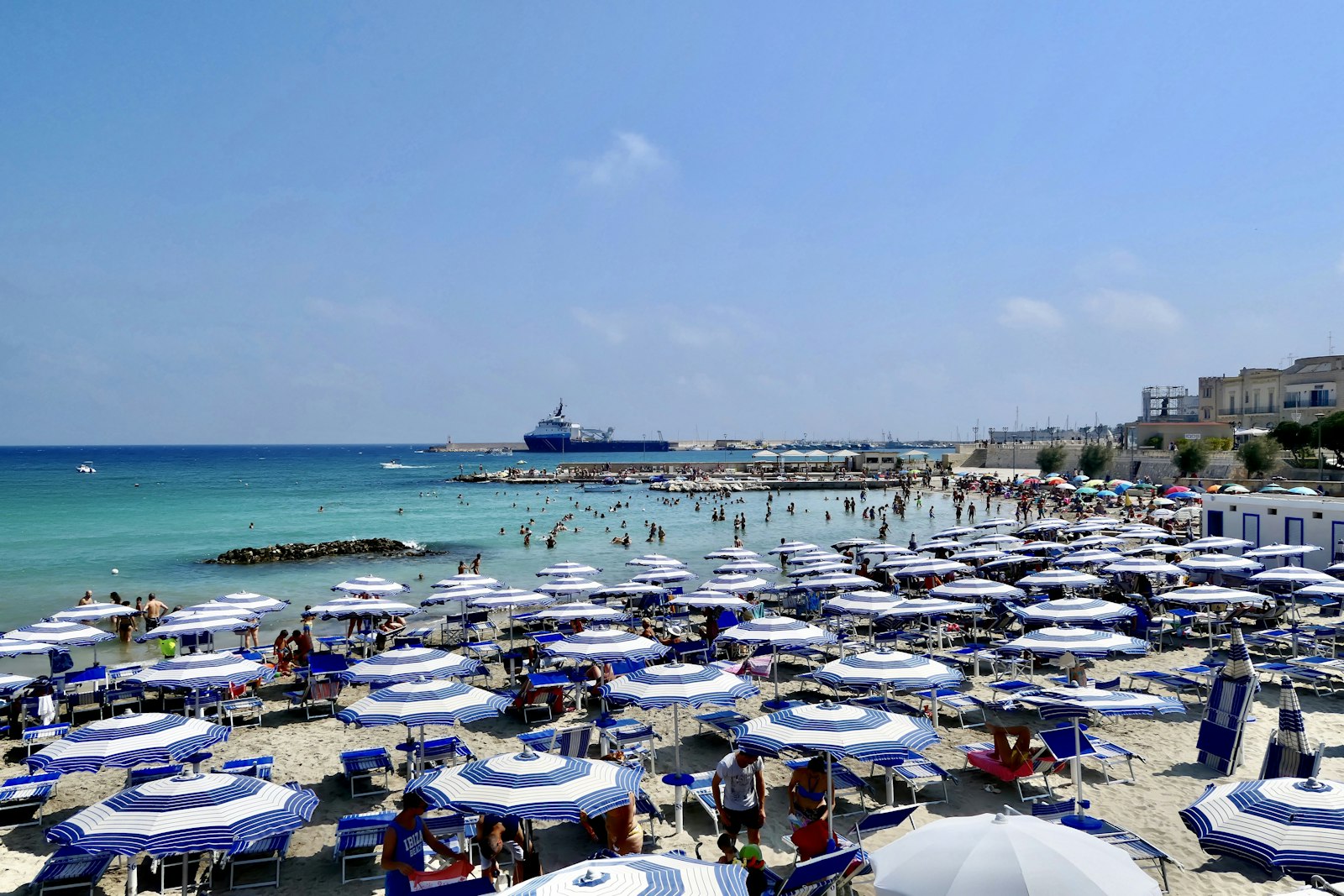
This section explains why August is the month that divides opinion. It has the warmest sea and the most reliable sunshine, but it’s also when most of Italy goes on holiday at the same time, and the south’s beaches absorb a large share of that.
The peak is Ferragosto on 15 August, a national holiday that coincides with the Feast of the Assumption. According to Romewise, many Italians now take about a week or ten days around the 15th, or from the 15th to the end of the month, rather than all of August. Beaches get very busy on the day itself, and the summer season effectively ends around mid-September. Some shops and family-run businesses still close for three to seven days around the 15th, although most restaurants and supermarkets now stay open.
Early July
Season in full swing
Schools are out, beach clubs are fully open and weekends get busy, but midweek is still relaxed.
Mid-July to early August
Building up
Domestic holidays start, prices and occupancy climb, and the hot spells are most frequent.
About 8 to 22 August
Ferragosto peak
The fullest beaches, traffic queues on coastal roads and the hardest weeks to find a room.
Late August
Easing
Families head home before school; the sea is still at its warmest.
1 to 15 September
The sweet spot
Warm water, fewer people, beach clubs still open in most resorts.
The week ranges above are a rule of thumb rather than fixed dates. Prices change; check before you book. If August is your only option, book early, choose a base with several beaches within reach, arrive at the sand by about 9 am and keep the middle of the day for a long lunch in the shade. Our round-up of beach destinations in August compares alternatives across Europe.
When Not to Go to Southern Italy Beaches
This section is the honest list of the weeks most likely to disappoint a beach trip. None of them is a disaster for every traveller, but each one trips up visitors every year.
| Avoid | Why | Go instead |
|---|---|---|
| The week around 15 August | Peak domestic holiday; full beaches, roads and rooms | First half of September |
| A swimming trip in May | The sea averages about 18.5 °C | Late June, at about 22.5 °C |
| Late September for a fixed beach week | Bad weather becomes more likely in the second half of the month | 1 to 15 September |
| November to April for swimming | Sea about 14 to 19.5 °C; many beach services closed | Visit the towns instead and swim in summer |
| Heat-wave days at midday | Highs can pass 35 °C, and 40 °C in places | Swim early and late; rest in the afternoon |
Not sure how your dates look? Run them through the free When Not to Go checker, or use the Shoulder Season Detector to find the quieter weeks. Wherever you go in high summer, carry shade for free beaches and water shoes for rocky coves; the free Packing Generator builds a list for your dates.
Better Month If You Want Something Else
This section helps if beaches are only part of what you want from the south, or if your dates are flexible.
If you want
The quietest warm swims
Go in the first two weeks of September, when the sea is still about 24 to 25.5 °C.
If you want
Long days and empty sand
Go in late June, and accept a cooler sea of about 22 °C. See beach destinations in June.
If you want
Towns, food and walking
Go in May or October, when highs sit around 22 to 23 °C. Our southern Italy towns covers the old towns.
If you want
Matera with a beach add-on
Pair the city with Maratea or the Ionian coast in June or September. See the Matera travel guide.
If you want
Classic summer heat
Go in July for warm water before the Ferragosto peak. Compare beach destinations in July.
If you want
Other Mediterranean options
Compare Mediterranean beaches in September and Italy in September.
For festival months across Italy, the free Festival Month Matcher is a quick way to see what’s on during your dates.
5 Common Mistakes When Planning Southern Italy Beaches
1. Booking the Ferragosto week without knowing it
Many visitors pick mid-August simply because it suits their holidays, then find full beaches, slow roads and few rooms left. If you must travel then, book early and plan on early starts; if you can move, the first half of September is far calmer.
2. Expecting warm water in May
May is sunny and pleasant on land, but the sea averages about 18.5 °C. Unless you like a cold plunge, save swimming trips for late June onwards.
3. Sticking to one beach whatever the wind
In Salento especially, the wind can make one coast choppy and the other calm on the same day. Check the forecast each morning and pick the sheltered side.
4. Underestimating the heat
Heat waves can push highs past 35 °C and sometimes 40 °C. Long midday sessions on a free beach with no shade are the most common way to lose a day of the trip.
5. Arriving in October expecting full summer service
The water can still be pleasant, but the Italian beach season effectively ends in mid-September, and many beach clubs, kiosks and seasonal restaurants close soon after. Check what’s open before you commit to a seaside base.
Southern Italy Beaches FAQ
QWhen is the best time to visit southern Italy beaches?
The first half of September is the best overall, with sea temperatures of about 24 to 25.5 °C and far fewer people than in August. Late June to mid-July is a close second. August has the warmest water, about 26 to 26.5 °C, but also the biggest crowds, especially in the week around the Ferragosto holiday on 15 August.
QIs the sea warm enough to swim in southern Italy in June?
Yes, for most people, though it feels fresh. Average sea temperatures in June are about 22 to 22.5 °C in Calabria, Cilento and Salento, rising to about 25 °C in July. Days are long and beaches are quiet, so June suits swimmers who don’t mind cooler water. May, at about 18.5 °C, is too cold for most.
QHow crowded are southern Italy beaches in August?
Very crowded around the middle of the month. Many Italians take a week or ten days of holiday around Ferragosto on 15 August, and popular beaches, coastal roads and accommodation fill up. Early August and the last days of the month are a little calmer. If you go, book early, arrive at the beach by about 9 am and keep a car for quieter coves.
QIs September a good time for beaches in southern Italy?
Yes, especially the first half. The sea stays at about 25 to 25.5 °C on the Tyrrhenian coast and about 24 °C in Salento, highs are around 26 to 27 °C, and the August crowds have gone. Bad weather becomes more likely in the second half of the month, so keep some flexibility if you travel after mid-September.
QWhich is better for beaches, Calabria or Puglia?
It depends on the beach you want. Calabria’s Costa degli Dei around Tropea and Capo Vaticano has cliffs, coves and very clear water. Salento in southern Puglia has long sandy beaches on its Ionian side and cliffs and caves on its Adriatic side, plus the option to switch coasts with the wind. Both have similar sea temperatures through the summer.
QWhere are the quietest beaches in southern Italy?
Outside August, much of the south is quiet. Calabria’s Ionian coast has long, open beaches with fewer visitors than Tropea, Maratea’s coves are calm in June and September, and the Cilento coast is less built up than the Amalfi Coast nearby. In Salento, Torre Rinalda on the Adriatic side is known as a calmer option even in August.
The Bottom Line
For southern Italy beaches, aim for the first half of September or late June to mid-July, when the sea is warm and the coast still has room; treat the week around 15 August as the one to avoid unless you plan for crowds. Pick Calabria or Maratea for cliffs and clear coves, Salento for sand and two seas. For more on the country, browse our Italy travel guides.
Sea, cities and quiet weeks
Time your whole Italy trip, month by month
When to Go: Italy sets out the best and worst months for each region, sea and air temperatures, holiday and festival peaks, the shoulder weeks and when to book, so a beach stay in the south fits neatly with the rest of your route.
Digital download · All sales final
Free download
Which month for your country?
Get the free 12-Month Map: every month marked good, shoulder or avoid, region by region, on four printable pages.
- Greece to Japan, Morocco to Peru: 24 countries
- See the crowd and price peaks before you book
- Free, no purchase needed
Your download page opens as soon as you sign up. 24 countries available.