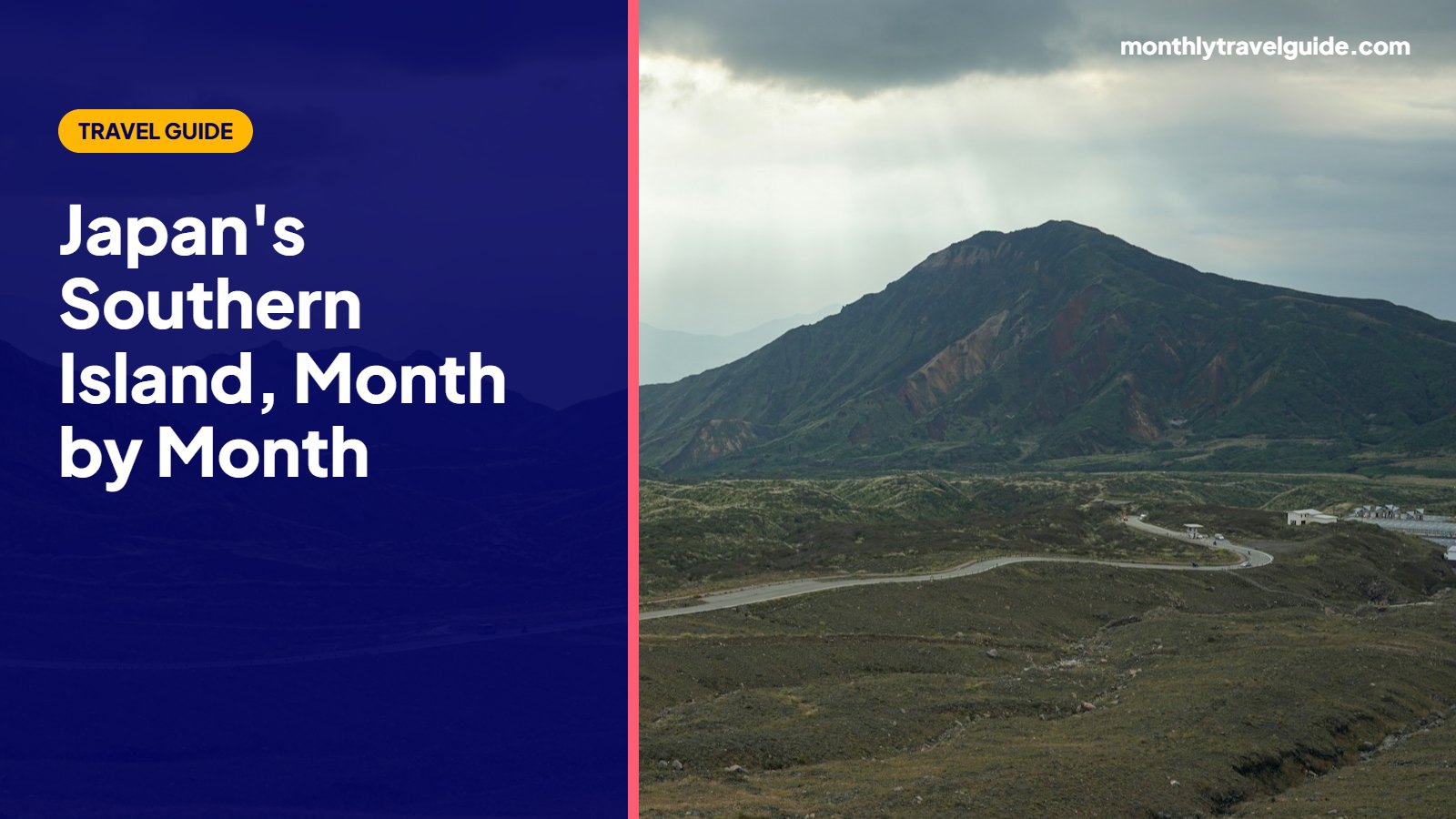
This Kyushu travel guide is the starting point for Japan’s southern main island: its cities, its volcanoes and hot springs, how to get around and, above all, when to go. Kyushu is mild for most of the year and easy to reach by bullet train or by air, yet it sees far fewer foreign visitors than Tokyo or Kyoto. The best months are usually late March to May and October to November, while June and July bring the rainy season and August to early October carries the highest typhoon risk. Below you’ll find the island region by region, the months, the main routes and links to our full guides for each city.

Kyushu at a glance
Six regions, one island
Best overall: late Mar to May · Oct to Nov
North
Fukuoka · Saga
City food, festivals, the main gateway
Mar to May · Oct to Nov
West
Nagasaki
Harbour city, lantern-lit winters, islands
Mid-Apr to mid-May · Mid-Oct to mid-Nov
Centre
Kumamoto · Aso
Castle city and the vast Aso caldera
Late Mar to May · Oct to Nov
East
Oita · Beppu
Steaming onsen towns
Mar to Apr · Oct to Nov
South-east
Miyazaki
Takachiho Gorge, surf coast
Apr to May · Nov
South
Kagoshima · Yakushima
Sakurajima volcano, cedar forests
Mar to May · Oct to Nov
Best windows follow long-term climate averages (Climates to Travel, Japan Meteorological Agency) and our individual city guides. Every year differs.
Short answer
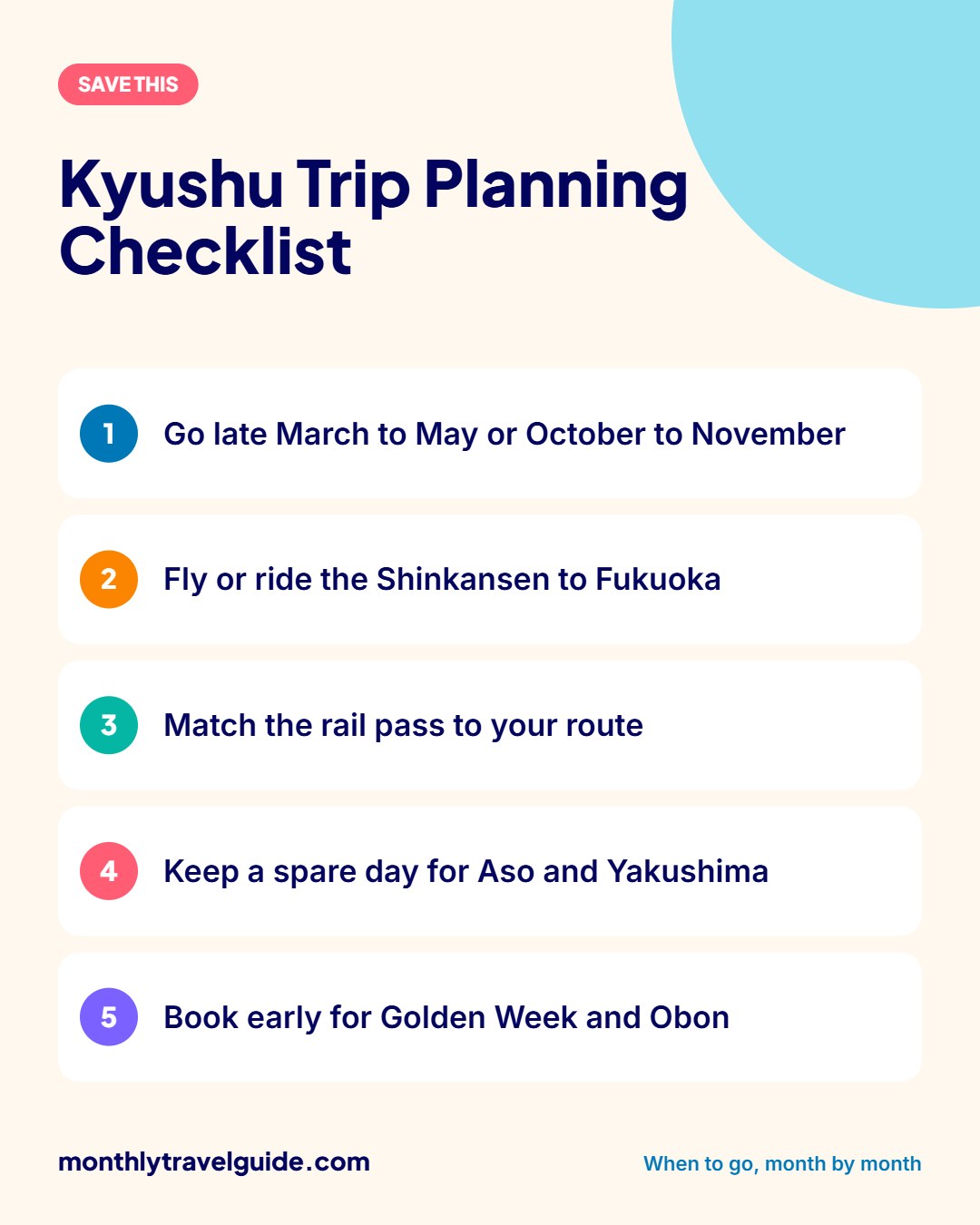
Visit Kyushu from late March to May or from October to November, when days are mild, rain is moderate and the cities, gorges and volcano viewpoints are at their best. Fly or take the bullet train to Fukuoka, then loop south by Shinkansen and limited express. Avoid June and July for rain, keep August to early October flexible for typhoons, and book early around Golden Week and Obon.
Key takeaways
Kyushu is made up of seven prefectures: Fukuoka, Saga, Nagasaki, Kumamoto, Oita, Miyazaki and Kagoshima.
Fukuoka is the gateway, about 5 hours from Tokyo and about 2 hours 30 minutes from Shin-Osaka by Shinkansen.
The fastest Kyushu Shinkansen trains link Hakata and Kagoshima-Chuo in about 1 hour 15 minutes.
The rainy season in northern Kyushu usually runs from early June to mid-July; June and July are the wettest months.
Typhoons are most frequent from August to early October, and the south coast is the most exposed.
The JR Kyushu Rail Pass comes in all-island, northern and southern versions; it does not cover the Sanyo Shinkansen to Osaka.
Kyushu Travel Guide: Where Kyushu Is and Why It Works
This section explains what Kyushu is and how it fits into a Japan trip. Kyushu is the most south-westerly of Japan’s four main islands, joined to Honshu by rail tunnels under the Kanmon Strait, and it’s divided into seven prefectures on the main island, with Okinawa often grouped with it as the wider Kyushu region (JRailPass).
What makes the island stand out is variety in a small space. In one week you can eat at open-air food stalls in Fukuoka, walk the hillside churches and gardens of Nagasaki, look into the Aso caldera, soak in the steaming baths of Beppu, row under a waterfall in Takachiho Gorge and watch Sakurajima smoke across the bay in Kagoshima.
| Prefecture | Known for | Our guide |
|---|---|---|
| Fukuoka | Yatai food stalls, Hakata festivals, the main airport | Fukuoka travel guide |
| Nagasaki | Harbour views, Peace Park, Lantern Festival, Gunkanjima | Nagasaki travel guide |
| Kumamoto | Kumamoto Castle, Suizenji garden, Mount Aso | Kumamoto travel guide |
| Oita | Beppu’s hells and onsen districts, Yufuin | Beppu travel guide |
| Saga | Ceramics towns and a feudal past | Day trip from Fukuoka |
| Miyazaki | Takachiho Gorge, beaches and surf | See the nature section below |
| Kagoshima | Sakurajima volcano, Yakushima, Amami islands | See the nature section below |
🗓️ Free: the 12-Month Map for Japan
Every month on one page: best weeks, shoulder weeks and the ones to skip. Print it or keep it on your phone.
Food is a reason to come on its own, from Fukuoka’s yatai stalls to champon in Nagasaki and steam-cooked eggs in Beppu; our Kyushu food guide covers what to order in each region.
🧰 Try it while you read: a free tool for this trip
Free trip timing tool
What Kind of Traveller Are You?
Seven quick taps pick your travel type, then show the countries and months where it shines.
Loading the tool…
Kyushu Travel Guide: The Best Months, One by One
This section rates each month for a first trip around Kyushu, using long-term averages for Fukuoka from Climates to Travel and the seasonal outlook from the Japan Meteorological Agency. The south runs a little warmer and wetter, and the mountains around Aso run much cooler.
Kyushu month verdicts
Bar = rainfall · high / low °C
Jan
10° / 3° · 75 mm
Cold, quiet; Nagasaki Lantern Festival may start
Feb
11° / 4° · 70 mm
Cool, dry; good onsen weather
Mar
14° / 7° · 105 mm
Blossom from late March
Apr
19° / 11° · 120 mm
Mild, green; one of the best months
May
24° / 16° · 135 mm
Warm and sunny; Golden Week at the start
Jun
27° / 20° · 250 mm
Rainy season sets in
Jul
31° / 25° · 300 mm
Heaviest rain, then humid heat
Aug
32° / 25° · 210 mm
Hottest; Obon; typhoon risk
Sep
28° / 21° · 175 mm
Peak of the strongest typhoons
Oct
23° / 15° · 95 mm
Often sunny and fresh
Nov
18° / 10° · 90 mm
Clear days, autumn leaves
Dec
12° / 5° · 70 mm
Cool, cloudy; New Year rush
Fukuoka averages from Climates to Travel, rounded. Verdicts assume a first trip with cities, nature and onsen.
The pattern is simple. Rain climbs from about 70 mm in February to about 250 mm in June and about 300 mm in July, then drops to about 95 mm in October and 90 mm in November. Highs rise from about 10 °C in January to about 32 °C in August. Cherry blossom usually runs from late March to early April, peaking around the end of March across much of the island and a few days later in Kagoshima.
October deserves special mention. The Japan Meteorological Agency notes that it’s often sunny and fresh in northern Kyushu, thanks to frequent high pressure, and autumn colour follows in November in the hills. For leaf timing across the country, read our guide to autumn leaves in Japan.
When to Go: Japan
Blossom, autumn colour or quiet temples?
Every month across Japan rated for weather, crowds and prices, region by region, from Hokkaido to Okinawa, with a 7-day booking plan and the free 12-Month Map.
See the Japan guide · $19About 100 pages · PDF, US Letter and A4 · Digital download · All sales final
Rainy Season, Typhoons and Winter in Kyushu
This section covers the three weather patterns that shape a Kyushu trip. None of them closes the island, but each can change a short itinerary.
| Period | What to expect | What it means for you |
|---|---|---|
| Early June to mid-July | Rainy season (baiu); northern Kyushu has some of Japan’s highest rainfall totals | Plan indoor options; mountain roads and trails can close after heavy rain |
| Late July to August | Very hot and humid, sometimes 35 °C or more | Sightsee early and late; take the heat seriously |
| August to early October | Most frequent typhoons; the strongest have struck in September | Keep a spare day; ferries and trains can stop |
| October to November | Often sunny, rain falls below 100 mm a month | The most reliable weeks of the year |
| December to February | Often cloudy, light precipitation; cold spells can bring snow, heavy snow on Aso | Great for onsen; pack warm layers |
Sources: Japan Meteorological Agency for the rainy season, summer heat and winter; Climates to Travel for typhoon timing and winter snow.
Warning
Typhoons can halt Shinkansen, ferries and flights across Kyushu for a day or more, and the southern coast is the most exposed. If you travel between August and early October, follow official forecasts, avoid a plan that depends on one fixed travel day and book refundable rooms where you can. The free Storm Season Check shows storm-season risk for any destination.
Winter is underrated. January averages run about 6 to 7 °C in the north and about 9 °C on the south coast, so days are cold but rarely harsh, and the hot springs feel at their best. For more cold-weather soaking ideas, see our list of winter hot spring trips.
The Main Cities: Fukuoka, Nagasaki, Kumamoto and Beppu
This section is the hub for our city guides. Each has its own month-by-month verdicts and festival dates.
Kagoshima, at the southern end of the Shinkansen line, faces Sakurajima and is the jumping-off point for Yakushima; see the nature section below.
Kyushu’s Volcanoes, Gorges and Forests
This section covers the four natural sights that most often anchor a Kyushu trip. All of them depend more on weather than the cities do, so they’re where timing matters most.
Mount Aso and the caldera
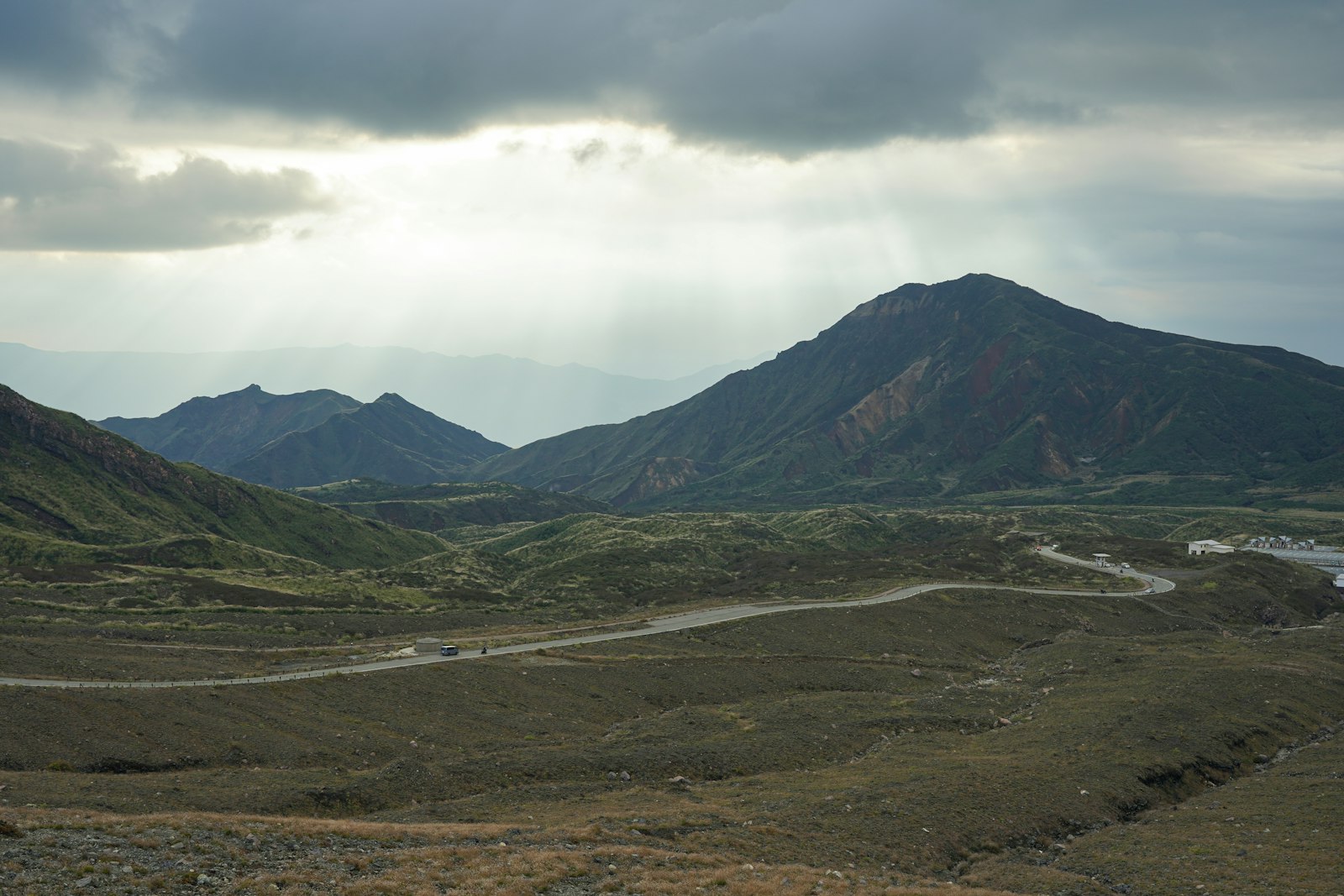
Mount Aso, in Kumamoto Prefecture, rises to about 1,592 m inside a vast caldera ringed by grassland. Its weather station records a January mean of about -1.3 °C and about 713 mm of rain in June, so it’s far colder and wetter than the cities below (Climates to Travel). Access to the active crater depends on volcanic gas and alert levels and can close at short notice; our Kumamoto guide explains how to check.
Takachiho Gorge
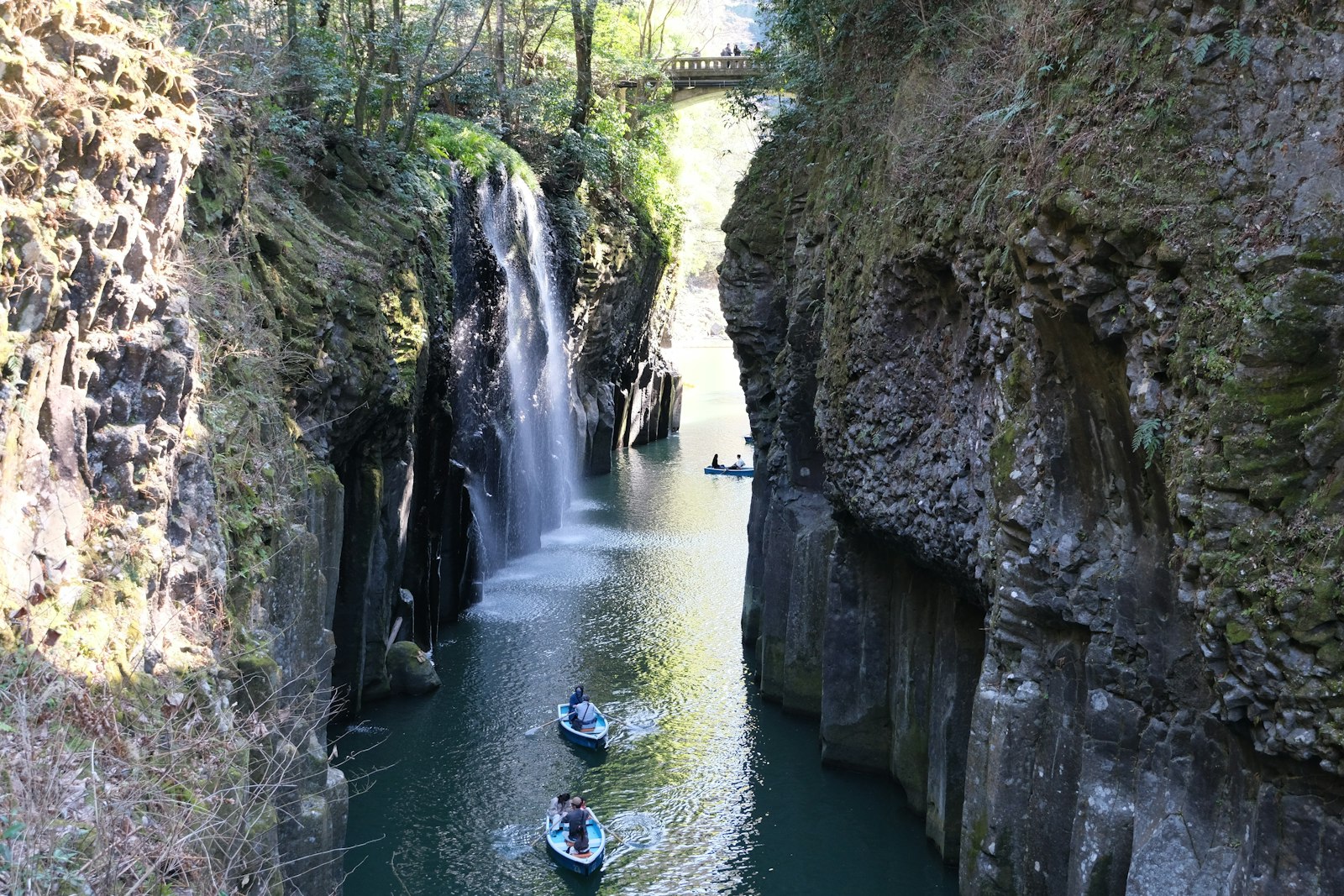
In the hills of northern Miyazaki, Takachiho Gorge is a narrow basalt canyon where you can rent a rowboat and row up to the 17 m Manai Falls; a boat is the only way to get right under the falls. The Japan National Tourism Organization puts the green-leaf season from April to October and autumn colour from mid-November to early December, with summer illuminations and night kagura dance performances nearby. By car it’s about 2.5 hours from Miyazaki; direct buses also run from Kumamoto.
Sakurajima, Kagoshima
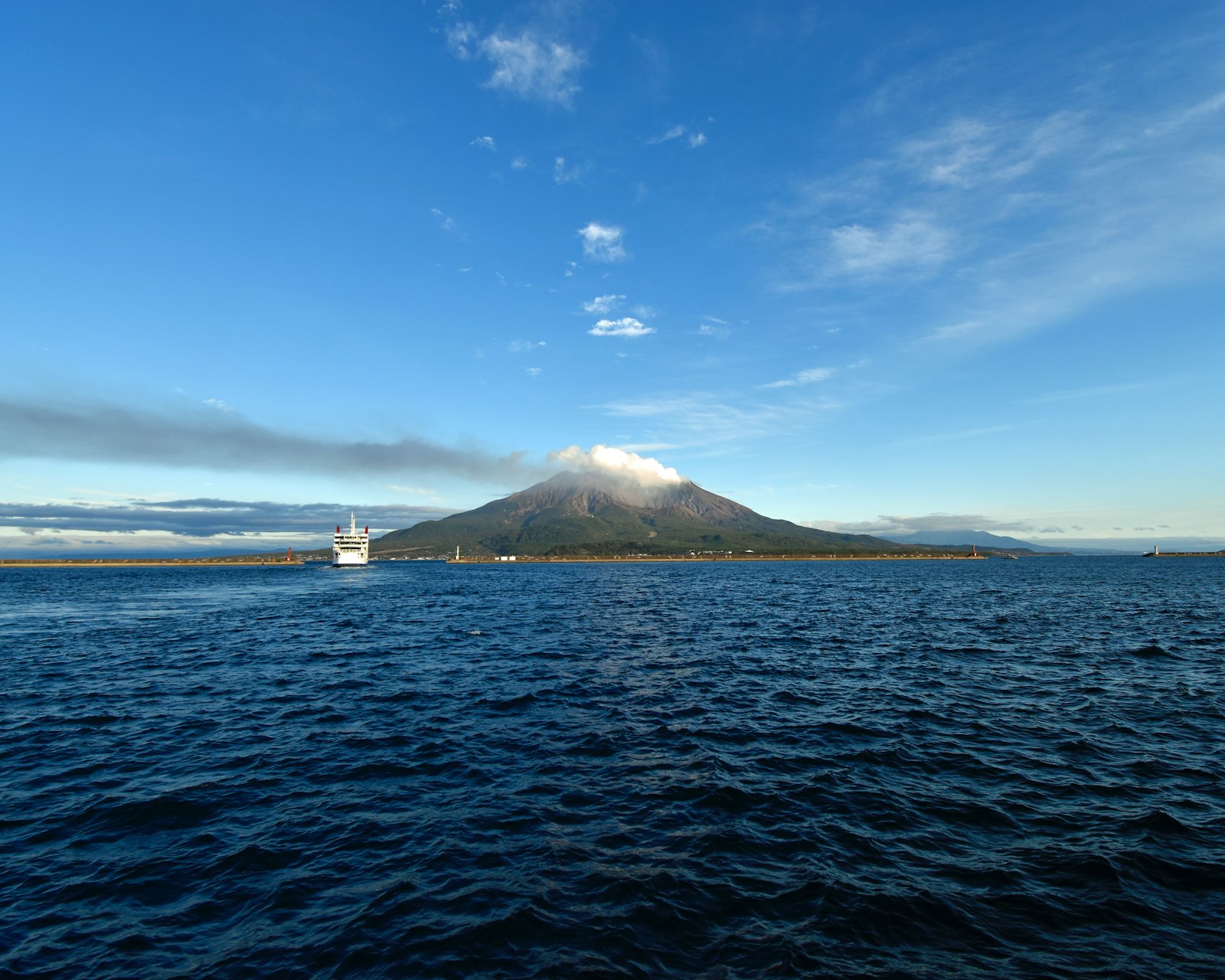
Sakurajima is an active volcano in Kagoshima Bay, often trailing a plume of smoke, with people living on its lower slopes. The Sakurajima Ferry crosses from Kagoshima Port in about 15 minutes and runs 24 hours a day, every 15 minutes in the daytime at weekends and hourly late at night (Go Live Travel Japan).

The Smart Timing Bundle
Pick the month, book in the right order, pack once
Six printable timing tools for any trip: the Trip Timing Planner, When to Book, When NOT to Go, the Shoulder Season Playbook, the family timing guide and the Packing by Season System.
See the bundle · $37Six products, $100 separately · Digital download · All sales final
Yakushima
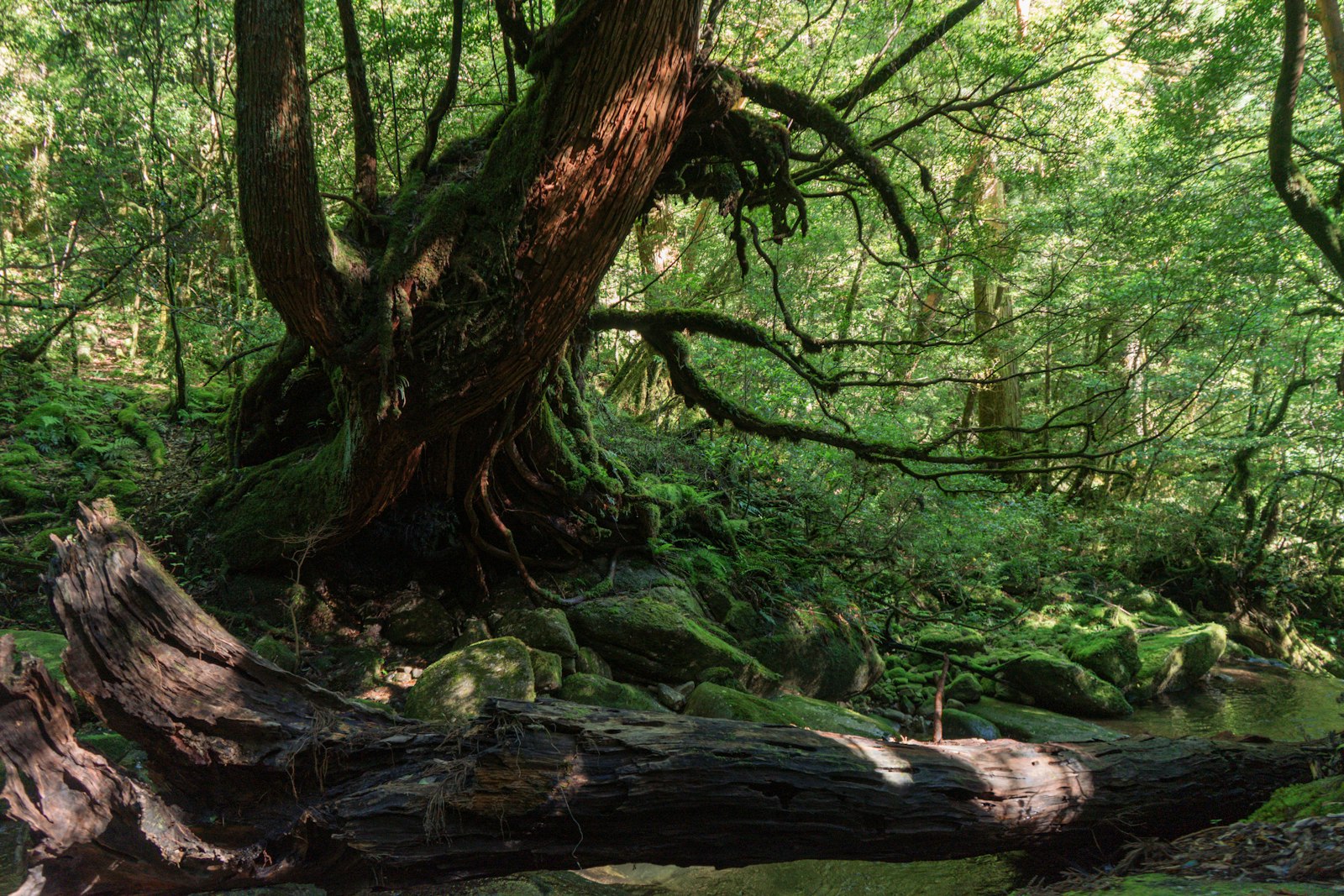
Off the south coast, Yakushima is a mountain island whose cedar forests are partly listed as a UNESCO World Natural Heritage site. Some of its Yakusugi cedars are over 1,000 years old, and locals joke that it rains 35 days a month. The Japan National Tourism Organization lists the jetfoil from Kagoshima at about 2 hours 35 minutes, the ferry at about 4 hours and the flight at about 40 minutes. Rough seas can cancel boats, so leave a buffer day before any onward flight.
Getting to and Around Kyushu
This section covers transport, which decides how much you can fit in. Most visitors arrive in Fukuoka by air or by Shinkansen from Honshu, then use trains for the main cities and a hire car or tour for the mountains.
| Route | Train | Typical time |
|---|---|---|
| Tokyo to Hakata (Fukuoka) | Tokaido and Sanyo Shinkansen | About 5 hours |
| Shin-Osaka to Hakata | Sanyo Shinkansen | About 2 hours 30 minutes |
| Hakata to Kumamoto | Kyushu Shinkansen (Mizuho) | About 35 minutes |
| Hakata to Kagoshima-Chuo | Kyushu Shinkansen (Mizuho) | About 1 hour 15 minutes |
| Hakata to Nagasaki | Relay Kamome, then Nishi-Kyushu Shinkansen | About 1 hour 25 minutes at best |
| Hakata to Beppu | Sonic limited express | Just under 2 hours 30 minutes |
Sources: Go Fukuoka for times from Fukuoka to Honshu; JRailPass for the Kyushu Shinkansen; our city guides for Kumamoto, Nagasaki and Beppu.
The JR Kyushu Rail Pass is the main money-saver for foreign visitors. According to japan-guide.com, the all-Kyushu version runs for 3, 5 or 7 consecutive days, the northern version for 3 or 5 days and the southern version for 3 days, and all of them include the Kyushu and Nishi-Kyushu Shinkansen within their area. None covers the Sanyo Shinkansen between Fukuoka and Osaka. Prices change; check before you book, and add up your planned fares first.
Tip
Trains reach the cities, but not the best of Aso, Takachiho or the Kunisaki Peninsula. Many travellers rent a car for two or three days mid-trip. Drive on the left, and allow extra time on mountain roads in fog or heavy rain.
How Many Days Do You Need in Kyushu?
This section helps you size the trip. Kyushu rewards slow travel, but the core loop fits a week because the Shinkansen does the long hauls.
3 to 4 days
Fukuoka plus one: Nagasaki or Beppu. Good as an add-on to a Honshu trip.
5 to 7 days
The classic loop: Fukuoka, Nagasaki, Kumamoto and Aso, Beppu, with one night in each region.
8 to 10 days
Add the south: Kagoshima and Sakurajima, plus Takachiho by car.
12 days or more
Add Yakushima with buffer days for boats, or slow down in the onsen towns.
Whatever the length, sleep at least one night in a hot spring town and keep the mountain days flexible. For more onsen ideas in autumn, see our list of hot springs in October.
When Not to Go to Kyushu
This section is the honest part. Kyushu works in every month, but some weeks can spoil a short trip.
| Avoid | Why | Do this instead |
|---|---|---|
| Mid-June to mid-July on a nature trip | Peak rainy season; mountain roads and trails can close | Go in May or October |
| A tight schedule from August to early October | Most frequent typhoons; ferries to Yakushima and trains can stop | Keep buffer days or move to late October |
| Golden Week (late April to early May) | Domestic holiday rush, full hotels and trains | Go in mid-April or mid-May |
| Obon (mid-August) | Hottest weeks plus heavy domestic travel | Go in late September or October |
| New Year week | Many small restaurants and shops close; transport is busy | Go in mid-January or February |
Not sure about your dates? Run them through the free When Not to Go checker, or find quieter weeks with the Shoulder Season Detector.
Better Month If You Want Something Else
This section helps if your trip has a specific goal beyond a general first visit.
Cherry blossom
Late March to early April, peaking around the end of March; Kagoshima a few days later.
Autumn leaves
November in the hills; mid-November to early December in Takachiho Gorge.
Festivals
Early May for Hakata Dontaku, July for Yamakasa, early October for Nagasaki Kunchi.
Onsen and quiet
January and February, outside the New Year week.
Beaches and warm sea
July to September in the south, if you accept the typhoon risk.
Green Aso and Takachiho
April to June, before or early in the rainy season.
To match your travel month to a festival elsewhere in Japan, try the free Festival Month Matcher, or let the Best Month Finder suggest the best month for your style of trip.
5 Common Mistakes on a Kyushu Trip
1. Treating Kyushu as a day trip from Osaka
Fukuoka is about 2 hours 30 minutes from Shin-Osaka, but the island’s best sights are spread out. Give Kyushu at least four nights, or you’ll spend most of your time on trains.

The complete kit
Every country guide, every timing tool
All 24 When to Go country guides, the six Smart Timing tools and every 12-Month Map, with a Start Here that tells you what to open first.
See the kit · $127The five bundles cost $225 separately · Digital download · All sales final
2. Buying the wrong rail pass
The Kyushu passes don’t cover the Sanyo Shinkansen to Osaka, and the northern and southern versions stop at set boundaries. Map your route first, then pick the pass that matches it, or none at all.
3. Planning Aso or Yakushima with no spare day
Volcanic gas can close the Aso crater area, and rough seas can cancel boats to Yakushima. Put a flexible day next to every weather-dependent sight.
4. Ignoring Japanese holiday weeks
Golden Week, Obon and New Year fill trains and hotels across Kyushu. Check the calendar before you book and move your dates by a week if you can.
5. Skipping the onsen towns
A night in Beppu or another hot spring town, with a bath before dinner, is one of the best parts of a Kyushu trip.
Kyushu Travel Guide FAQ
QWhat is the best month to visit Kyushu?
October and November are the most reliable months: Fukuoka averages about 95 mm of rain in October and 90 mm in November, with highs of about 18 to 23 °C, and autumn colour follows in the hills. April and May come next, with mild days and fresh green. Avoid June and July for rain and keep August to early October flexible for typhoons.
QIs Kyushu worth visiting?
Yes, especially if you’ve already seen Tokyo and Kyoto. Kyushu packs food cities, a harbour city with a layered history, an active volcano, deep gorges, ancient cedar forests and some of Japan’s best hot springs into one island linked by bullet train. It feels less crowded than the main tourist corridor, and distances between the highlights are short.
QHow many days do you need in Kyushu?
Five to seven days covers the classic loop of Fukuoka, Nagasaki, Kumamoto with Mount Aso, and Beppu, with a night in each region. Add two or three days for Kagoshima and Takachiho, and more for Yakushima, where boats can be cancelled in rough seas. Three or four days works only if you choose one or two areas.
QIs the JR Kyushu Rail Pass worth it?
It can be if you ride the Shinkansen several times. The all-Kyushu pass runs for 3, 5 or 7 days, and the northern and southern versions cover part of the island; all include the Kyushu and Nishi-Kyushu Shinkansen within their area. It doesn’t cover the Sanyo Shinkansen to Osaka. Add up your fares first, as prices change.
QWhen is typhoon season in Kyushu?
Typhoons can affect Kyushu from about June to October, but they are most frequent from August to early October, and the strongest have struck in September. The southern coast is the most exposed. If you travel then, follow official forecasts, keep a spare day in your plan and book flexible rooms, as trains, ferries and flights can stop.
QHow do you get from Tokyo to Kyushu?
The quickest way is usually to fly to Fukuoka, whose airport is about 5 minutes from Hakata Station by subway. By rail, the Shinkansen from Tokyo to Hakata takes about 5 hours, and from Shin-Osaka about 2 hours 30 minutes. From Hakata, the Kyushu Shinkansen continues south to Kumamoto and Kagoshima-Chuo.
The Bottom Line
The short version of this Kyushu travel guide: go from late March to May or from October to November, fly or ride the Shinkansen to Fukuoka, and give the island at least five nights with one in a hot spring town. Leave room for rain in June and July and for typhoons from August to early October. For more on the country, browse our Japan travel guides.
Blossom, rain, typhoons and leaves
Time your whole Japan trip month by month
When to Go: Japan sets out the best and worst months for each region, rainy season and typhoon timing, cherry blossom and autumn leaf windows, Golden Week and Obon peaks and when to book, so Kyushu and the rest of your route fall in the right weeks.
See When to Go: Japan →Digital download · All sales final
Free download
The 12-Month Map, free
The whole year for one country on four printable pages, so you can see the right months before you read anything else.
- Good, shoulder and avoid months at a glance
- Region by region, not one average for the whole country
- Prints cleanly on US Letter
Your download page opens as soon as you sign up. 24 countries available.