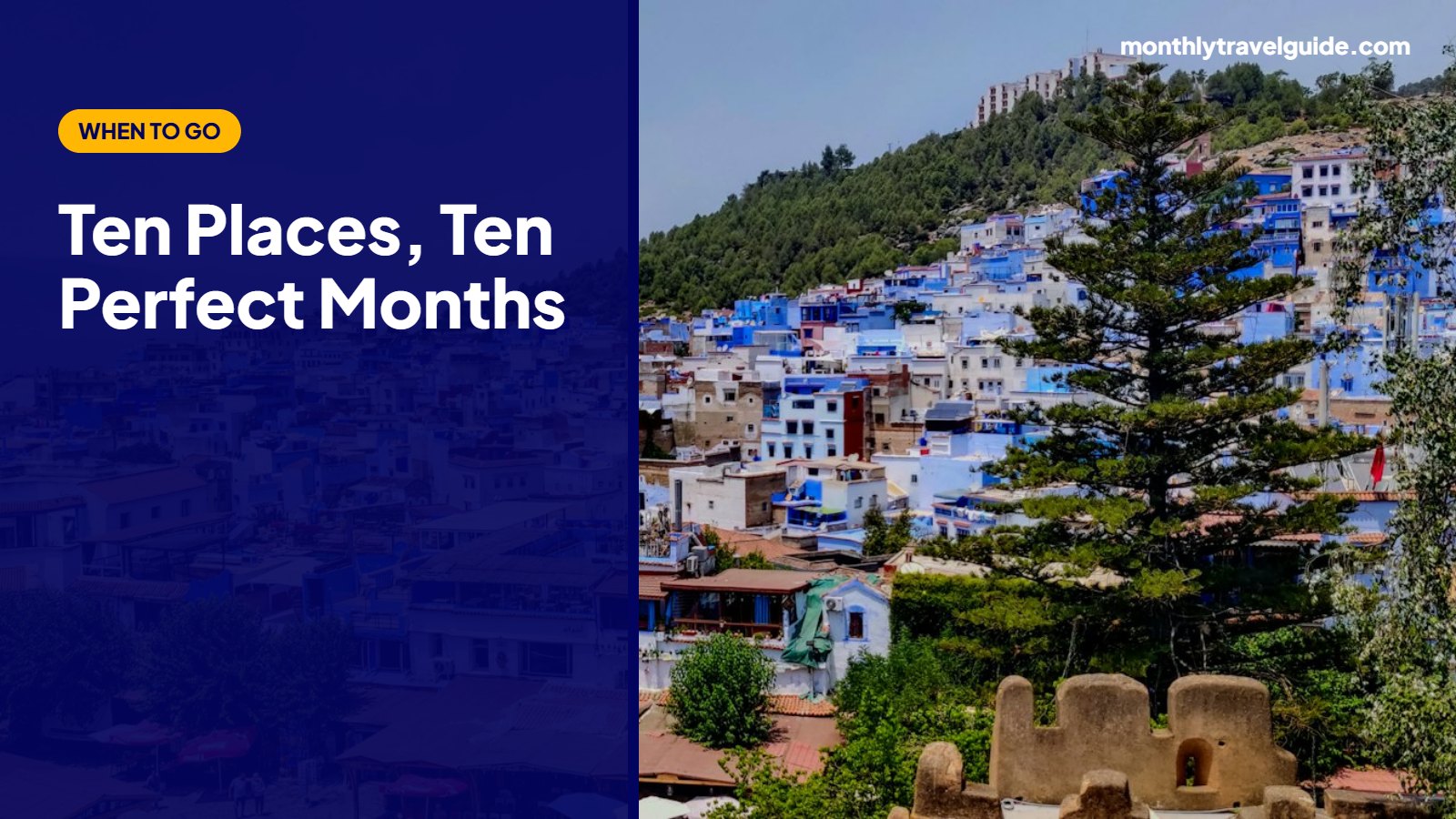
The best places to visit in Morocco cover more ground than most first-timers expect: imperial cities, a blue mountain town, Saharan dunes, snowy High Atlas peaks and a windy Atlantic coast, all within one country. The catch is that each one peaks in a different month. Marrakech and the desert are at their best in spring and autumn, the coast stays cool when the interior bakes, and the Atlas carries snow from about December to March. This guide ranks ten places, gives each one its best month, and flags the weeks to skip.
Ten places, ten timings
Morocco: where to go and when
Marrakech
Apr, Oct
Fes
Apr, Oct
Chefchaouen
May, Jun, Sep
Merzouga dunes
Apr, Oct
Essaouira
May to Oct
Imlil and the High Atlas
Apr to May, Sep to Oct
Ait Benhaddou
Mar to Apr, Oct to Nov
Todra Gorge
Apr, Oct
Dades and the Valley of Roses
Mid-May
Agadir and Taghazout
Jun to Sep
Best months based on long-term climate averages from Climates to Travel and Best Date Weather, plus seasonal notes from trekking and travel guides listed below. Every year differs.
Quick answer
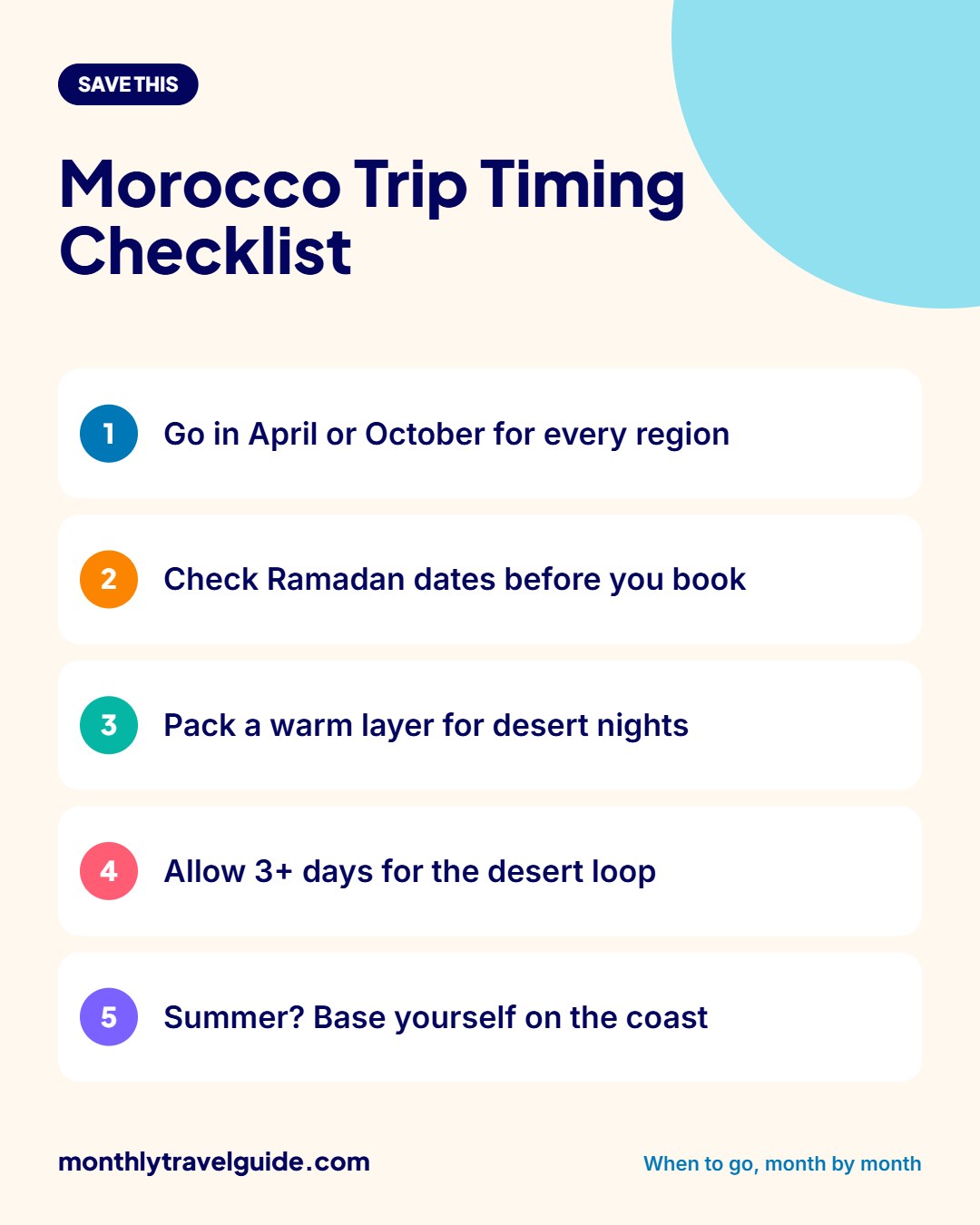
For one trip that covers cities, desert and mountains, go in April or October. Marrakech then sits around 25 to 28 °C by day, the Merzouga dunes around 29 to 30 °C, and the High Atlas is mostly free of snow. In July and August, head for Essaouira or the Agadir coast instead, because Marrakech averages about 37 °C and the desert about 42 °C.
Key takeaways
Spring (March to May) and autumn (late September to November) are the best seasons for nearly every inland place on this list.
Summer belongs to the coast: Essaouira’s average highs stay near 21 to 22 °C from June to September.
Snow and ice usually cover Toubkal from December to March, so winter trekking needs crampons and a guide.
Desert nights are cold in winter: Merzouga averages about 4 to 5 °C at night in December and January.
Ramadan moves about 10 to 11 days earlier each year, so check its dates before you book.
The Best Places to Visit in Morocco at a Glance
This section gives each of the ten places a verdict for spring, summer, autumn and winter, so you can see at once which ones fit your dates. Green means go, amber means go with a plan, and red means another season is far better.
Season verdicts for ten places
Spring = Mar to May · Autumn = Sep to Nov
Marrakech
Fes
Chefchaouen
Merzouga dunes
Essaouira
Imlil and Toubkal
Ait Benhaddou
Todra Gorge
Dades and Roses
Agadir and Taghazout
Winter verdicts allow for cold nights inland, rain in the north and snow in the High Atlas.
Three patterns explain most of the grid. Inland, summer heat is the problem: Climates to Travel puts July highs at about 37.7 °C in Marrakech, and the same source gives about 35 °C for Fes. In the north, winter rain is the problem, with November the wettest month in Fes. In the mountains, snow is the issue from about December to March. The coast is the exception, mild in almost every month.
🧰 Try it while you read: a free tool for this trip
Free trip timing tool
Best Month Finder
Pick a country and your priorities; get the three months that suit you best.
Loading the tool…
Imperial Cities: Marrakech and Fes
This section covers the two cities that anchor most first trips. Both are inland, both bake in July and August, and both are at their best when days sit in the low to mid 20s.
1. Marrakech: best in April and October
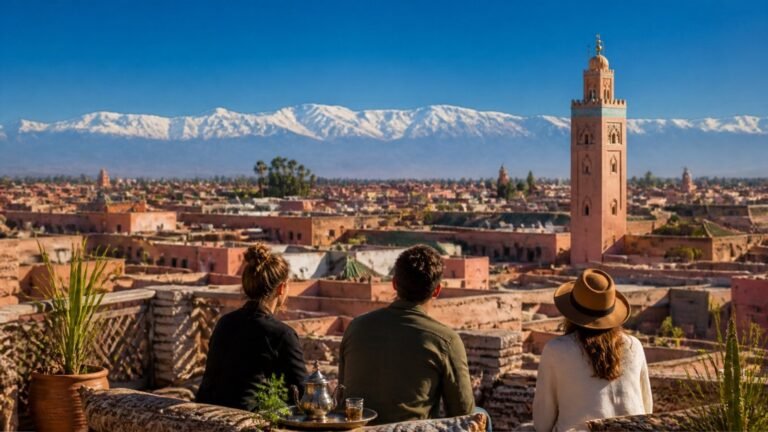
Marrakech is the obvious first stop: the souks, the riads, the gardens and the square minaret of the Koutoubia Mosque rising over the old town. Like most Moroccan minarets it is a square tower, and it makes a handy landmark in the lanes. The city also works as the base for the High Atlas, Ait Benhaddou and the road to the desert.
According to Climates to Travel, highs average about 25.8 °C in April and 28.4 °C in October, while July and August average about 37 °C, with heat waves above 45 °C possible. Winter days are pleasant at about 19 to 20 °C, but nights drop to about 6 °C on average and sometimes near freezing. The source names March, April and late September to mid-November as the best periods.
2. Fes: best in April and October
Fes is the older, denser and more inward-looking of the two. Its medina is a maze of lanes, workshops and tanneries where carts give way to donkeys and mules, and a local guide for the first morning saves a lot of wrong turns. Plan at least two full days.
When to Go: Morocco
Coast, cities, mountains or desert?
Every month across Morocco rated for heat, crowds and prices, region by region, with Ramadan and festival timing explained and a 7-day booking plan.
See the Morocco guide · $19112 pages · PDF, US Letter and A4 · Digital download · All sales final
Fes sits further north than Marrakech, so winters are colder and wetter. Climates to Travel lists average highs of about 22 °C in April and 26 °C in October, and about 35 °C in July and August. November is the wettest month at about 66 mm, and winter nights fall near freezing. That makes April, May, late September and October the comfortable windows.
| City | Best months | Hottest months | Coolest nights | Watch out for |
|---|---|---|---|---|
| Marrakech | Mar to Apr, late Sep to mid-Nov | Jul to Aug, about 37 °C | Jan, about 6 °C | Heat waves in summer |
| Fes | Apr to May, late Sep to Oct | Jul to Aug, about 35 °C | Jan, about 4 °C | Rain from Oct to Mar |
🗓️ Free: the 12-Month Map for Morocco
Every month on one page: best weeks, shoulder weeks and the ones to skip. Print it or keep it on your phone.
If Marrakech is your only stop and you are going in autumn, read our guide to Morocco in October for more detail on that month.
The North: Chefchaouen in the Rif Mountains
This section covers the blue town of the Rif, the one place on this list where early summer is the best season rather than one to avoid.
3. Chefchaouen: best in May, June and September
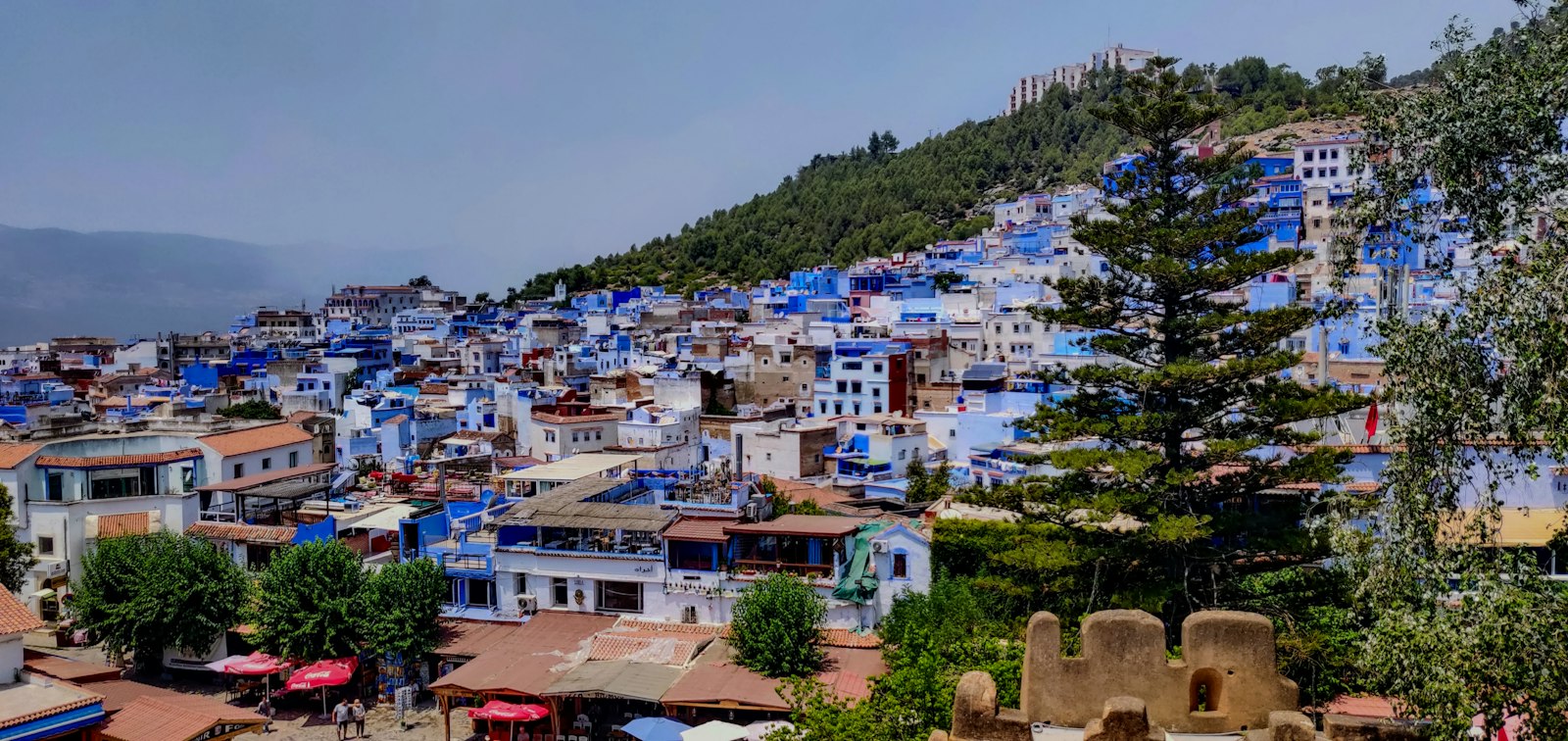
Chefchaouen is famous for its blue-washed lanes and stepped streets, set below rugged peaks. Stay a night to see the lanes after the day-trip coaches leave.
Data from Best Date Weather shows why the timing differs from the south. June scores best, with highs of about 28 °C and rain on only about 8 percent of days, followed by September. March is the wettest month, and December to February are cool, with highs of about 15 to 16 °C and frequent rain. August is the hottest, at about 34 °C.
The Sahara Side: Merzouga, Todra and Ait Benhaddou
This section covers the road from Marrakech to the dunes, where long distances make the season matter even more than in the cities.
4. Merzouga and the Erg Chebbi dunes: best in April and October
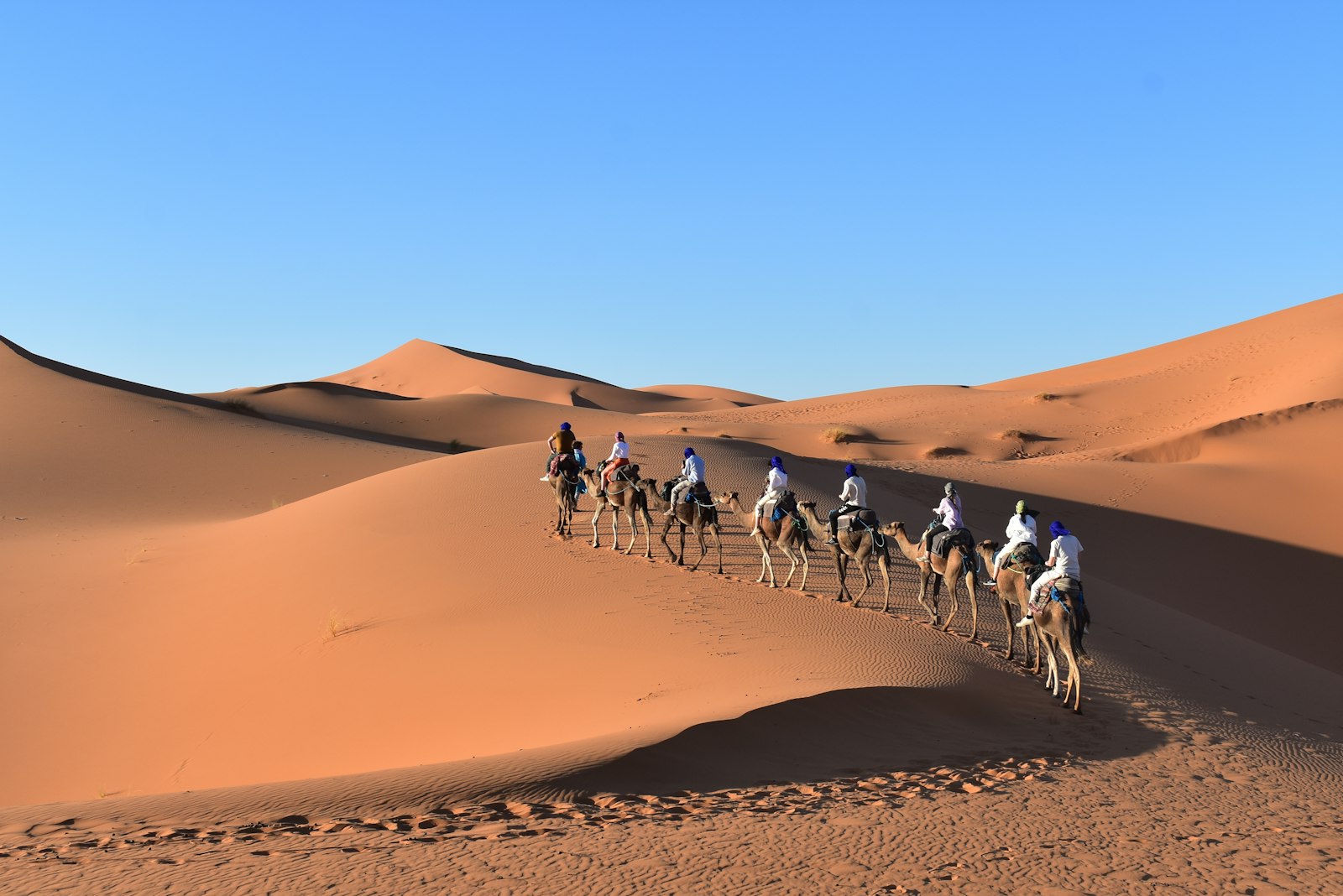
The orange dunes of Erg Chebbi rise beside the village of Merzouga, on the edge of the Sahara. Most visitors ride out on one-humped camels (dromedaries) in the late afternoon, sleep in a desert camp and watch the sunrise from the sand. From Marrakech it’s a long road: Journal of Nomads puts it at about 12 hours by bus, so most people break the trip in Ouarzazate or near the gorges.
The temperature curve is steep. Best Date Weather gives highs of about 29 °C in April and 30 °C in October, but about 42 °C in July and 41 °C in August. Winter days are pleasant at about 18 °C, but nights drop to about 4 to 5 °C in December and January, so pack a warm layer for the camp. Rickshaw Travel notes that many desert camps close in summer until September.
5. Ait Benhaddou: best in March to April and October to November
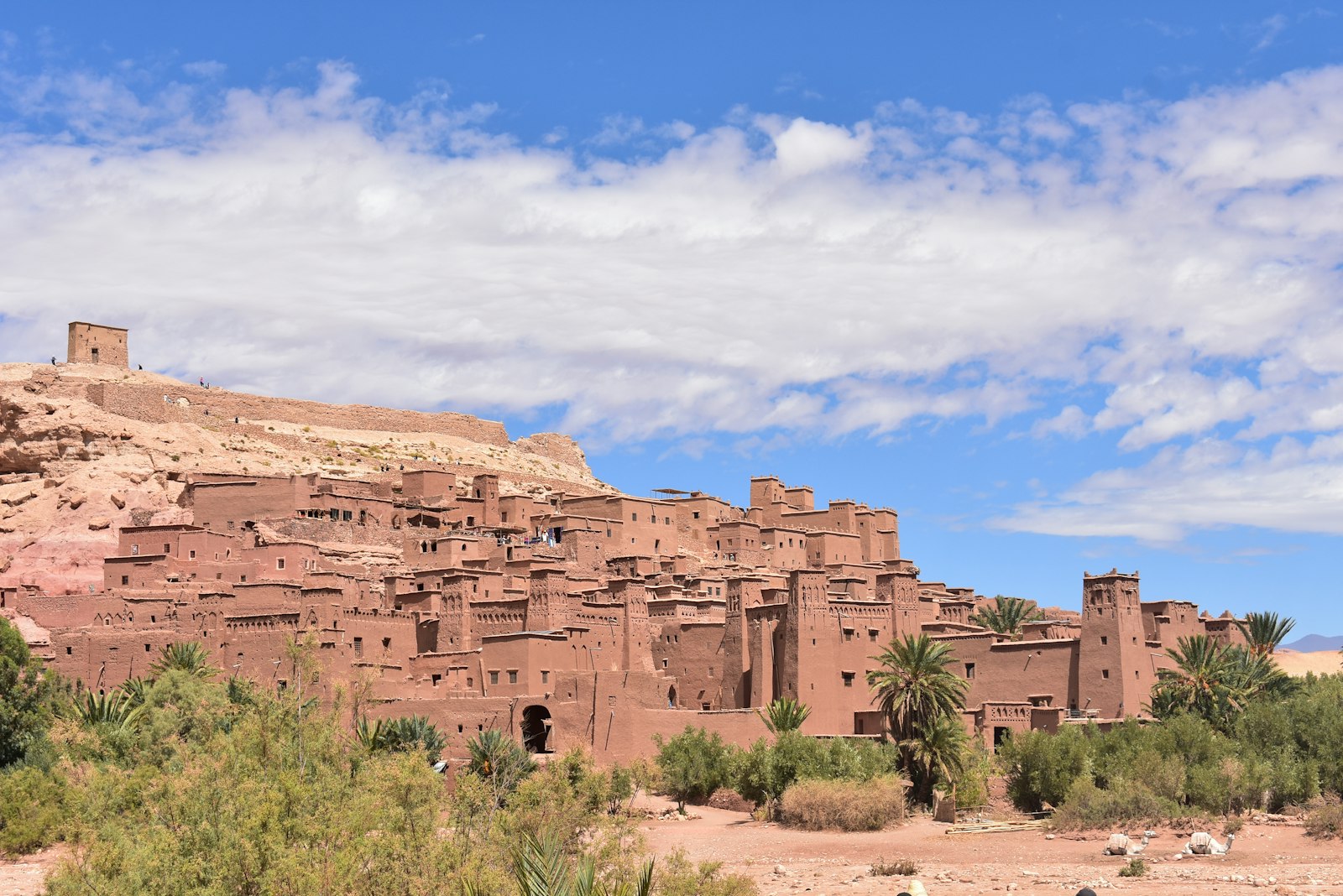
Ait Benhaddou is a fortified mud-brick village on a hill about 30 km north of Ouarzazate, listed by UNESCO and used as a film location many times. Most people see it on the drive from Marrakech to the desert. The trip to Ouarzazate alone takes about 4 to 5 hours (Journal of Nomads). Go early in the morning or late in the day, when the earth walls turn gold and the heat is lower.

The Smart Timing Bundle
Pick the month, book in the right order, pack once
Six printable timing tools for any trip: the Trip Timing Planner, When to Book, When NOT to Go, the Shoulder Season Playbook, the family timing guide and the Packing by Season System.
See the bundle · $37Six products, $100 separately · Digital download · All sales final
The pass over the mountains can see snow in winter, so build in slack between December and March. In summer, the heat makes the climb up to the granary at the top hard work in the middle of the day.
6. Todra Gorge: best in April and October
Todra Gorge, near the town of Tinghir, is a narrow canyon with tall rock walls and a river at the bottom. It sits about 200 km, or roughly three hours by car, from Merzouga (Journal of Nomads), so it fits neatly on the way to or from the dunes. Walk the floor of the gorge in the morning, before the sun reaches it, and look for the palm groves and villages along the river valley on the approach.
Warning
Distances on the desert route are long and the roads cross mountain passes. Don’t try to do Marrakech to Merzouga and back in two days. Three days is the minimum, and four gives you time at Ait Benhaddou and the gorges.
Atlas Mountains: Imlil, Toubkal and the Valley of Roses
This section covers the high country, where snow, not heat, sets the calendar. The High Atlas rises within sight of Marrakech, and its peaks carry snow for a good part of the year.
7. Imlil and Mount Toubkal: best in April to May and September to October
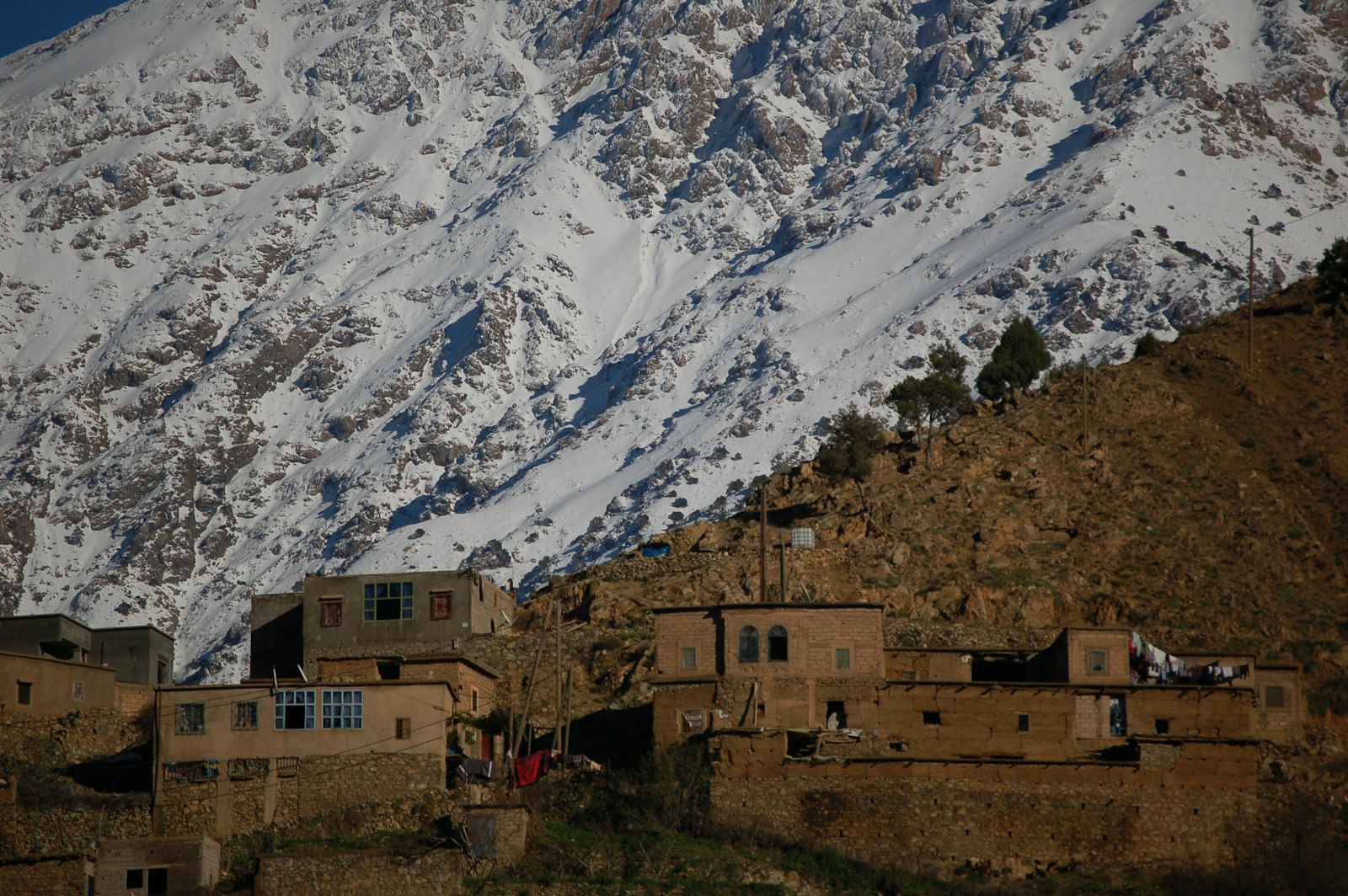
Imlil is the trailhead village for Toubkal, which rises to 4,167 m, and a good base for gentler day walks between Berber villages and terraced fields. According to Much Better Adventures, snow and ice are typical from about December to March, when crampons and an ice axe are usually needed; April can still be snowy, and May may keep snow high up.
June to September is usually snow-free, but Imlil averages about 30 °C in July. The same source names April, May, September and October as the best months overall, with September and October more reliably dry and clear than November. If you want to see the snowy peaks rather than climb them, a winter day trip from Marrakech works well.
8. Dades Valley and the Valley of Roses: best in mid-May
The Dades Valley runs along the southern side of the High Atlas, with kasbahs, palm groves and the twisting road into the Dades Gorge. Nearby, the town of El-Kelaa M’Gouna gives its name to the Valley of Roses. World Nomads says the rose harvest happens in mid-May, and a three-day festival with music, dancing and markets is usually held then, with dates that shift with the harvest.
The Atlantic Coast: Essaouira, Agadir and Taghazout
This section covers the coast, which works almost all year and is the answer to Morocco’s summer heat. The ocean keeps temperatures low and steady, and the wind is part of the deal.
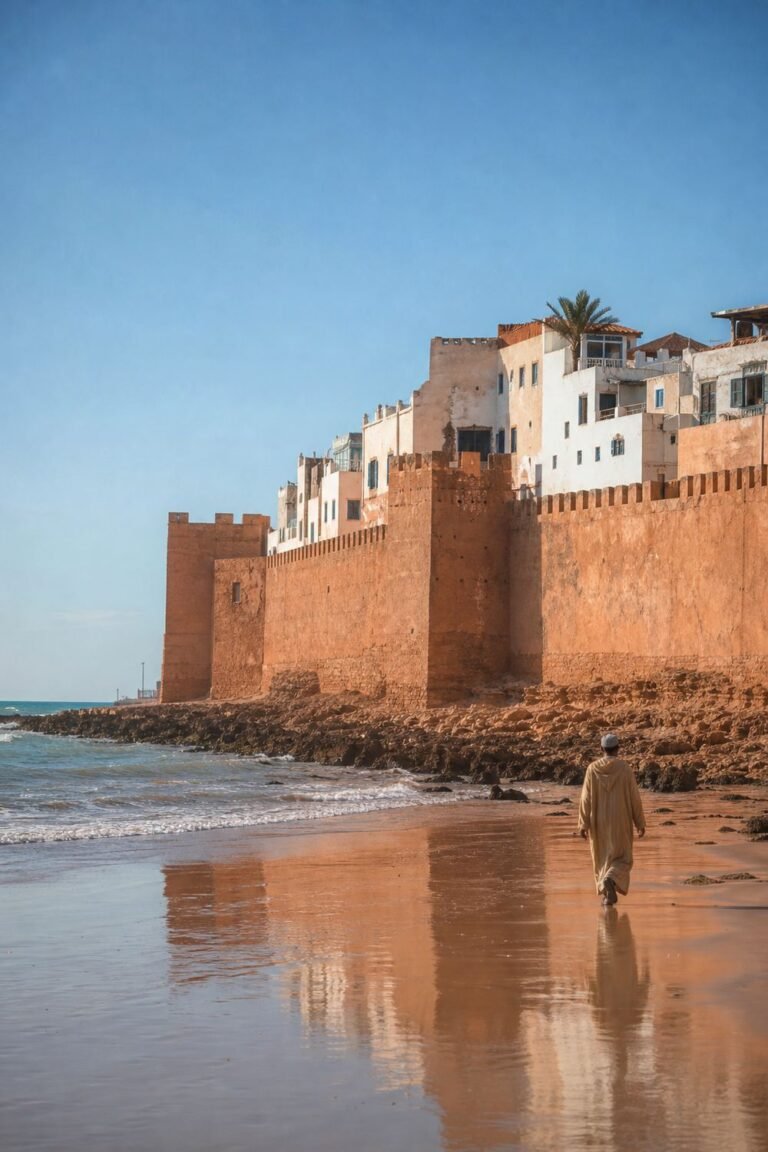
9. Essaouira: best from May to October
Essaouira is a walled port town with white houses, blue boats and a working fishing harbour. It’s much calmer than the big cities and a natural place to finish a trip. Climates to Travel gives average highs of only about 18 to 22 °C all year and says wind blows in every season; in summer it usually arrives as an afternoon breeze, and mornings are often foggy.
Rain falls mostly from October to April, so May to October is the best window. Bring a sweater even in August. The Gnaoua music festival, which blends Gnaoua traditions with jazz, blues and other styles, is usually held in June (Rickshaw Travel).
10. Agadir and Taghazout: best from June to September for escaping the heat
Agadir is a modern beach city with a long, wide bay, and the fishing village of Taghazout to the north is known for its surf. Rickshaw Travel notes that sea breezes keep Agadir comfortable in June, when the interior is already very hot, which makes this stretch of coast the best summer base on the list.
Ramadan, Summer Heat and Atlas Snow: Timing the Best Places to Visit in Morocco
This section covers the three timing factors that affect every place above. None of them should stop a trip, but each one changes how you plan it.

The complete kit
Every country guide, every timing tool
All 24 When to Go country guides, the six Smart Timing tools and every 12-Month Map, with a Start Here that tells you what to open first.
See the kit · $127The five bundles cost $225 separately · Digital download · All sales final
Ramadan
Ramadan follows the lunar calendar, so it starts about 10 to 11 days earlier each year and moves through every season over about three decades (Taste of Maroc). During the month, restaurants that mainly serve locals close in the daytime, but places in tourist areas and hotels usually stay open. Small shops often open late, close for an hour or two around sunset for the evening meal (iftar), and reopen at night. Sights and tours mostly keep running, sometimes on shorter hours.
Visitors are not expected to fast, but be discreet: eat in restaurants or your riad rather than on busy streets. Taxis are hard to find just before sunset, so plan transfers for earlier in the day. Some businesses close for a day or two for the holiday at the end of the month.
Summer heat
From June to September, the interior is hot and the desert is extreme. If summer is your only option, base the trip on Essaouira, Agadir and Chefchaouen, see Marrakech early and late in the day, and leave the dunes for another season. The free When Not to Go checker can show the hottest weeks for any destination.
Atlas snow
From about December to March, snow covers the High Atlas peaks. It’s a fine time for views and for a guided winter trek with the right gear, but not for a casual summit. Roads over the mountains can be slowed by snow, so allow a spare day on the desert route. For the full winter picture, see our guide to Morocco in December.
When Not to Go: Weeks That Spoil a Short Trip
This section is the honest part. Morocco works in every month, but some plans don’t.
Avoid
The desert in July or August
Highs of about 41 to 42 °C in Merzouga, and many camps closed until September.
Go in April or October.
Avoid
A casual Toubkal climb from December to March
Snow and ice need crampons, an ice axe and experience.
Trek in May, September or October.
Avoid
Chefchaouen in March
The wettest month there, with rain on almost a third of days.
Go in May, June or September.
Avoid
Fes in November
The wettest month in Fes, with cool evenings.
Go in October or April.
Avoid
Ramadan with a tight schedule
Shorter hours and quiet afternoons can slow a fast trip.
Add a day, or travel outside the month.
Prices change; check before you book, especially for spring and autumn weekends and school holidays, when riads in Marrakech and Fes fill first. The free Shoulder Season Detector helps you spot the quieter weeks either side of the peaks.
Better Month If You Want Something Else
This section helps if Morocco is one of several options, or if one goal matters more than the rest.
If you want
Winter sun
Morocco’s coast and Marrakech by day are mild, but nights are cold. Compare other options in our guide to winter sun in January.
If you want
More of Africa in winter
See places to visit in Africa in February for warmer and drier picks across the continent.
If you want
An autumn trip
October suits Morocco well; for other ideas, see where to travel in October.
If you want
Festival timing
Roses in mid-May and Gnaoua music in June. Check other dates with the Festival Month Matcher.
5 Common Mistakes When Planning a Morocco Trip
1. Trying to see all ten places in a week
The desert loop alone takes three or four days. Pick one region per week.
2. Booking the desert for midsummer
A sunset camel ride sounds fine until the dunes sit at about 42 °C. In July and August, swap the desert for the coast and come back in spring or autumn.
3. Packing only for heat
Desert nights in winter, the mountains at almost any time and the windy coast all call for a warm layer.
4. Forgetting to check Ramadan
Ramadan doesn’t stop a trip, but it changes opening hours and the rhythm of the day. Check the dates first.
5. Expecting Toubkal to be an easy walk in winter
From about December to March the summit route is snow and ice. Go with a qualified guide and the right gear, or trek in autumn instead.
Best Places to Visit in Morocco: FAQ
The Bottom Line
The best places to visit in Morocco all share one rule: match the place to the season. Go in April or October for cities, dunes and mountains in one trip, use the coast and the north for summer, and save Toubkal for May, September or October. For more on the country, browse our Morocco travel guides.
Morocco and beyond
The Sun, Souks & Safari Bundle
Pairing Morocco with Egypt, the UAE, Tanzania or South Africa? The bundle brings the When to Go guides for these sun, souk and safari countries together, so you can compare heat, rain, wildlife and festival months side by side and pick the right country for your dates.
See the bundle →Digital download · All sales final
Free download
The 12-Month Map, free
The whole year for one country on four printable pages, so you can see the right months before you read anything else.
- Good, shoulder and avoid months at a glance
- Region by region, not one average for the whole country
- Prints cleanly on US Letter
Your download page opens as soon as you sign up. 24 countries available.