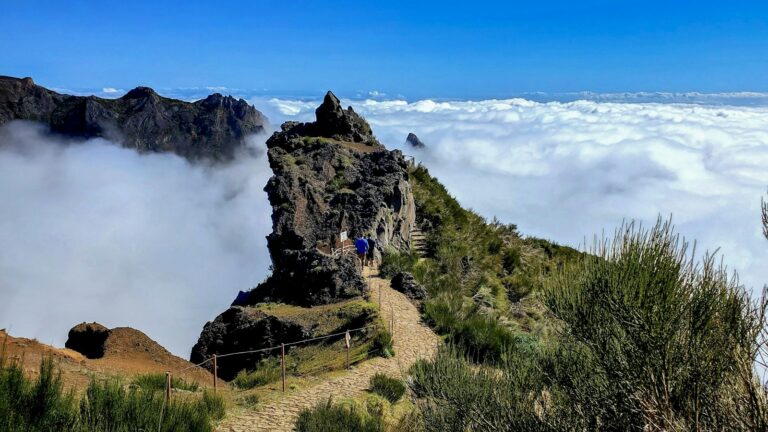
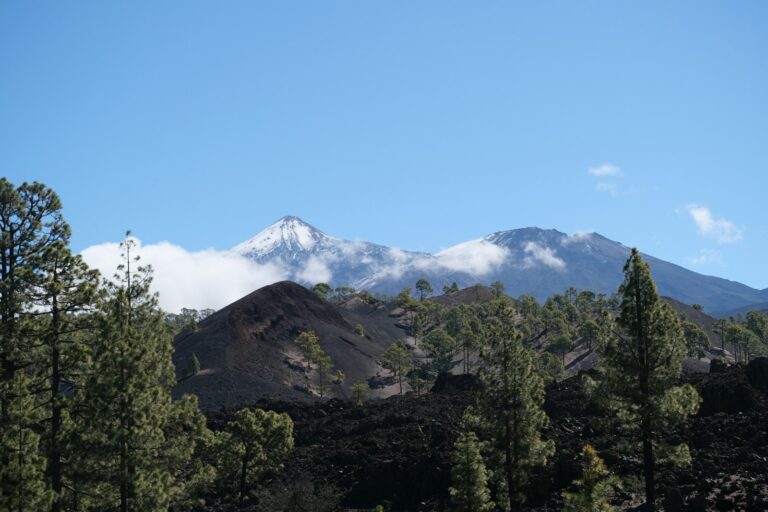
The best things to do in La Palma are hiking the volcanic ridges and the Caldera de Taburiente, watching the stars from one of the darkest skies in Europe, walking young lava fields and swimming in seawater pools along a black-sand coast. The island is the greenest and steepest of the western Canary Islands, and it rewards travellers who come for the outdoors rather than for resort beaches. Timing matters more than most visitors expect: winter brings the rain and closes some observatory visits, high summer brings heat on exposed trails, and dust-laden calima can hide the views for a few days in any season. This guide pairs each activity with the months that suit it best.

Quick answer
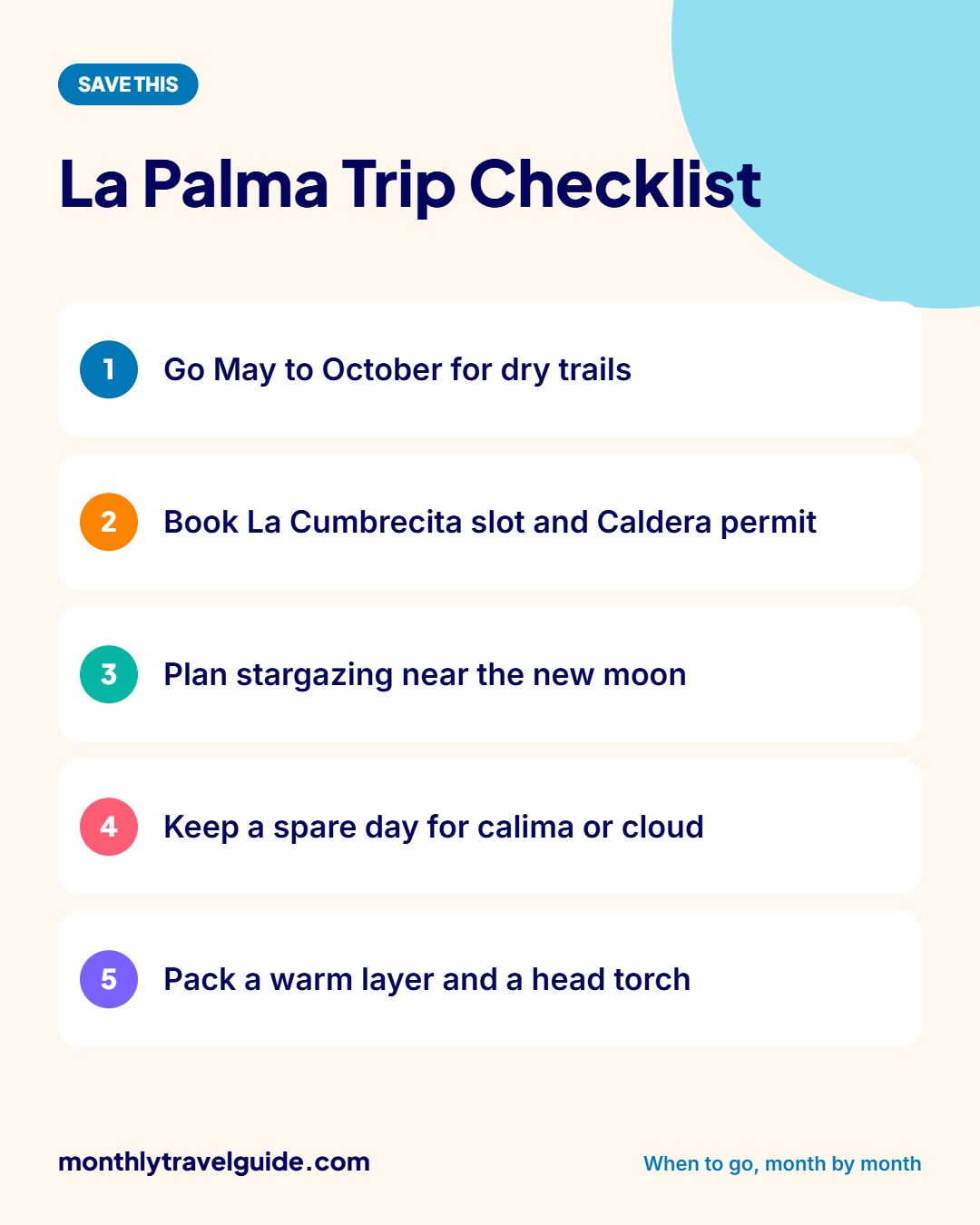
The top things to do on La Palma are hiking the Caldera de Taburiente and the Volcano Route, stargazing from the island’s protected dark-sky viewpoints, a guided walk to the Tajogaite volcano, and swimming at Charco Azul or Tazacorte. Go from May to October for dry trails and clear nights; May, June, September and October balance warmth and comfort best. November to January is wettest.
Key takeaways
La Palma was the world’s first Starlight Reserve, and a sky law limits light, radio and air-route pollution.
The Roque de los Muchachos observatory sits above 2,400 m; public daytime visits pause from December to March.
Summer is driest, with 1 to 6 mm of rain a month; November to January bring 81 to 89 mm.
La Cumbrecita viewpoint needs a booked slot, and Caldera camping needs a free permit.
Calima dust episodes usually last two to three days and can come in any season.
The sea peaks at about 24 °C in September and October.

Things to Do in La Palma, Month by Month
This section rates every month for the island’s main activities, using long-term averages for La Palma from Weather2Travel.
La Palma month verdicts
Bar = rainfall · high °C · sea °C
Jan
16 °C · 81 mm · sea 20 °C
Wet north, cool peaks
Go with careFeb
16 °C · 67 mm · sea 19 °C
Carnival and Los Indianos
Go with careMar
16 °C · 51 mm · sea 19 °C
Greener hills, fewer showers
GoApr
17 °C · 34 mm · sea 19 °C
Good hiking, flowers
GoMay
19 °C · 13 mm · sea 20 °C
Dry, mild, long days
GoJun
21 °C · 6 mm · sea 22 °C
Clear nights, warm sea
GoJul
23 °C · 1 mm · sea 22 °C
Hot on exposed ridges
Go with careAug
24 °C · 3 mm · sea 23 °C
Peak heat and holidays
Go with careSep
23 °C · 17 mm · sea 24 °C
Warmest sea, still dry
GoOct
21 °C · 51 mm · sea 24 °C
Warm sea, first showers
GoNov
19 °C · 88 mm · sea 22 °C
Wettest stretch begins
SkipDec
17 °C · 89 mm · sea 21 °C
Wet, shortest days
SkipAverages from Weather2Travel. The summit area is far cooler, with a winter average of about 3 °C.
The pattern is simple. Rain falls mainly from October to March and peaks at about 88 to 89 mm in November and December, with around eight rain days a month. From May to August the island is almost dry, with 1 to 13 mm a month and eight to nine hours of sunshine a day. Coastal highs only move between about 16 °C and 24 °C.
Altitude changes everything. The Isaac Newton Group of Telescopes notes that the north-east catches most of the rain on the trade winds, while the south is drier and sunnier, and that the average winter temperature at the Roque de los Muchachos is about 3 °C. Pack for two climates on the same day.
🧰 Try it while you read: a free tool for this trip
Free trip timing tool
What Kind of Traveller Are You?
Seven quick taps pick your travel type, then show the countries and months where it shines.
Loading the tool…
Stargazing: The Top Thing to Do in La Palma After Dark
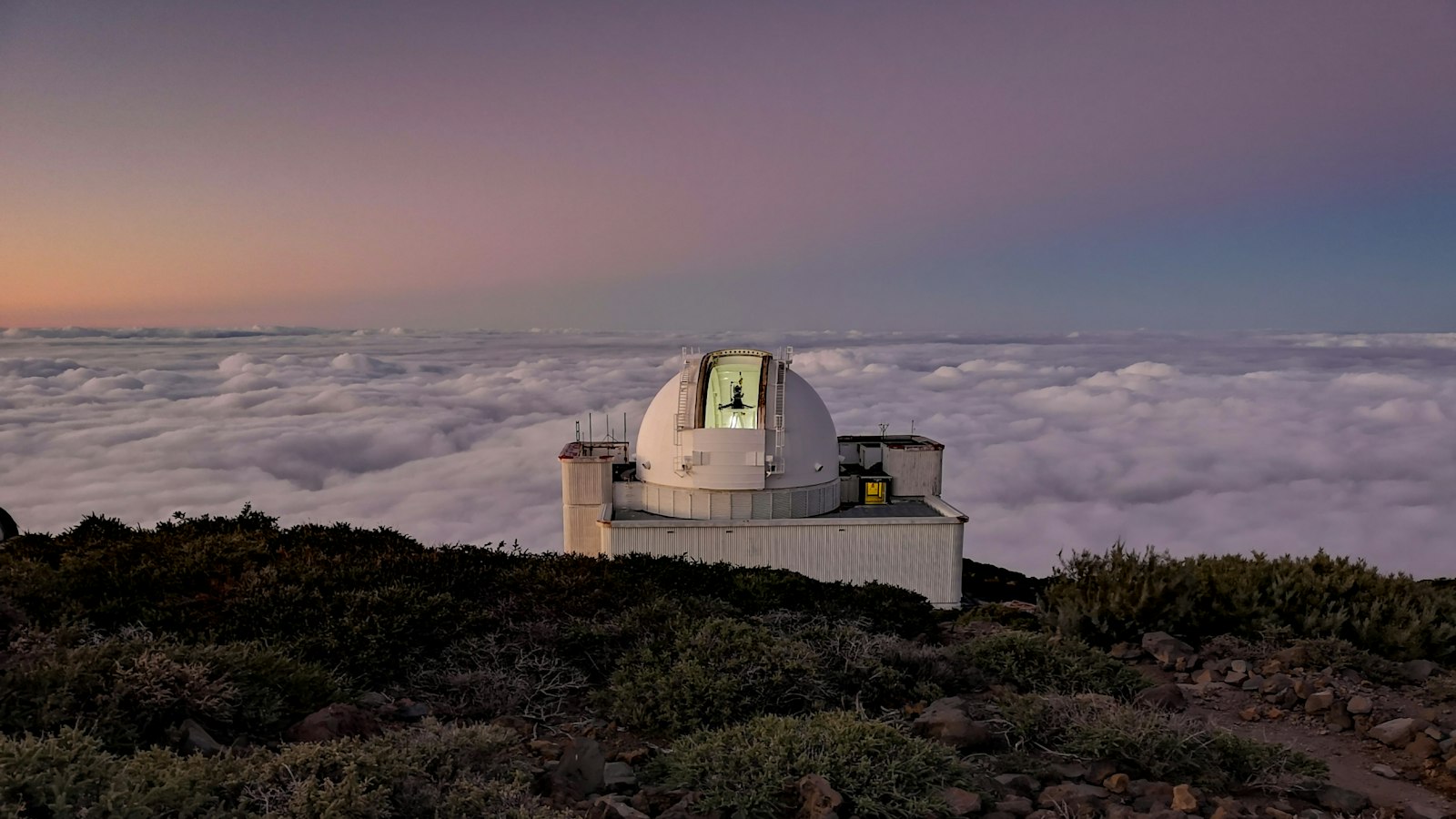
This section covers the island’s best-known night activity. La Palma was the world’s first Starlight Reserve and is also a Starlight Tourist Destination, according to the island’s official Stars Island La Palma site. A sky law protects it from light, atmospheric and radio pollution and keeps aircraft routes away from the observatory.
The Roque de los Muchachos Observatory sits above 2,400 m on the rim of the Caldera, usually above the sea of clouds that the trade winds pile against the island.
| Way to stargaze | What it involves | Best months |
|---|---|---|
| Observatory daytime visit | A small-group guided tour of about 1 hour 30 minutes, booked in advance with a certified Starlight guide | Not offered from December to March |
| Sunset and stars tour | A guided trip to the summit for sunset, then telescope viewing lower down | Driest months, May to October |
| Public viewpoint on your own | Drive to a dark-sky viewpoint, let your eyes adjust for 20 minutes | Any clear, moonless night |
| From your terrace | Many rural stays have dark skies thanks to the island’s lighting rules | All year, between fronts |
🗓️ Free: the 12-Month Map for Spain
Every month on one page: best weeks, shoulder weeks and the ones to skip. Print it or keep it on your phone.
Source for observatory visits: Instituto de Astrofísica de Canarias. Daytime visits run only when telescope work and the weather allow, and they pause from December to March because of winter conditions.

The Smart Timing Bundle
Pick the month, book in the right order, pack once
Six printable timing tools for any trip: the Trip Timing Planner, When to Book, When NOT to Go, the Shoulder Season Playbook, the family timing guide and the Packing by Season System.
See the bundle · $37Six products, $100 separately · Digital download · All sales final
Tip
Plan stargazing around the moon, not just the month. The week around new moon gives the darkest sky, and the Milky Way core is highest in the evening from late spring to late summer. Take a warm jacket even in August: at over 2,400 m the summit is far colder than the beach.
Hiking La Palma: Caldera, Volcano Route and Tunnels
This section compares the three classic walks. La Palma has a dense network of marked trails, and these are the ones that most visitors plan a trip around.
| Walk | Distance and effort | Access | Best months |
|---|---|---|---|
| Caldera de Taburiente from Los Brecitos | Under 2 hours down to the campsite area, then the long walk out via Barranco de las Angustias | About 45 minutes’ drive from Los Llanos, or a 4×4 taxi | April to June, September to October |
| Ruta de los Volcanes (GR 131, stage 3) | 23.7 km from Refugio del Pilar to Fuencaliente; high difficulty | One-way: book a taxi or arrange a pick-up | March to June, September to November |
| Marcos y Cordero (PR LP 6) | Water channel walk with 13 tunnels from Casa del Monte at about 1,350 m | 4×4 taxi up a 14 km track | May to October, dry days only |
Sources: Senderos de La Palma (national park) and GR 131 stage 3 for the Caldera and the Volcano Route; La Palma 24 for Marcos y Cordero.
Caldera de Taburiente National Park
The Caldera is a huge eroded crater ringed by peaks, with pine forest, streams and the island’s only campsite inside. From Los Brecitos the walk to the campsite is all downhill and takes under two hours. Walking out through the Barranco de las Angustias means about three hours of ravine walking between the Dos Aguas junction and the road at the bottom, so plan a full day. Access to La Cumbrecita viewpoint is regulated from 8:30 to 16:00 and has to be booked through the national parks reservation website, and camping inside needs a free permit for up to two nights, booked at least a week ahead.
Ruta de los Volcanes
This ridge walk follows a chain of cinder cones down the spine of the island. The trail office rates it for trained hikers, warns that heat and wind can cause dehydration and that there is no water on the way, and recommends starting around 9:00. It suggests the route all year except on the hottest summer days.
Marcos y Cordero and Los Tilos
The famous springs walk follows a water channel through laurel forest and 13 tunnels. A head torch and a waterproof layer are essential, and a helmet is advised. Parts of the trail have been closed at times; at the last review, walkers could only go from Casa del Monte as far as tunnel 12. Check the official status of the PR LP 6 before you book a taxi, and don’t go in rain.
Warning
Trails on La Palma are steep and loose after rain. If the forecast shows a front, or if AEMET has a warning for wind or rain, swap a ridge or ravine walk for a coastal day. In an emergency call 112.
Volcanoes: Tajogaite, Teneguía and the South
This section covers the island’s volcanic landscapes, which are among the most striking things to do in La Palma. The south is a line of young cones and lava fields that runs down to the lighthouse at Fuencaliente.
The Tajogaite eruption broke out at the foot of the Cumbre Vieja ridge and ran for close to three months, creating what is now the youngest land in Spain. You can’t wander onto it alone. Certified guides lead a walk of about 7 km and 2.5 hours to the closest authorised point, past instruments that still monitor the volcano, according to Soy Ecoturista. The minimum age is 11, the route is not suitable for people with breathing or mobility problems, and you need closed shoes, a hat and water.
Further south, the San Antonio and Teneguía volcanoes can be visited on easier paths near Fuencaliente. The landscape of black ash, vines and lava runs down to the coast at Echentive, where a road passes the two volcanoes on its way to a lava beach with saltwater pools.

Note
Puerto Naos, the main beach resort on the west coast, was hit hard by volcanic gas after the eruption. It has been reopening in stages, with businesses and the beach returning bit by bit, as reported by RTVC. Check the latest access rules before booking a stay there.
Swimming, Natural Pools and Black-Sand Beaches
This section covers where to get in the water. La Palma’s coast is rugged, with few sandy beaches and a strong Atlantic swell, so natural seawater pools are often the safer choice.

The complete kit
Every country guide, every timing tool
All 24 When to Go country guides, the six Smart Timing tools and every 12-Month Map, with a Start Here that tells you what to open first.
See the kit · $127The five bundles cost $225 separately · Digital download · All sales final
Charco Azul
North-east, San Andrés y Sauces
Seawater pools sheltered by rocks; calm sections suit children.
La Fajana
North, Barlovento
Similar seawater pools with calmer zones and sections open to the sea.
Tazacorte
West coast
The island’s longest beach, almost 2 km of black sand, with a breakwater and a blue flag.
Los Cancajos
East coast, near the capital
A resort beach close to Santa Cruz and the airport, known for sunrises.
Echentive
Far south, Fuencaliente
A lava-field beach with three small pools beside the volcanoes.
Nogales
North-east, Puntallana
A wild black-sand cove with strong currents; for looking more than swimming.
Details from Hello Canary Islands, which also gives the golden rule for every pool and small harbour: if the sea is rough, don’t swim. The water is warmest from July to October, at about 22 to 24 °C, and coolest in February to April, at about 19 °C.

Towns, Food and Festivals Worth Timing
This section covers the slower side of the island, from the capital’s old streets to the festival that turns it white. These are good things to do in La Palma on a cloudy or windy day, when the peaks are hidden.
Santa Cruz de La Palma, the capital, has a compact old town of balconied houses and plazas along the waterfront, and it is the easiest base without a car. In the south, the vineyards around Fuencaliente grow in black volcanic ash, and local wine, cheese and mojo sauces turn up on almost every menu.
Usually February or March
Los Indianos
On Carnival Monday, Santa Cruz fills with people dressed in white for a talcum powder battle, Caribbean music and dancing. It recalls emigrants returning rich from the Americas, especially Cuba (Hello Canary Islands).
Every five years
Bajada de la Virgen de Las Nieves
The island’s great festival, with cultural events, dances and pilgrimages to the capital. Rooms fill fast in the festival year.
July and August
Spanish summer holidays
Canary and mainland families travel in the school holidays. Book cars and rural houses early.
Christmas and Easter
Holiday weeks
Flights from the other islands and the mainland fill up; book ahead.
Prices change; check before you book. To match your dates against festivals elsewhere, try the free Festival Month Matcher.
Calima, Clouds and Rain: Weather That Changes Your Plans
This section explains the three weather patterns that most often change a La Palma itinerary.
| Pattern | When | What to do |
|---|---|---|
| Calima (Saharan dust) | Any season; episodes usually last two to three days | Swap summit views and long hikes for towns and pools; limit hard exercise |
| Sea of clouds | Common, especially with trade winds | Drive above it for views and stars; the coast can stay grey |
| Winter rain fronts | Mainly October to March; wettest November to January | Keep ravine and tunnel walks for dry days |
| Summer heat on ridges | July and August | Start hikes early; carry extra water |
Calima is fine Saharan dust carried on east winds. Guide to Canary Islands says it is most frequent in winter and early spring, when dust travels low, but it can also come in summer, and that a typical episode lasts two to three days before the sky clears. The Isaac Newton Group adds that on La Palma itself July and August are the most affected months. During strong episodes, visibility drops and air quality worsens; people with asthma or heart conditions should stay indoors and avoid exercise.
Build one spare day into any trip of a week or more, and check the weather risk for your dates with the free Storm Season Check.
When Not to Go to La Palma
La Palma works all year, but some weeks suit certain plans badly.
| Avoid | Why | Do this instead |
|---|---|---|
| November to January for long hikes | The wettest months, with about 81 to 89 mm of rain and eight rain days | Go from April to June or in September and October |
| December to March for an observatory tour | Public daytime visits are paused | Go from spring to autumn |
| Midday ridge walks in July and August | Heat, wind and no water on the Volcano Route | Start at 9:00 or hike in May or October |
| A Bajada festival year without bookings | The whole island celebrates | Book months ahead or choose another year |
| A fixed summit day on a short trip | Calima or cloud can hide the view | Keep two possible days for the Roque |
Unsure about your own dates? Run them through the free When Not to Go checker or the Best Month Finder.
Better month if you want something else
If you want
The clearest stars
June to September: driest nights and the Milky Way high in the evening.
If you want
The warmest sea
September and October, at about 24 °C.
If you want
Green hills and waterfalls
Late winter to spring, after the rains, as long as you hike on dry days.
If you want
Winter sun
La Palma is mild but cloudy in the north-east in winter; compare the drier islands in January winter sun destinations.
If you want
Another Atlantic volcano island
See Pico Island in September for a similar hiking and whale trip further north.
Planning a wider trip? Compare La Palma with warm European destinations in November and the best time to visit Mallorca, or see island destinations for February.
5 Common Mistakes on a La Palma Trip
1. Planning without a car
Buses link the main towns, but trailheads and the observatory are hard to reach without a car or taxi. Hire a car early, especially in summer.
2. Packing only for the beach
The Roque de los Muchachos can be close to freezing in winter and cold at night even in summer. Bring a warm layer, a waterproof jacket, proper hiking shoes and, for the tunnels, a head torch.
3. Forgetting to book the Caldera
La Cumbrecita viewpoint needs a booked slot, and camping in the national park needs a free permit booked at least a week ahead.
4. Trusting one day for the summit
Calima or a wall of cloud can hide the view for a day or two. Keep the observatory or the sunset tour flexible across two possible dates.
5. Swimming in rough sea
The Atlantic swell can be powerful even on sunny days. Use the natural pools when waves are up and respect red flags.
Things to Do in La Palma: FAQ
What is La Palma best known for?
La Palma is best known for its dark skies and the Roque de los Muchachos Observatory, the deep Caldera de Taburiente crater, and its volcanoes, including the recent Tajogaite eruption. It is one of the greenest Canary Islands, with laurel forest in the north-east, and it was the world’s first Starlight Reserve. Most visitors come to hike, stargaze and explore rather than to lie on a beach.
What is the best month to visit La Palma?
May, June, September and October are the best months for most visitors. They are dry or nearly dry, warm without the peak summer heat, and the sea is between about 20 °C and 24 °C. June to September gives the clearest nights for stargazing. November to January is the wettest period, with about 81 to 89 mm of rain a month.
How many days do you need in La Palma?
Plan five to seven days to see the main sights without rushing. That allows one day for the Caldera, one for the Volcano Route or the south, one for the observatory and stargazing, one for Los Tilos and the north-east pools, plus a spare day for calima or cloud. Three days covers the highlights if you have a car and good weather.
Can you visit the observatory on La Palma?
Yes, on a daytime guided visit. Small-group tours of about an hour and a half are led by certified Starlight guides and must be booked in advance. They run only when telescope work and weather allow, and they are not offered from December to March. Separate sunset and stargazing tours run by local companies fill the evenings.
Is La Palma good for beaches?
La Palma has a few good beaches, but it is not a classic beach island. Tazacorte has almost 2 km of black sand and a breakwater, and Los Cancajos is close to the capital. The natural seawater pools at Charco Azul and La Fajana are often safer in swell. If a long sandy beach is your priority, other Canary Islands suit you better.
Can you visit the new volcano on La Palma?
Yes, but only with a certified guide. Organised walks of about 7 km and two and a half hours reach the closest authorised point to the Tajogaite volcano and pass monitoring instruments still in use. The minimum age is 11, and the walk is not suitable for people with breathing or mobility problems. Wear closed shoes and bring a hat and water.
The Bottom Line
The best things to do in La Palma are the ones that use its height and darkness: the Caldera, the Volcano Route, the observatory and a night under the stars. Go from May to October, keep a spare day for calima or cloud, and book the Caldera and the observatory ahead. For more on the country, browse our Spain travel guides.
If dark skies are the main draw, compare La Palma with stargazing in Big Bend in December, another trip planned around the moon and the season.
Islands, cities and coasts
Time your Spain trip month by month
When to Go: Spain sets out the best and worst months for each region, from the Canary Islands to Andalusia and the north coast, with heat and rain patterns, festival months, school holiday peaks and the weeks to book early, so La Palma and the rest of your route fall in the right season.
See When to Go: Spain →Digital download · All sales final
Free download
See the whole year before you book
Our free 12-Month Map puts every month for one country on four pages: when the weather works, when the crowds and prices peak, and the weeks to skip.
- 24 countries to choose from
- Region-by-region verdicts
- Printable PDF
Your download page opens as soon as you sign up. 24 countries available.